Stapelhaus
Standing on the Rhine bank in front of the choir of Groß St. Martin, the Stapelhaus recalls Cologne's medieval staple right and is today regarded as a symbol of the trading metropolis.
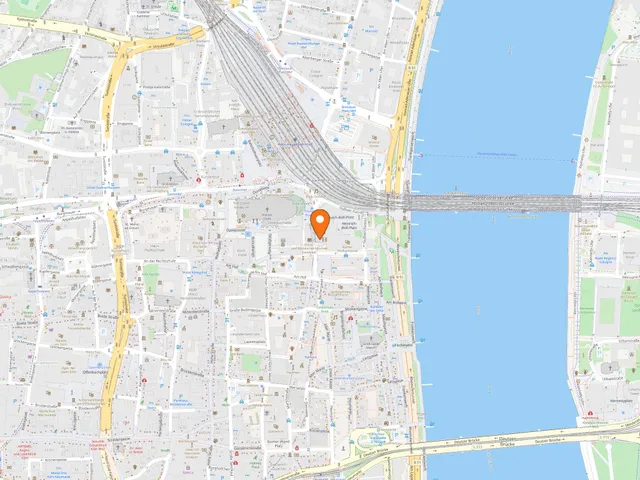
On the Rhine bank at the Frankenwerft in Cologne's old town, in front of the choir of the church of Groß St. Martin, stands the Stapelhaus (Kölsch: Stapelhuus). Its name derives from Cologne's staple right, which was in force from 1259.
At a Glance
- Location
- In front of the choir of Groß St. Martin, on the old town's Rhine bank
- Named after
- Cologne's staple right (from 1259)
- Former use
- originally a fish market hall (Vischkouffhuis) in the market quarter
- Defining rebuild
- 1558–1561 as a Late Gothic structure, side length approx. 46 m
- Stair tower
- added 1900–1901 by city architect Friedrich Carl Heimann
- Current owner
- Kreishandwerkerschaft Köln (Cologne guild association)
- Meaning today
- symbol of the trading metropolis of Cologne
Things to do here
- Admire the late-Gothic building on the Rhine bank
- Discover the graceful stair tower
- Take photos in front of the choir of Groß St. Martin
- Stroll along the Frankenwerft by the Rhine
- Trace the fascinating history of the staple right and fish trade
From fish hall to staple right
As early as the High Middle Ages, a hall for the sea-fish trade stood on this spot in the market quarter by the Rhine. Fish was an important food for the people of Cologne: it was considered cheap for those on low incomes and was permitted during Lent. In the Middle Ages and Late Middle Ages, Cologne was the main trading hub of the entire West for fish, especially sea fish such as herring, stockfish, bloaters and plaice.
Under the staple right, all goods had to be offered in Cologne for purchase and processing – in the case of fish, above all for preserving. Inside the building the fish were washed, cut up, salted, stored and repacked, marked with Cologne's brand of the Three Crowns and sold on. Drainage pipes led the foul-smelling liquids straight into the Rhine.
The fish trade and the guild of the Fischmenger
Cologne did not only catch, prepare and sell fish for its own needs but also ran wholesale trade and shipping. The fish hall dealt en gros, while retail took place at the neighbouring fish market and in the surrounding lanes. Wholesalers came from far away, including from the Netherlands, and Cologne's dealers in turn supplied customers as far as the Main region.
The traders, known as Fischmenger and Fischmengerssen, were organised in a guild and came from distinguished families. Unlike in many other towns, fish in Cologne was a permitted trading good for women too – the „Feschwiever" were guild members. Their work was nonetheless restricted: in 1397 they were barred from selling larger fish that had to be weighed, and in 1482 from trading in salted goods. They were left with the small fresh (green) fish.
Rebuilds and destruction
In 1425 the hall between the Fischpforte and Mühlengasse was demolished and rebuilt; it now also served to tax further goods such as butter, cheese, bacon, oil, salt, flax and tar. From 1558 to 1561 the Late Gothic, battlement-crowned building known from Rhine panoramas was erected. At around 46 m in side length it was unusually long, its eastern wall forming part of the city wall while a half-timbered front faced the Rhine. In its two storeys merchants could rent lockable chambers (Stuvven).
The staple right remained in force until 1815, when the Congress of Vienna prohibited the enforced intermediary trade; the compulsory transhipment finally ended in 1831. In the second half of the 19th century the storage rooms became superfluous, also because of the railway. In 1900–1901 the city had the building remodelled by city architect Friedrich Carl Heimann; it gained its slender stair tower, sometimes called the Ritterturm or Geschlechterturm, along with refined dining rooms and halls on the lower floor. The name „Stapelhaus" was probably chosen only at this point. From 1902 until its destruction, the upper floor housed the Museum of Natural History, which displayed native and foreign animal groups. In 1942 and again in 1944/45 incendiary bombs destroyed the building; only the stair tower and remnants of the south side survived. In the 1960s a plain reconstruction with the hipped roof common in Cologne was built on the retained ground plan.
Today
The Stapelhaus is owned by the Kreishandwerkerschaft Köln. From 1988 to 2013 it was home to the Federal Association of Visual Artists Cologne (BBK Köln e. V.), which held exhibitions of regional and international artists. On the fourth floor is the Colonia Forum business club, the „club of good prospects".
Gallery
Map
Blue dots: other places nearby — tap to explore.
Address
Frankenwerft
Köln
Hours
Mo: 14:00–23:00
Di: 14:00–23:00
Mi: 14:00–23:00
Do: 14:00–23:00
Fr: 12:00–00:00
Sa: 12:00–00:00
So: 12:00–00:00
Contact
You might also like — related or nearby
Comments
- Loading comments…
Sources & links
- Official website
- Official website (retrieved 2026-07-19)
- Wikidata (retrieved 2026-07-17)
- Wikipedia (retrieved 2026-07-17, rev 268258104)
Auto-generated, last verified: 2026-07-17
How this page is made
This page draws on open sources — Wikipedia, Wikidata, official websites and the city’s open data. Every statement is checked against the sources linked here, and pages are refreshed regularly.
Spotted a mistake anyway? Tell us below — we read every submission.