Schildergasse
The Schildergasse is one of Cologne's central shopping streets, linking Neumarkt with Hohe Straße as a pedestrian zone. With Roman roots and a name derived from medieval shield painters, it blends centuries of history with modern retail.
Running east to west through Cologne's Altstadt-Nord district, the Schildergasse is one of the city's best-known shopping addresses. Anyone strolling here is also walking along one of Cologne's oldest streets.
At a Glance
- District
- Altstadt-Nord
- Length
- 534 metres
- Route
- pedestrian zone between Neumarkt and Hohe Straße
- Age
- Cologne's second-oldest street, Germany's oldest shopping street
- Name origin
- medieval shield and coat-of-arms painters
- 2023 ranking
- fifth among Germany's busiest shopping streets
- Chain-store share
- around 90.8 %
- Transit
- Neumarkt, Heumarkt and Appellhofplatz underground stations
The Schildergasse owes its name not to street signs but to the coat-of-arms and shield painters who lived and worked here in the Middle Ages – in the 14th century most of the craft's masters actually lived on this street.
Roman Origins
The roots of the Schildergasse reach back to Roman times. Its present course roughly follows the former Decumanus maximus, the Roman east-west axis that connected directly to the Cardo maximus – today's Hohe Straße. The forum, the Romans' central marketplace, lay at the intersection of both axes. Unlike Hohe Straße, however, the Schildergasse's Roman past is not firmly established, as only sparse finds have surfaced here.
Where the Name Comes From
The street owes its name to the many shield and coat-of-arms painters who settled here in the Middle Ages. Locals called it "Schildergaß" or "Schildergazin," and in Latin "platea clippeorum." As late as the 14th century, most masters of this craft lived here. From 1452 the guild house of the coat-of-arms painters and tailors stood in the street. The present name, "in der Schildergasse," first appeared in 1797.
Craftsmen, Painters and Monasteries
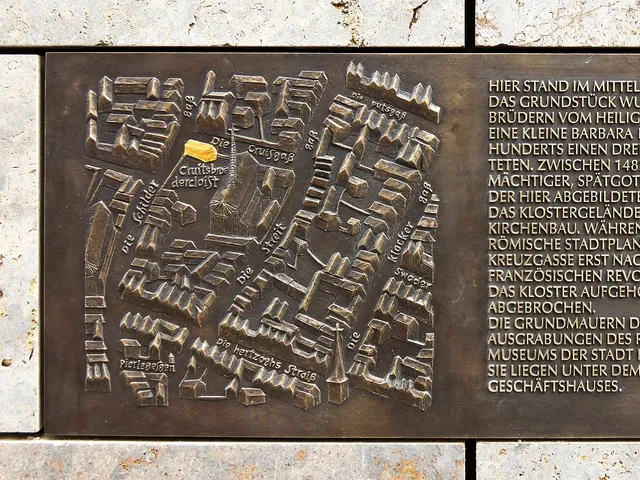
Over the centuries the Schildergasse was a dense network of workshops, homes and courtyards. Many painters from Nuremberg kept their workshops here, and famous names such as Stefan Lochner and Bartholomäus Bruyn the Elder lived nearby – though not on the street itself. Monasteries moved in too: Beguines, Antonines, Crosier friars and Poor Clares founded their convents here. A silent witness to that era still stands today: the Antoniterkirche, which grew out of the Antonine monastery founded in 1298 and was completed around 1380. It is regarded today as a place of calm amid the bustling shopping street.
Emperors, Beer and Grand Townhouses
For a long time the Schildergasse was also an address for the wealthy and powerful. From 1508, Nicasius Hackeney had the "imperial court" built here, where Emperor Charles V stayed overnight twice. The brewing trade shaped the street as well: the Mirweiler house served as the brewers' guild hall, and the six-metre beer fountain, unveiled in 1972, still recalls that tradition today. Prosperous families such as the Rinck erected grand buildings, including "zum goldenen Ring," built in 1513.
From Promenade to Pedestrian Zone
In the 19th century the Schildergasse developed into an urban promenade. Cafés such as the "Café Royal" became meeting points – Karl Marx and Friedrich Engels were among the guests, and political assemblies were held here during the March Revolution of 1848. In 1914 the Tietz department store opened at the junction with Hohe Straße, considered at the time the largest and most modern department store in Europe. On 23 February 1966, the Schildergasse became Cologne's first pedestrian zone. When Hohe Straße followed in 1967, the result was one of Germany's longest car-free shopping miles at 1,417 metres.
The Schildergasse Today
Today, branches of major retail and fashion chains line up alongside boutiques, specialty shops and restaurants. Textiles account for the largest share of floor space at around 60 %, followed by shoe shops at 22 %. About 40 % of the stores offer more than 500 m² of sales area. A striking modern landmark is the Weltstadthaus, opened in 2005, with around 14,400 m² of retail space. Ranked fifth among Germany's busiest shopping streets in 2023, the Schildergasse remains one of the country's most popular destinations.
Timeline
- 1298Founding of the Antonine monastery, from which the Antoniterkirche later emerged
- 1452The guild house of coat-of-arms painters and tailors is established on the street
- 1508Nicasius Hackeney has the "imperial court" built
- 1797The present name "in der Schildergasse" appears for the first time
- 1914Opening of the Tietz department store, then Europe's largest
- 1966The Schildergasse is declared Cologne's first pedestrian zone
- 1972Inauguration of the six-metre-high beer fountain
- 2005Opening of the Weltstadthaus with around 14,400 m² of retail space
Gallery
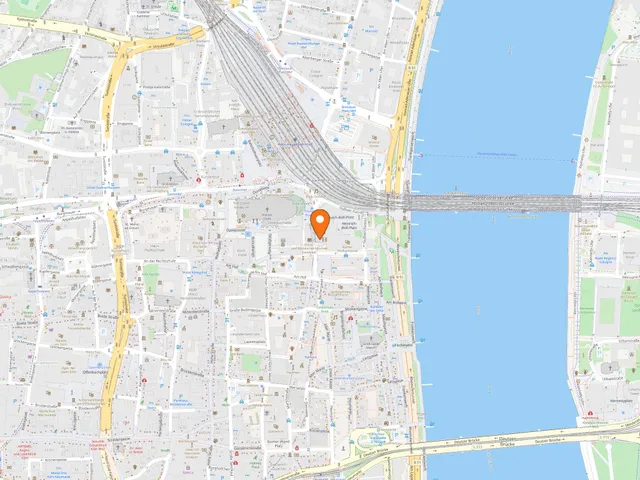
Map
Blue dots: other places nearby — tap to explore.
Address
Schildergasse
50667 Köln
You might also like — related or nearby
Comments
- Loading comments…
Sources & links
Auto-generated, last verified: 2026-07-13
How this page is made
This page draws on open sources — Wikipedia, Wikidata, official websites and the city’s open data. Every statement is checked against the sources linked here, and pages are refreshed regularly.
Spotted a mistake anyway? Tell us below — we read every submission.