Platzjabbeck
Late-medieval wooden figure on Cologne's town hall tower that, since 1913, opens its mouth and sticks out its red tongue on every full hour.
High up on Cologne's town hall tower sits a grim wooden head that greets passers-by on the Alter Markt on every full hour — the Platzjabbeck. The name is stressed on the second syllable and is often shortened to Jabbeck.
Source: Wikipedia
At a Glance
- Type
- Movable wooden sculpture (man's head)
- Installed
- 1445 at the expense of Cologne's city council
- Movable since
- 1913
- Mechanism
- Opens its mouth and sticks out its tongue on every full hour
- Appearance
- Slouch hat, wide-open eyes, wild black beard, red tongue
- Location
- Top storey of the town hall tower, east side below the tower clock
- District
- Altstadt-Nord, city centre
Origin of the Name
The name draws on several languages at once: "Platz," the Cologne dialect word jappe meaning ‘to yawn' or ‘to open the mouth wide,' and the French bec for ‘mouth' or ‘beak.' Together they aptly describe exactly what the figure does — open its mouth wide.
History
The sculpture dates back to the late Middle Ages. A surviving invoice shows that it was mounted on the tower in 1445 at the expense of Cologne's city council. At first the head remained rigid; only in 1913 was it made movable. Since then the Platzjabbeck opens its mouth every hour and pushes out its red tongue.
Meaning and Interpretation
What the figure originally stood for remains unclear for lack of historical evidence. One reading sees it as mockery: after the city government had passed to the guilds and gaffeln, the grimacing head may have ridiculed the patricians who had ruled before. That would place it alongside the Kallendresser figures on the same tower and, in a broader sense, among Cologne's grinning heads and envy heads.
Gallery
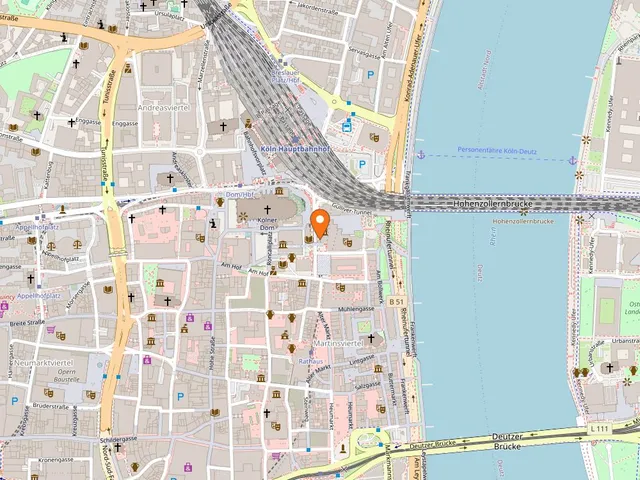
Map
Blue dots: other places nearby — tap to explore.
Address
Rathauspl. 2
50667 Köln
You might also like — related or nearby
Comments
- Loading comments…
Sources & links
Auto-generated, last verified: 2026-08-01
How this page is made
This page draws on open sources — Wikipedia, Wikidata, official websites and the city’s open data. Every statement is checked against the sources linked here, and pages are refreshed regularly.
Spotted a mistake anyway? Tell us below — we read every submission.