Mülheimer Freiheit
Street in Cologne-Mülheim, once lined with late-Baroque merchant houses. Its name recalls the liberties Mülheim received in 1322.
At the beginning of the 18th century, Protestant families from Cologne moved to this street, among them the Andreae family of entrepreneurs, who were then leaders in the production of velvet, silk and linen.
Source: Wikipedia
At a Glance
- Type
- Street
- Location
- Mülheim district and borough, Cologne
- Origin of the name
- Liberties with which Mülheim was granted town status in 1322
- Surviving buildings
- Houses from the 18th and early 19th centuries, with reconstructed exteriors
- Original Baroque façade
- House no. 102, dating from 1762
- Fountain
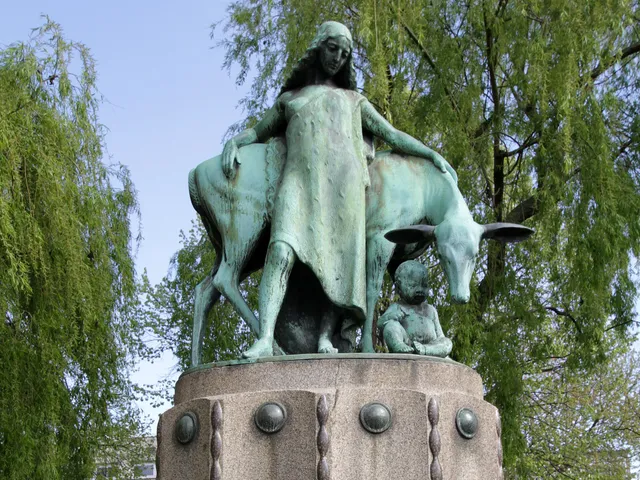
- Mülheimia, at the junction with Krahnenstraße
- Heritage protection
- Listed buildings within the Deutz/Mülheim cultural landscape area
The building at Mülheimer Freiheit 59, once the popular excursion inn "Zum Rheinberg" with a dance hall and garden terraces, was closed in 1943 and converted into a forced-labour camp for around 300 people from Poland and the former Soviet Union.
Name and Town Rights
In 1322, Count Adolf VI raised the settlement of Mülheim to the status of a town and granted it extensive liberties. These included civic rights with exemption from all levies and services, as well as the right to hold its own court and mint. The street name derives from these rights.
Baroque Merchant Houses
Until Mülheim was destroyed in the Second World War, numerous late-Baroque houses belonging to merchant families defined the character of the street. Many were lost in the war. Several houses around the mariners' church of St. Clemens and the Mülheimia fountain survived largely intact, above all the late-Baroque merchant houses at the northern end. House no. 119 was built in 1775 by the city architect Johann Georg Leydel for the silk manufacturer Theodor Schütte as a seven-bay Baroque building in the gatehouse style. From around 1870, villas for Mülheim entrepreneurs were built along the high riverbank, of which only a few largely survived the war.
Traces of the 20th Century
Until the November pogrom of 1938, house no. 78 contained the synagogue and community center of the Jewish congregation. A memorial plaque above the entrance, donated by an ecumenical working group in 1979, commemorates this. The inn “Zum Rheinberg” at no. 59 was closed in 1943 and converted into a forced labor camp. About 300 people from Poland and the former Soviet Union were made to work from there in the KHD Werke machine factory for wartime production.
The Mülheimia Fountain
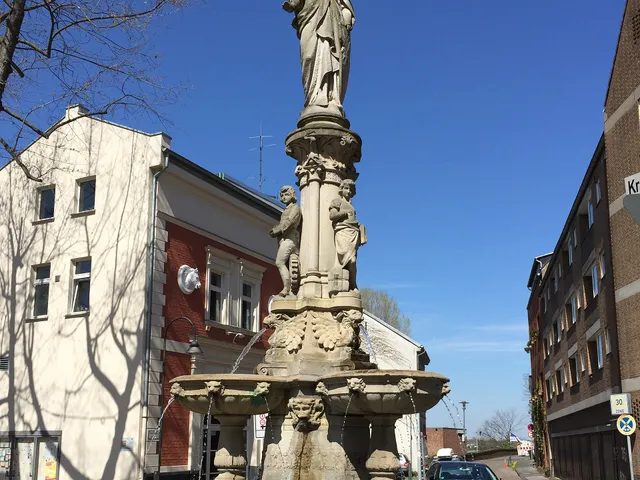
The Mülheimia was the first of originally seven municipal fountains. Its site was previously occupied by the “Pütz” drinking-water pump, which was removed in 1884 when the “Rheinische Wasserwerksgesellschaft” took over the water supply. The main figure carries the Mülheim flag and personifies what was then the district town. Beneath it stand three boys in medieval dress, representing trade, industry and agriculture.
Good to Know
The Prussian King Frederick William IV stayed in the neoclassical house no. 121, built around 1820 for the manufacturer Theodor Steinkauler, when he visited for the laying of the foundation stone for the continuation of work on Cologne Cathedral. At nos. 113 and 115, the Willi Peter organ workshop built church organs from 1952 to 2015, most recently the organ of St. Peter in Cologne.
Timeline
- 1322Mülheim gains liberty rights; Count Adolf VI elevates it to a town
- Anfang 18. Jh.Protestant merchant families (incl. Andreae) settle on the street
- 1762House no. 102 with Baroque façade built
- 1770House no. 117 'Haus zum Morian' built
- 1775Palace-like house no. 119 built for Theodor Schütte
- 1884'Pütz' pump at Krahnenstraße removed (water works company)
- 1938Synagogue at no. 78 used until the November pogrom night
- 1943'Zum Rheinberg' inn (no. 59) converted into forced labour camp
Gallery
Map
Blue dots: other places nearby — tap to explore.
You might also like — related or nearby
Comments
- Loading comments…
Sources & links
Auto-generated, last verified: 2026-10-13
How this page is made
This page draws on open sources — Wikipedia, Wikidata, official websites and the city’s open data. Every statement is checked against the sources linked here, and pages are refreshed regularly.
Spotted a mistake anyway? Tell us below — we read every submission.