Breslauer Platz
The northern forecourt of Cologne Central Station — home to the city's main bus terminal and the Musical Dome, Cologne's largest theatre.
Located on the north side of Cologne Central Station, Breslauer Platz serves as a second forecourt complementing the main southern entrance.
At a Glance
- Type
- Square and station forecourt
- Location
- Altstadt-Nord, Innenstadt district
- Established
- from 1945
- Named after
- the city of Breslau (Wrocław), since 1959
- Traffic
- distributed across four stacked levels
- Highlights
- central bus terminal, Musical Dome
The square only came into existence after World War II through heavy wartime destruction – and a reinforced concrete bunker built in 1942 by architect Wilhelm Riphahn at its northern corner was designed from the outset to be later converted into a parking garage, yet instead served for decades as an office building for the Raiffeisen-Waren-Zentrale, with its bunker origins no longer visible from the outside.
Things to do here
- Stroll across the spacious station forecourt
- Marvel at the striking Musical Dome
- Watch the lively bustle at the bus station
- Photograph the architecture around the square
- Set off from here to explore Cologne's old town
Origins
Before the Second World War, the site was occupied by the residential buildings of the Kunibert quarter, which bordered directly on the northern station entrance. When American forces entered the left-bank city on 6 March 1945, the square was created — an intervention that cut deep into the urban fabric. For over a decade it had no name.
The Name
In 1956, Cologne entered into a civic partnership with Breslau (now Wrocław), intended as a "symbol for all Germans displaced from their homelands". The square's name followed from this connection in 1959. Today the partnership carries little weight in everyday Cologne life and no longer features on the city's official website.
Four Levels of Traffic
Since the expansion of the Nord-Süd-Fahrt arterial road, traffic has been distributed across four stacked levels: the U-Bahn at the bottom, then the Nord-Süd-Fahrt, then the square level, with the railway viaduct running overhead. The original U-Bahn station opened on 19 October 1970. For construction of the Nord-Süd-Stadtbahn line, Breslauer Platz station was closed between August 2007 and December 2011, causing significant disruption.
Buildings Around the Square
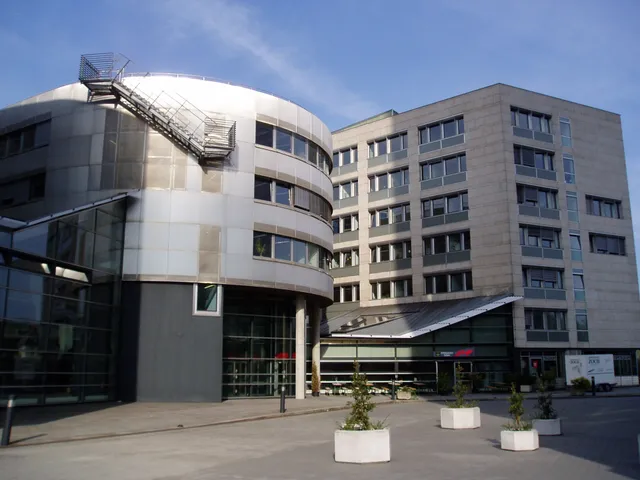
The northern corner is marked by a high bunker built in 1942 by Wilhelm Riphahn, used since 1953 by the Raiffeisen-Waren-Zentrale and no longer recognisable as a bunker from the outside. The Kommerz-Hotel, with its distinctive red aluminium panels, defines the northeast corner. The central bus terminal on the "Breslauer Berg" only moved to its current location in 1986, during the construction of the Philharmonie and the combined Wallraf-Richartz and Museum Ludwig complex; a two-storey underground car park with 400 spaces lies beneath it.
Musical Dome
To the west stands the Musical Dome, opened in 1996 — a glass-and-steel membrane structure covering 4,500 m² with 1,769 seats, making it the city's largest theatre. It was built in just six months, originally as a temporary venue for the musical Gaudí. Despite several planned demolitions, the structure will likely eventually fall to future development of the site.
The Old Goldgasse
Long before the square existed, a street called Goldgasse ran down to the Rhine, first recorded as "Goltgazze" in 1232. It appears on Arnold Mercator's city map of 1570 as "die golt gaß", and during the French occupation in 1813 it was renamed "rue de la Tête d'Or".
Timeline
- 1232Goldgasse first mentioned in records as 'Goltgazze'
- 1942Wilhelm Riphahn builds a high-rise bunker for the city
- 6. März 1945American troops occupy Cologne; square created as second station forecourt
- 1953RWZ moves into the converted bunker as office building
- 1959Square officially named 'Breslauer Platz' (city partnership since 1956)
- 19. Oktober 1970Breslauer Platz underground station opens
- 1975S-Bahn expansion (tracks 10+11) reduces the square's size
- 14. September 1986Philharmonie opens; central bus station moves to current location
Map
Blue dots: other places nearby — tap to explore.
Address
Breslauer Pl.
50668 Köln
You might also like — related or nearby
Comments
- Loading comments…
Sources & links
Auto-generated, last verified: 2026-06-26
How this page is made
This page draws on open sources — Wikipedia, Wikidata, official websites and the city’s open data. Every statement is checked against the sources linked here, and pages are refreshed regularly.
Spotted a mistake anyway? Tell us below — we read every submission.