Haus Töller
A tradition-steeped brewpub in the southern Old Town since 1871, with its original Thekenschaaf counter and a guestbook of famous visitors including Konrad Adenauer and Joseph Beuys.
since 1871
Haus Töller in the southern part of Cologne's Old Town is a traditional brewpub (Brauhaus) that has been in operation since 1871 and to this day runs largely in the style of a 19th-century Cologne tavern. The core of its building is among the oldest surviving houses in the city.
At a Glance
- Address
- Weyerstraße 96, southern Cologne Old Town
- Founded
- 1871 by Theodor Töller as the "Brauerei Töller" (Töller Brewery)
- Building
- the core of one of Cologne's oldest surviving houses, documented between 1343 and 1451
- Special feature
- one of the last houses in Cologne with a Thekenschaaf (the landlord's carved counter alcove) still serving its original purpose
- Kölsch (Cologne's local top-fermented beer)
- Päffgen since 2007 (previously Sion, then Mühlen)
- Seating
- 199, of which 87 are in the original taproom
- Cuisine
- rustic Cologne fare, mostly homemade (including Halver Hahn, Hämchen, Himmel un Ääd)
- Owner today
- Henning Heuser (since November 2003)
Age comparison
Age compared with other places in Cologne.
From the "Steynen Huys" to a Brewpub
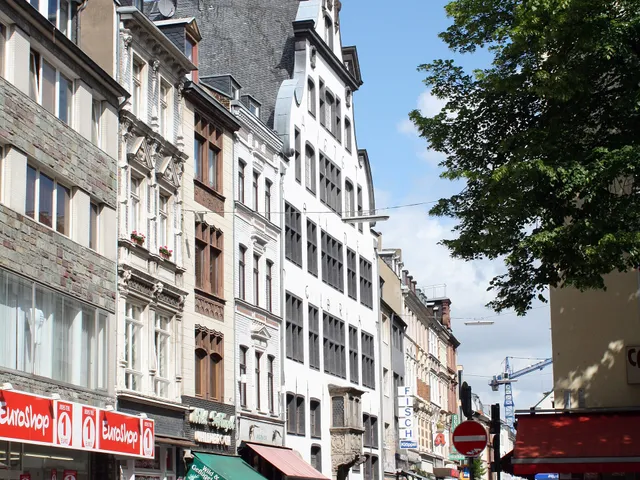
Weyerstraße follows an old Roman road that ran westward out of the city via Luxemburger Straße all the way to Trier and Luxembourg; only a few metres from the house stood the Weyertor, one of the largest gates in the medieval city wall. Along this busy street, inns, taverns and house breweries settled from the 15th century onward — towards the end of the 19th century, the short stretch between Rothgerberbach and the Weyertor counted as many as nine establishments with their own tap.
The building itself, the "Steynen Huys" (Stone House), was — unlike the simple half-timbered structures of the neighbourhood — built of stone and stood right next to the city's "Tollhaus" (customs house) at the Weyertor. Originally laid out as a double house with two separate halves ("Halbscheiden"), it changed hands several times over the centuries — its owners included the Cologne Cathedral Chapter and the Cologne Alexians. Only from 1772 onward were the two halves reunited into a single property. A hospitality business serving alcohol can be documented in the house from 1813, then under owner Joseph Geerling.
Father Töller, the "Cologne Original"
Peter Töller, who from 1859 ran a distillery in the neighbouring house, acquired the building in 1864 and gave it its present appearance by setting back the gable and adding two extra storeys. His son Theodor Töller founded the brewery in 1871, though it operated for only ten years; after that he ran the house as a tavern.
Theodor Töller entered Cologne memory as "Vater Töller" (Father Töller), "reinlicher Dores" (Clean Dores) or "Dores met däm naasse Plagge" (Dores with the wet rag) — nicknames he owed to his love of order, for he was forever on the move with a "Plaggen" (cleaning cloth). For a long time he refused to allow cigarettes in his establishment, because their ash fell more readily than that of the cigars customary until then and threatened to make a mess; besides, in his eyes only the very young or immoral older people smoked "Zibibbcher" (ciggies). He straightened the chairs and laid out the newspapers sorted by political leaning and date. From the Thekenschaaf he kept an eye on everything and grew irritable when guests rapped on the table or knocked over a glass. In 1912 he withdrew from the business. Numerous anecdotes circulate about him, and several poems are devoted to his role as a strict landlord — today he is regarded as a Cologne original. From the Töller name, an emblem also survives: three crowns modelled on Cologne's coat of arms above the letters H and T, which to this day adorn menus, furnishings and beer marks.
The Esser Era and Prominent Guests
On 1 May 1912, Peter Esser took over the house and ran it as "Schenkwirtschaft und Restauration von Peter Esser. Vorm. Th. Töller" (Peter Esser's Tavern and Restaurant, formerly Th. Töller). In 1915 he had a small hall built onto the rear, which extends the capacity to this day. His son Willy Esser, nicknamed "dä akademische Zappjung" (the academic tap boy) on account of his university studies, ran the business into the 1980s.
After the Second World War, the house was one of the few almost undamaged buildings in a Cologne city centre that had been more than 90 percent destroyed, and in 1947 it became the starting point for the re-founding of the KDStV Rappoltstein student fraternity. It is also recorded that Willy Esser travelled from ruined Cologne to the Carlsberg brewery in Denmark and brought back top-fermenting yeast for the first post-war Kölsch, which several Cologne breweries urgently needed. From the 1950s to the 1980s, the tavern was a meeting place for many celebrities. A guest book kept since the 1930s — today displayed behind glass in the taproom — gathers entries from Konrad Adenauer, Heinrich Lübke, Joseph Beuys, Rainer Werner Fassbinder, Roy Black, James Last, Wencke Myhre, Berti Vogts and Karl-Heinz Schnellinger, alongside many newspaper reports about the house.
Thekenschaaf, Zappes and the Original Furnishings
Because little has changed since the founding, the fittings and operation still largely match those of a 19th-century Cologne tavern. Most of the furniture has not been replaced since 1871 but only repaired — on some tables you can still see the marks of decades of scrubbing with a scouring brush. The wooden coffered ceiling of the taproom, the last of its kind in Cologne, also survives in its original form.
The floor plan follows the classic layout of a Cologne house brewery: through the entrance door you first enter a hallway that also serves as the taproom counter ("et Zappes"). In earlier times it served as a takeaway sales point and as a "Schwemme" (standing bar) for guests barred from the main room — in the era of the Free Imperial City, for example, the executioner, the knackers or the town soldiers. There is still no beer tap system to this day: the Köbes (the traditional Cologne waiters) draw the beer straight from wooden barrels, which are hoisted up through an opening in the floor from the cold store in the cellar using a chain hoist.
The centrepiece is the richly carved Thekenschaaf between the taproom counter and the main room, also known as the "Beichtstuhl" (confessional). This bay-window-shaped workstation of the landlord is still used in its original function: from here the landlord surveys the main room, the counter and the kitchen. The Köbes hand in their beer marks here, where they are lined up on a metal bracket that holds exactly 100 marks — from this the landlord reads off the number of Kölsch served and the fill level of the barrel. At the same time, the "Beichtstuhl" serves as an office and a storage place for tobacco and pickled eggs; an old W 48 desk telephone also stands inside it. Right beside it, a few tables are reserved as a Stammtisch (regulars' table) for the regular guests, some of whom have been coming for decades.
Haus Töller Today
After several changes of tenant, Henning Heuser took over the house in November 2003. In 2007 the brewery changed as well: after 51 years of Sion and 34 years of Mühlen Kölsch, the small Päffgen brewery has supplied it ever since — alongside Päffgen's own home brewpub, Haus Töller is one of the few establishments to carry the brand. Service is provided by Köbes in traditional blue work clothes; as in many Rhineland brewpubs, an empty glass is swapped for a full one even without an order until the guest places a beer coaster on top of it. Behind the scenes, a cook and a Kaltmamsell (cold-kitchen cook) take care of the catering.
The rustic Cologne menu offers mostly homemade classics such as Halver Hahn, Hämchen, Himmel un Ääd or Rhenish Sauerbraten made with horse meat; on Fridays, the Rhineland's potato-pancake day, there are Rievkooche (potato pancakes) with dark bread, beet syrup or apple sauce. Modern trappings such as a sound system, slot machine, cash register, espresso machine or television are nowhere to be found in Haus Töller.
Gallery
Map
Blue dots: other places nearby — tap to explore.
Address
Weyerstraße 96
50676 Köln
Hours
Mo: 17:00–00:00
Di: 17:00–00:00
Mi: 17:00–00:00
Do: 17:00–00:00
Fr: 17:00–00:00
Sa: 17:00–00:00
Contact
You might also like — related or nearby
Comments
- Loading comments…
Sources & links
- Official website
- Official website (retrieved 2026-08-19)
- Wikipedia (retrieved 2026-08-18, rev 256858982)
- Wikidata (retrieved 2026-08-18)
Auto-generated, last verified: 2026-08-18
How this page is made
This page draws on open sources — Wikipedia, Wikidata, official websites and the city’s open data. Every statement is checked against the sources linked here, and pages are refreshed regularly.
Spotted a mistake anyway? Tell us below — we read every submission.