St. Servatius
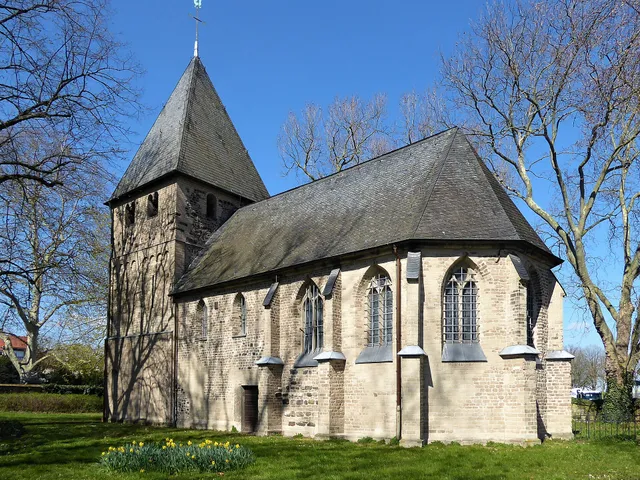
The Catholic parish church of Cologne's Immendorf district, on the "Heidenberg" hill, built 1873/74 on the site of several older predecessor buildings.
since 1874
St. Servatius is the Catholic parish church of Cologne's Immendorf district. It stands on a rise known locally as the "Heidenberg" and was built in 1873/74 on the site of several older predecessor buildings.
At a Glance
- Built
- 1873/1874, designed by August Carl Lange
- Location
- on the "Heidenberg", the centre of Cologne-Immendorf
- Predecessors
- a chapel, then an early Romanesque church (first mentioned in 948)
- Models
- tower modelled on St. Aposteln, transept on St. Andreas
- Consecration
- delayed until 1894, due to the archbishop's imprisonment
- War damage
- hit by artillery fire in the tower and crossing in 1945
- Listed status
- church, cemetery and gravestones listed as monuments in Immendorf
The early Baroque pulpit in St. Servatius, with its bishop reliefs, probably stood in the old-town church of St. Severin until secularisation in 1803 – meaning this piece of furnishing travelled all the way from the city centre to the Heidenberg hill in Immendorf.
Things to do here
- Experience the church's elevated position over Immendorf on the "Heidenberg" hill
- Discover the early Baroque pulpit with bishop reliefs, originally from St. Severin
- Trace the marked foundations of earlier churches in the floor
Age comparison
Age compared with other places in Cologne.
From Chapel to Today's Church
Several predecessor buildings once stood on the Heidenberg at the centre of the village of Immendorf: first, most likely, a small chapel, probably destroyed by Norsemen around 881, then an early Romanesque church mentioned in a donation charter of Archbishop Wichfrid dated 948 — a document later shown to be a forgery, though its content is considered plausible. Originally dedicated to St. Severinus, the patronage later passed, for unknown reasons, to St. Servatius of Tongeren. Foundations of the earlier buildings were reused in the current church and remain partly visible; since 1968, lighter-coloured stones in the floor mark their outlines.
A New Building Modelled on Staufer-Era Churches
As the congregation grew, the old church, extended in 1841/42, was no longer large enough. From 1864 the parish collected funds for a new building; after two rejected designs, architect August Carl Lange submitted plans in 1873 modelled on Staufer-era churches in the Rhineland — the tower follows the example of St. Aposteln, the transept that of St. Andreas. The building was financed partly through donations, interest from a foundation, and a loan. Its consecration was delayed until 1894 because Archbishop Paulus Melchers was imprisoned at the time of completion.
War Damage and Reconstruction
On 7 March 1945, a day before American troops took the village, an artillery shell struck the tower, which was occupied by German artillery observers, and the bell fell into the roof timbers. Shortly afterwards a German army shell fired from across the Rhine hit the crossing. Although one column collapsed, the vault held. Major repair works dragged on into the 1970s; during renovations in 1966/67, services were held in a temporary church.
Furnishings with Old Roots
Several furnishings come from the demolished old church or even older sources: the corpus of the hanging cross from the 15th/16th century, the early Baroque pulpit from around 1620 with bishop reliefs that probably stood in St. Severin in Cologne's old town until its secularisation in 1803, and a figure of St. Servatius by Christoph Stephan. The abstract windows in the side aisles and transept were designed by Hermann Gottfried in the 1950s and 60s.
Timeline
- 948First documented mention of a church in Immendorf
- 1841The old church is extended to the east
- 1873/1874The current church is built to designs by August Carl Lange
- 1894Delayed consecration by auxiliary bishop Hermann Joseph Schmitz (29 April)
- 1945Severely damaged by artillery fire (7 March)
- 1966/1967Temporary church used during extensive renovation
- 1968Foundations of earlier churches marked in the floor
Gallery
Map
Blue dots: other places nearby — tap to explore.
Address
Am Moosberg 6
50997 Köln
You might also like — related or nearby
Comments
- Loading comments…
Sources & links
- Official website
- Official website (retrieved 2026-07-20)
- Wikidata (retrieved 2026-07-03)
- Wikipedia (retrieved 2026-07-03, rev 267230427)
Auto-generated, last verified: 2026-07-03
How this page is made
This page draws on open sources — Wikipedia, Wikidata, official websites and the city’s open data. Every statement is checked against the sources linked here, and pages are refreshed regularly.
Spotted a mistake anyway? Tell us below — we read every submission.