St. Mariä Namen
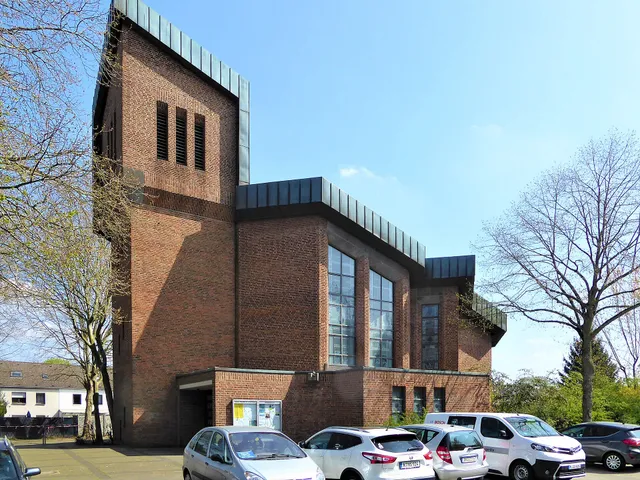
A 1967/68 brick church in Cologne-Esch by Hans Schilling, where the font, altar, and tabernacle are aligned along a single axis.
The parish was founded to serve Esch's growing population after its Romanesque predecessor church became too small. Hans Schilling designed not only the building but also the organ case installed in 1973.
Source: Wikipedia
At a Glance
- Type
- Catholic parish church
- Location
- Cologne-Esch, Chorweiler district
- Construction
- 1967–1968; consecrated 21 September 1968
- Architect
- Hans Schilling
- Material
- Exposed brick masonry
- Heritage status
- Listed monument since 18 January 1982 (No. 923)
- Name
- After the feast of the Holy Name of Mary
The baroque high altar painting from the old St. Martin's church was long forgotten and rediscovered around 1980 in a "desolate state" in the attic of the former rectory, after which it was restored.
History
As Esch expanded in the 1960s, the old Romanesque St. Martinus church could no longer accommodate the growing congregation, so Schilling was commissioned in 1966 to design a new church, sacristy, and separate rectory. Ground was broken in April 1967, the cornerstone laid in June, and the topping-out ceremony held in September of the same year, with consecration following in September 1968. Construction defects appeared shortly after completion and took years to resolve, while vandalism damaged the windows within a few years, prompting the installation of protective grilles. Landscape architect Gottfried Kühn designed the grounds in 1970, and a cross was added to the tower in 1990.
Architecture
The church stands on slightly raised, landscaped grounds alongside other parish buildings. Its irregular polygonal floor plan tapers into a parabolic apse, flanked by a taller pentagonal bell tower and a cylindrical stair tower that barely rises above the flat-roofed brick building's eaves. The trapezoidal entrance section, like the surrounding structures, is single-storey. Inside, the exposed brick walls continue, and the floor slopes down toward the full-height chancel niche and raised altar area.
Layout and Furnishings
A low, circular baptistery adjoins the chancel to one side, while the ground floor of the pentagonal tower houses the sacrament chapel with the tabernacle on the other—placing font, altar, and tabernacle on a single line across the nave. Confessionals and a Marian chapel face each other in semicircular niches along the side walls, and an organ and choir gallery extends into the nave on the left. The neo-Gothic font and a restored Baroque high-altar painting depicting St. Martin of Tours, both salvaged from the earlier church, remain in use, alongside a Baroque polychrome Madonna statue once housed in a now-demolished wayside shrine. Walter Prinz created the altar, ambo, tabernacle stele, and sedilia in 1969, and Wilhelm Strauß designed the abstract windows between 1969 and 1971.
Organ and Bells
The organ was built in 1973 by Gebrüder Hillebrand Orgelbau to a case designed by Schilling, and restored by Orgelbau Schulte in 2014/2015. The three-bell peal was cast in 1969 by the Petit & Gebr. Edelbrock foundry.
Timeline
- 1966Architect Hans Schilling commissioned to design the new building
- 1967Groundbreaking on 9 April, foundation stone on 4 June, topping-out ceremony on 11 September
- 1968Consecration of the church on 21 September
- 1969New windows (until 1971), altar, ambo, tabernacle stele, sedilia and bells created
- 1970Outdoor area designed by landscape architect Gottfried Kühn
- 1973New organ installed by Gebrüder Hillebrand Orgelbau
- 1982Listed as a heritage monument in Cologne on 18 January
- 1990Tower cross installed and tower crown created by Walter Prinz
Gallery
Map
Blue dots: other places nearby — tap to explore.
You might also like — related or nearby
Comments
- Loading comments…
Sources & links
Auto-generated, last verified: 2026-09-01
How this page is made
This page draws on open sources — Wikipedia, Wikidata, official websites and the city’s open data. Every statement is checked against the sources linked here, and pages are refreshed regularly.
Spotted a mistake anyway? Tell us below — we read every submission.