Church of the Resurrection Cologne-Ostheim
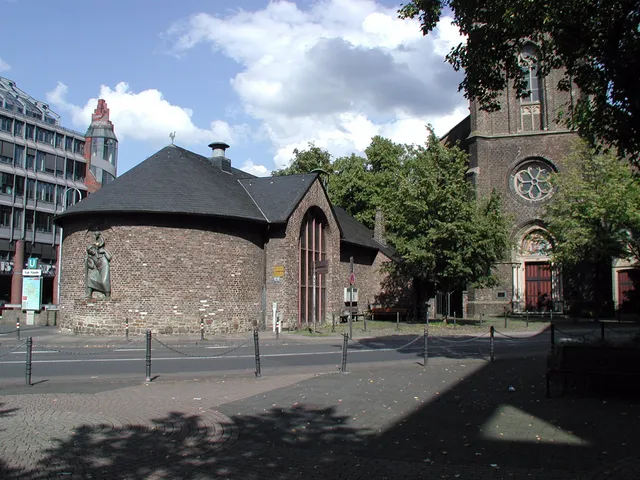
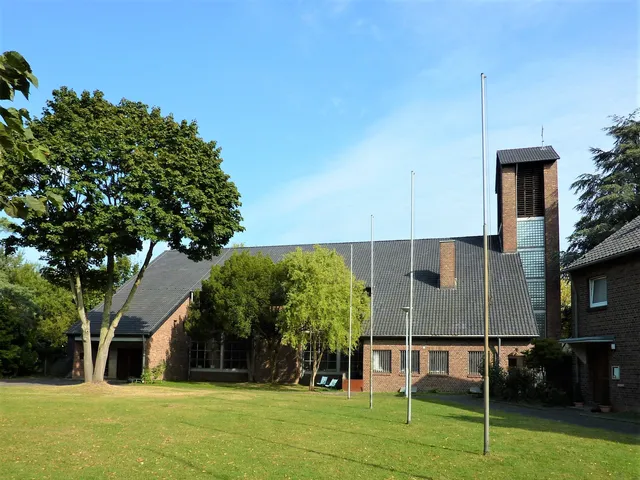
Protestant church with a round altar window and side light bands, consecrated in 1954 to a design by Gerhard Langmaack.
It took more than a century of shifting parish affiliations and makeshift meeting places before Ostheim's Protestant community finally got a church building of its own.
At a Glance
- Type
- Protestant church building
- Location
- Ostheim district, Kalk city borough
- Consecration
- 21 March 1954 (design by Gerhard Langmaack)
- Windows
- round altar window, side light bands
- Organ
- Willi Peter workshop, 1954, six stops
- Parish
- Cologne-Rath-Ostheim, Cologne-Rechtsrheinisch church district
- Extension
- senior citizens' meeting centre (2020/2021)
When the congregation's first prayer hall opened in a former workshop in 1934, the chairs were only borrowed and the singing was accompanied by two violins.
History
In 1840 Ostheim had just a single Protestant resident. Its Protestant inhabitants initially belonged to the Cologne-Mülheim parish, from 1855 to a vicarage congregation in Cologne-Deutz, and from 1877 to the Cologne-Kalk parish; by 1912 the community had grown to 48 members. In 1930 Pastor Oskar Söhngen founded a Protestant association that met in a tavern hall, a school, and at a member's home. A prayer hall opened in 1934 in a former workshop on Buchheimer Weg, with borrowed chairs and hymns accompanied by two violins, later joined by a harmonium. After 1948 the congregation gathered in the small hall of the Catholic youth centre of St. Servatius. By 1950 there were 867 Protestant residents, some 20 percent of the population, making a church building a necessity.
Windows
The architect also designed the windows in 1953. The chancel is dominated by a round window with geometric shapes, flanked on each side by five windows forming a light band that echoes the altar window's composition. Three further windows are set in the rear of the church.
Organ
The instrument was built as Opus 72 by the Willi Peter workshop, with six sounding stops on one manual and pedal. Church musicians here included Gustav Adolf Theill and Klaus Germann; Helmut Kickton learned the basics of organ playing on this instrument as a pupil of Klaus Germann.
Extension
The church is being extended with a senior citizens' meeting centre; ground was broken on 13 October 2020, with completion planned for March 2021. The 160 m² prefabricated timber annexe houses an event room, a counselling room, a kitchen, and accessible toilets, linked to the nave by a double door.
Good to Know
The consecration is dated 21 March 1954, though authoritative structural records list 1953 as the year of construction.
Timeline
- 1840A single Protestant resident lives in Ostheim.
- 1855Until then members of the Protestant Cologne-Mülheim congregation; vicarage congregation Cologne-Deutz founded.
- 1877Ostheim joins the parish of Cologne-Kalk.
- 1912Congregation grows to 48 Protestant believers.
- 1930Pastor Oskar Söhngen founds a Protestant association in Ostheim.
- 1934New prayer hall opens in a former workshop on Buchheimer Weg.
- 1950867 Protestant residents (20%); building a own church becomes necessary.
- 1954Church consecrated (21 March) and organ built.
Map
Blue dots: other places nearby — tap to explore.
Address
Heppenheimer Str. 7
51107 Köln
You might also like — related or nearby
Comments
- Loading comments…
Sources & links
- Official website
- Official website (retrieved 2026-09-19)
- Wikidata (retrieved 2026-09-03)
- Wikipedia (retrieved 2026-09-03, rev 266342261)
Auto-generated, last verified: 2026-09-03
How this page is made
This page draws on open sources — Wikipedia, Wikidata, official websites and the city’s open data. Every statement is checked against the sources linked here, and pages are refreshed regularly.
Spotted a mistake anyway? Tell us below — we read every submission.