Palatium
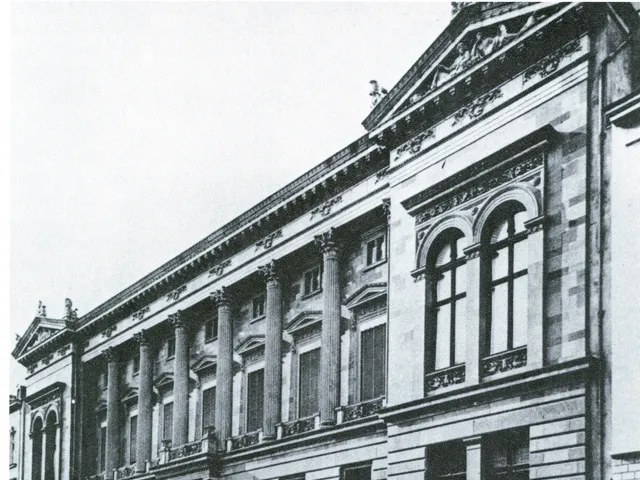
Triangular commercial building by Wilhelm Kreis, opened in 1912: semicircular corner towers with flat domes mark the island plot on Schildergasse.
The building was only made possible by a street breakthrough at the start of the 20th century. Two houses in Cologne had already borne the name "Palatium" in the Middle Ages.
Source: Wikipedia
At a Glance
- Type
- Office and commercial building
- Location
- Altstadt-Nord, Innenstadt district; bounded by Gürzenichstraße, Schildergasse and Hohe Straße
- Architect
- Wilhelm Kreis
- Construction
- built 1911, opened 1912
- Floor plan
- irregular, triangular
- Floors
- four storeys plus attic
- Heritage protection
- since 13 January 1986
Emperor Charles V stayed twice (in 1520 and 1531) at a Cologne "Palatium" on the Neumarkt – the "Caesar's Palace" built by Nicasius Hackeney on behalf of Emperor Maximilian I, though the builder did not live to see its completion.
Origins in the Street Breakthrough
In 1903, Cologne's city council decided to extend Schildergasse to Heumarkt. In 1910, city planner Carl Rehorst carried this out with a breakthrough from Gürzenichstraße to Schildergasse. The "Palatium" was built on the island plot this created, and its floor plan had to follow the triangular shape of the parcel. Thanks to this shape, the building also serves to split the flow of traffic.
Architecture with Corner Towers
The facade is clad in sandstone, and giant orders give the building a strongly vertical structure. The corners on the west and east sides are designed as semicircular round towers with flat domes and serve as a point de vue. The pier architecture is largely dissolved into expanses of glass. Facing Schildergasse and Gürzenichstraße, the building shows six bays each, plus two corner bays that underline its urban dominance.
War Damage and Heritage Protection
In the Second World War, the wing at the corner of Hohe Straße and Schildergasse was destroyed and subsequently rebuilt in a modern form. The building is regarded as significant for Cologne's architectural history. Across the street stands the Tietz department store, which was also built by Wilhelm Kreis.
Medieval Namesakes
Two medieval houses bore the name "palatium", Latin for "palace". One stood at the start of Schildergasse at the corner of Neumarkt and was also known as "zum Sale"; it belonged to Johann von Thurre from 1274. The second was built at today's Neumarkt 8–10 by the patrician Nicasius Hackeney on behalf of Emperor Maximilian I, as an estate with a tower, oriel, halls and a house chapel. Emperor Charles V stayed there overnight in 1520 and 1531. This estate was the predecessor of today's Richmodis-Haus.
Timeline
- 1274Johann von Thurre owns the medieval 'palatium'/'zum Sale' (Schildergasse 4)
- 1507Nicasius Hackeney acquires the Heydenrich estate; adjoining Schorenstein plot follows in 1508
- 1518Nicasius Hackeney dies before the estate is completed
- 1520Emperor Charles V stays overnight at the Hackeney Palatium (29 October)
- 1903City council decides to extend Schildergasse to Heumarkt
- 1910Street breakthrough from Gürzenichstraße to Schildergasse under Carl Rehorst
- 1911Construction of the Palatium commercial building by Wilhelm Kreis
- 1986Palatium is listed as a protected monument on 13 January
Gallery
Map
Blue dots: other places nearby — tap to explore.
You might also like — related or nearby
Comments
- Loading comments…
Sources & links
Auto-generated, last verified: 2026-10-22
How this page is made
This page draws on open sources — Wikipedia, Wikidata, official websites and the city’s open data. Every statement is checked against the sources linked here, and pages are refreshed regularly.
Spotted a mistake anyway? Tell us below — we read every submission.