Kunst- und Museumsbibliothek der Stadt Köln
One of the world's largest public libraries on modern art and photography – over 600,000 volumes, born from two Cologne museum libraries.
The Kunst- und Museumsbibliothek (KMB) is a municipal special library whose holdings are open to the public. Reading takes place in Cologne museums, while the administration and parts of the collection are housed elsewhere.
At a Glance
- Type
- publicly accessible special library of the City of Cologne
- Founded
- 1957
- Reading rooms
- in the Museum Ludwig (Heinrich-Böll-Platz, Altstadt-Nord, Innenstadt district) and in the Museum für Angewandte Kunst (An der Rechtschule)
- Administration
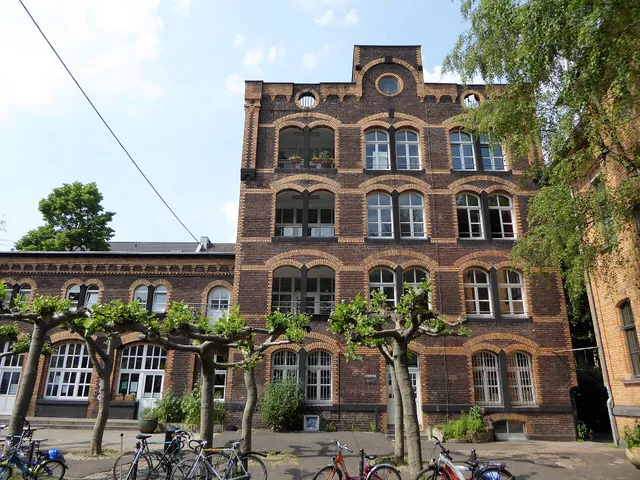
- Vogelsanger Straße 78
- Interim locations since 2025
- Barthonia-Forum in Ehrenfeld and Gremberghoven
- Director
- art historian Dr. Elke Purpus (since 2004)
- Status
- on the Red List of Culture since 2013, category 2 (“endangered”)
In 2010 the library was threatened with closure and the break-up of its holdings due to budget cuts – Mayor Jürgen Roters announced the decision to keep it at the memorial service for the late patron Irene Ludwig.
Focus on Modern Art and Photography
The KMB owes its profile above all to modern art and photography, fields in which it ranks among the largest public libraries in the world. Its collecting priorities are funded by the German Research Foundation (Deutsche Forschungsgemeinschaft). For photography, the Bruno Uhl Library of the Deutsche Gesellschaft für Photographie and the library of the Agfa Foto-Historama were added in the late 1970s. The libraries of George Brecht and Bernard Schultze followed in 2005. For the 50th anniversary of the Museum Ludwig in 2006, the patron Irene Ludwig donated her working library to the KMB.
From Periodical Archive to Incunabula
The collection includes more than 9,700 periodical titles; around 500 journals and museum periodicals are currently subscribed to. There are also dossiers on more than 100,000 artists (as of 2026). Despite its focus on the modern era, the library holds seven incunabula, 100 prints from the 16th century and 140 from the 17th century, as well as further items from the 18th and 19th centuries.
Early Digital Cataloguing
The KMB emerged from the libraries of the Wallraf-Richartz-Museum and the Kunstgewerbemuseum, today's Museum für Angewandte Kunst. Because the collection was not catalogued until the 1960s, it could be recorded entirely by computer together with the Deutsches Rechenzentrum in Darmstadt – pioneering work in Germany. Since 2000, the entire catalogue, with the exception of the auction catalogues, has been searchable online.
Threats and the Question of Space
Due to lack of space, the library was spread across three locations in the 1970s; a building of its own was begun, but construction was halted. From 1974 to 2012, the Rheinisches Bildarchiv was administratively attached to it. From 2009, a new building was planned in Neustadt-Süd for the destroyed Historical Archive, which the KMB and the Bildarchiv were to share. In 2014, however, the city council approved a scaled-down building without the library. In 2010, austerity measures threatened closure and the breakup of the collections, until Mayor Jürgen Roters ended the debate. Since May 2015, an agreement between the City and the University of Cologne has provided for the joint operation of the “Zentralbibliothek für Kunst und Kunstgeschichte”; a solution to the space problem is still being sought.
Using the Library
Holdings stored off-site due to lack of space can be requested in advance for the reading room. Journal articles have been available through the Subito document delivery service since late 2008.
Timeline
- 1957KMB emerges from the libraries of the Wallraf-Richartz Museum and the Museum of Applied Arts
- 1974Rheinisches Bildarchiv is organisationally attached to the KMB (until 2012)
- 1986Additional reading room opened in the new Museum Ludwig building
- 2000Entire library catalogue made available online
- 2004Elke Purpus becomes director, succeeding Karl Stamm
- 2010Library threatened with closure by budget cuts; Mayor Roters ends the debate
- 2014City council decides on a new Historical Archive building without the KMB
- 2015City and University of Cologne agree on joint operation of the Central Library for Art
Gallery
Map
Blue dots: other places nearby — tap to explore.
Address
Heinrich-Böll-Platz
50667 Köln
Hours
Mo: 14:00–21:00
Di: 10:00–21:00
Mi: 10:00–21:00
Do: 10:00–21:00
Fr: 10:00–18:00
Contact
You might also like — related or nearby
Comments
- Loading comments…
Sources & links
- Official website
- Official website (retrieved 2026-10-13)
- Wikidata (retrieved 2026-10-13)
- Wikipedia (retrieved 2026-10-13, rev 270414604)
Auto-generated, last verified: 2026-10-13
How this page is made
This page draws on open sources — Wikipedia, Wikidata, official websites and the city’s open data. Every statement is checked against the sources linked here, and pages are refreshed regularly.
Spotted a mistake anyway? Tell us below — we read every submission.