Galeria Cologne Hohe Strasse
1912–1914 department store where Germany's first-ever department store escalator went into operation in 1925.
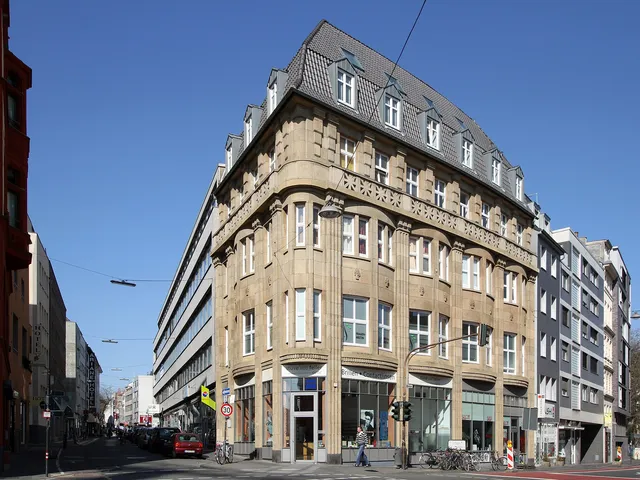
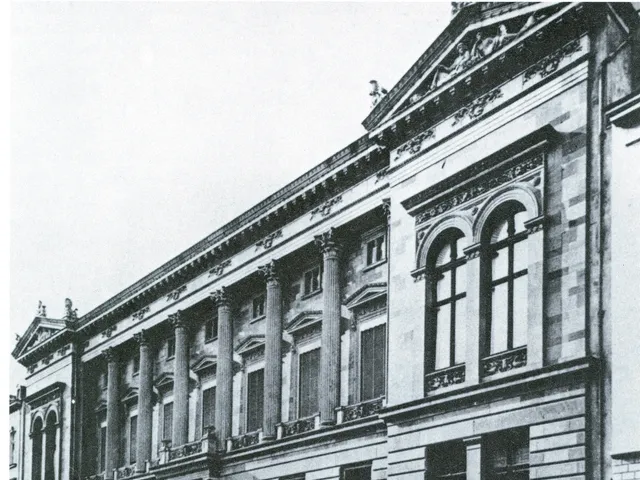
The building on Cologne's Hohe Strasse ranks among the country's historically significant department store buildings. It was designed by Wilhelm Kreis, one of the leading architects of his day, who also created the Tietz department store in Wuppertal.
Source: Wikipedia
At a Glance
- Type
- historically significant department store of the Galeria group
- Location
- Hohe Strasse 41–53, Altstadt-Süd district, Innenstadt borough
- Construction period
- 1912 to 1914
- Structure
- five-storey reinforced concrete skeleton building
- Protection status
- listed monument in North Rhine-Westphalia
In 1925, the first escalator in a German department store was put into operation here, considered a special attraction at the time.
History
From 1911, Leonhard Tietz AG planned a multi-department store modelled on French examples, and Kreis won the associated architectural competition. The building became the company's flagship. As early as 1891, the firm had run its first Cologne branch at the corner of Hohe Strasse and Blindgasse, covering just 180 square metres. Four years later, it moved closer to the city centre into a newly built sales house. Cologne became the company headquarters in 1897, and in 1902 an Art Nouveau arcade building was added between Hohe Strasse and An St. Agatha.
Architecture
Kreis structured the façade in classical forms. The sculptural work was carried out by Johannes Knubel, who had previously executed the façades of the Tietz buildings in Düsseldorf and Wuppertal. To blend in with the old town, the building initially featured a tall slate roof, which no longer exists today.
A 1925 Innovation
In 1925, the store put Germany's first department store escalator into operation. At the time, it was considered a major attraction.
Renovations
Between 1956 and 1957, Hermann Wunderlich, an architect for the Kaufhof group, added further sales floors behind an aluminium curtain façade in the company's signature green. Based on a design by Reinhold Clüser, a multi-storey car park with a spiral ramp was built on Cäcilienstrasse, later expanded in 1991/1992.
Timeline
- 1891First Cologne branch opened at Hohe Straße/corner of Blindgasse
- 1895Move to a newly built store closer to the city center
- 1897Cologne becomes the company headquarters of Tietz
- 1902Opening of a new Art Nouveau arcade building
- 1911Building conceived on behalf of Leonhard Tietz AG
- 1912–1914Construction of the department store at Hohe Straße 41–53 designed by Wilhelm Kreis
- 1925First escalator in a German department store put into operation
- 1956/1957Extension by Hermann Wunderlich with aluminum curtain facade
Gallery
Map
Blue dots: other places nearby — tap to explore.
Address
Hohe Straße 41-53
50667 Köln
You might also like — related or nearby
Comments
- Loading comments…
Sources & links
Auto-generated, last verified: 2026-09-02
How this page is made
This page draws on open sources — Wikipedia, Wikidata, official websites and the city’s open data. Every statement is checked against the sources linked here, and pages are refreshed regularly.
Spotted a mistake anyway? Tell us below — we read every submission.