Köln West Station
Station on Cologne's railway ring with a listed reception façade and a light-rail stop running at right angles beneath the tracks.
The station owes its existence to the transformation of Cologne in the late 19th century: when the city wall came down and the Neustadt was built, the railway tracks had to be reorganised as well.
At a Glance
- Type
- Local transport station on the Cologne railway ring (part of the Left Rhine line)
- Location
- Venloer Straße, Neustadt-Nord district, Innenstadt borough
- Opened
- 1891
- Tracks
- two platform tracks, plus eight tracks without platforms for freight traffic
- Platform
- 210-metre island platform, 76 centimetres high
- Regional services
- RE 22, RB 24, RB 26 and RB 48
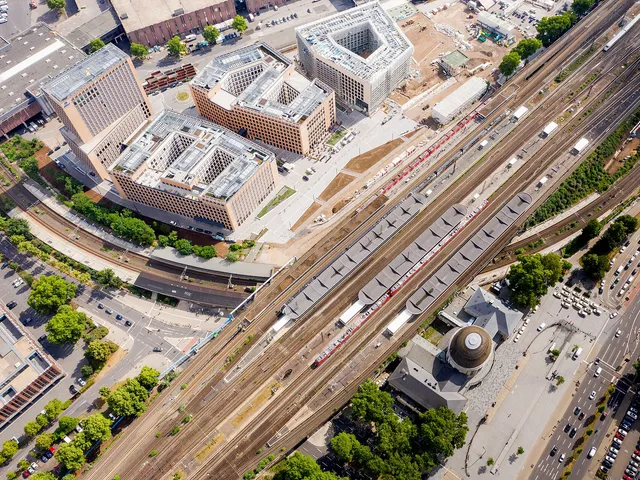
At Köln West station, the southbound passenger track loops in a wide arc around the depot yard, making its route almost 500 metres longer than that of the northbound track.
History and Façade
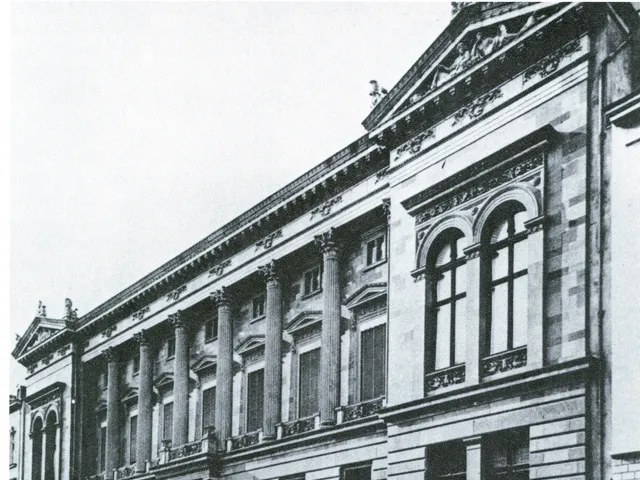
From 1859, the connection from the Cölner Centralbahnhof to the Left Rhine line ran along the inside of the city wall, in the area of today's Ringe. After the wall was demolished starting in 1881, the city council decided in 1883 to move the tracks onto an embankment further from the centre. Underpasses were built at all the arterial roads. Köln West – spelled "Cöln West" until 1914 – and Köln Süd were built on the line, which was overseen by Ernst Dircksen. The façade of the former reception building already looked much as it does today. Unlike now, however, the embankment then carried a platform hall spanning the passenger tracks and the platform with its waiting room.
Accessible Redevelopment
As part of North Rhine-Westphalia's "Modernisation Offensive 2", the station underwent a comprehensive refurbishment. A new island platform was built at tracks 1 and 2, south of Venloer Straße. It now stands at 76 centimetres instead of the previous 38, allowing step-free boarding and alighting. In addition, 42 metres of platform canopy were newly built, the access routes were redesigned, and the lighting, loudspeakers, display cases, seating and waste bins were replaced. The old platform remains in place and is closed to the public by metal fences. An additional staircase, intended to shorten routes during the renovation of the bridge over Venloer Straße, has no date yet.
Tracks and Route Layout
Anyone travelling south has to make a detour here: directly north of the station, the passenger tracks diverge. The northbound track leads directly to the main station, while the southbound track skirts the operations depot to the north in a wide arc and is almost 500 metres longer. The freight tracks branch off at the north end on the same level: towards Köln-Ehrenfeld, continuing to the Köln – Aachen high-speed line, and towards Köln-Nippes, from where they continue as the left lower Rhine line. A track known as the "Schlundgleis" ("throat track") also branches off the freight tracks and leads through several underpasses, across the site of the dismantled Köln Gereon freight yard, into the operations depot.
Electronic Interlocking
Construction of the "linker Rhein" electronic interlocking began at the station in 2020, with a budget of 110 million euros. It was scheduled to enter service at the end of 2024, but actually went live on 19 May 2025.
Connection to the Light Rail
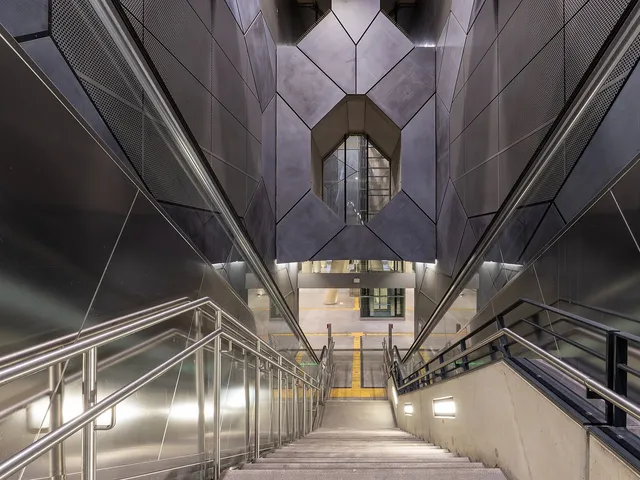
Light-rail lines 3, 4 and 5 stop at Hans-Böckler-Platz/Bf. West. Two lifts run from the platform to both Venloer Straße and the light-rail platforms, and there are additional stairs from the forecourt. At the western end, line 5 separates from lines 3 and 4 on a grade-separated junction. The remaining 30-centimetre platform sections once served line 5, which has run high-floor vehicles since 2002; only the 90-centimetre sections are still used. Since almost all stops towards the city centre have now been converted to high platforms, passenger service with low-floor trains is no longer possible today.
Timeline
- 1859Opening of the Cölner Centralbahnhof with its link to the left Rhine line
- 1881Removal of the city wall begins and the Neustadt is laid out
- 1883City council decides to move the railway line onto an embankment (9 January)
- 1891Opening of Köln West and Köln Süd stations
- 1914Spelling "Cöln West" used until this year, afterwards "Köln West"
- 2002High-floor vehicles operate on Stadtbahn line 5 from this year
- 2007New LC destination displays installed since autumn
- 2025Electronic interlocking "linker Rhein" commissioned (19 May)
Gallery
Map
Blue dots: other places nearby — tap to explore.
You might also like — related or nearby
Comments
- Loading comments…
Sources & links
- Official website
- Official website (retrieved 2026-10-22)
- Wikidata (retrieved 2026-10-22)
- Wikipedia (retrieved 2026-10-22, rev 266709865)
Auto-generated, last verified: 2026-10-22
How this page is made
This page draws on open sources — Wikipedia, Wikidata, official websites and the city’s open data. Every statement is checked against the sources linked here, and pages are refreshed regularly.
Spotted a mistake anyway? Tell us below — we read every submission.