Gereonshaus
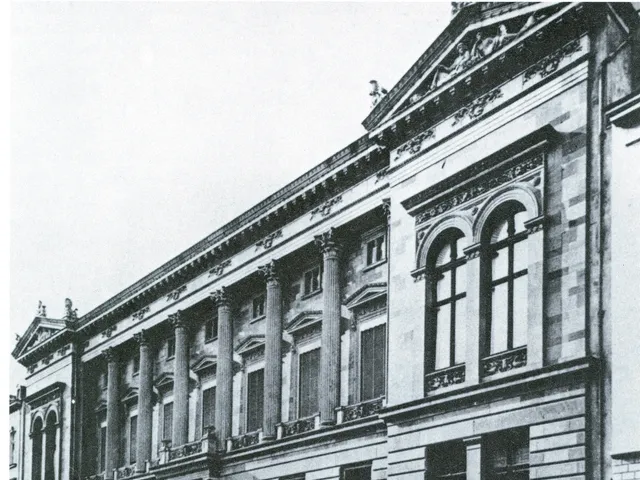
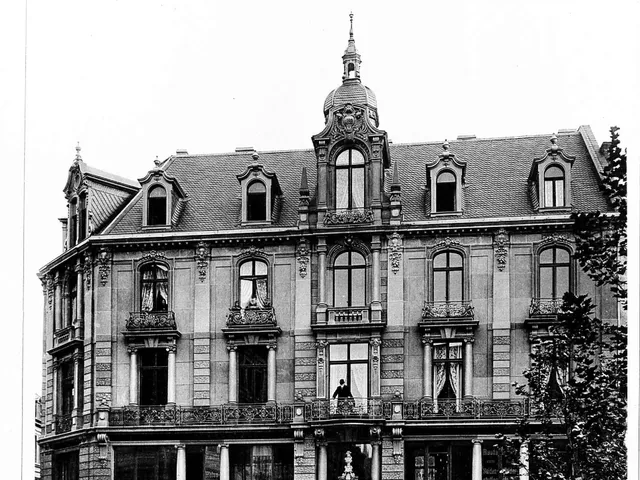
Monumental office building of 1909/10 by Carl Moritz, now home to the German Association of Cities and Towns.
Built on the site of five former townhouses, the building offered exhibition space on the ground floor plus offices, storage rooms and studios for the newly founded Cologne Artists' Association from the very start.
Source: Wikipedia
At a Glance
- Type
- Office and commercial building, originally a counting house
- Location
- Gereonstraße 18–32, Altstadt-Nord (Innenstadt district)
- Construction
- 1909 to 1910
- Architect
- Carl Moritz
- Style
- Classicism
- Size
- Street frontage about 60 metres, depth roughly 70 metres, around 300 rooms on 3,250 m² of built area
- Protection
- Listed historic building since 14 June 1988
- Today
- Headquarters of the German Association of Cities and Towns
Despite a two-month construction workers' strike during the building period, the Gereonshaus still met its agreed completion date of July 1, 1910.
Banking Quarter on Gereonstraße
With the 1859–1862 bank building for the A. Schaaffhausen'sche Bankverein, the street running from An den Dominikanern via Unter Sachsenhausen to Gereonstraße developed into a Cologne hub for banks, insurers and office buildings. The Gereonshaus marked the chronological endpoint of this development on the north side, while Peter Behrens's 1914 building for Frank & Lehmann (Unter Sachsenhausen 37) formed its counterpart on the south side.
Construction and Early Use
The client, Aktiengesellschaft für Grundbesitz, commissioned Carl Moritz to design the building, with builder Bruno Josef Weithase contributing to the design and Georg Klöppel overseeing on-site construction. Despite a two-month construction workers' strike, the building was completed on schedule by 1 July 1910. By 1913, 98 companies occupied the house, including the Daimler Motor Company's office and artist studios such as that of Olga Oppenheimer; by 1930, 96 tenants were recorded.
Destruction and Reconstruction
The building suffered severe damage in the Second World War; the courtyard warehouse and the rear building's east wing were lost and never rebuilt. Reconstruction took place from 1950 to 1952 on behalf of Allianz, following designs by Peter Franz Nöcker, who added a fifth full storey and replaced the steep mansard roof with a flatter gabled roof.
Present Appearance and Use
The dressed-stone façade of the front building survived reconstruction, though the added fifth floor was rendered in plaster and the bay windows above the portals were simplified. In January 2009 the German Association of Cities and Towns acquired the Gereonshaus, and after a 2009–2011 renovation by the firm Jöhnsen - Ranft - Lüke, it became the association's new headquarters, later also housing several affiliated municipal organisations.
Timeline
- 1859–1862Construction of the bank building for A. Schaaffhausen'scher Bankverein
- April 1909Demolition of five residential buildings begins for the new construction
- Dezember 1909Shell construction of Gereonshaus completed
- 1. Juli 1910Completion of Gereonshaus despite construction workers' strike
- 191398 companies use Gereonshaus as tenants
- 193096 tenants recorded in Gereonshaus
- 1950–1952Reconstruction after war damage by architect Peter Franz Nöcker
- 14. Juni 1988Listed as a historic monument in Cologne
Gallery
Map
Blue dots: other places nearby — tap to explore.
You might also like — related or nearby
Comments
- Loading comments…
Sources & links
Auto-generated, last verified: 2026-09-12
How this page is made
This page draws on open sources — Wikipedia, Wikidata, official websites and the city’s open data. Every statement is checked against the sources linked here, and pages are refreshed regularly.
Spotted a mistake anyway? Tell us below — we read every submission.