Cologne Town Hall Tower Figures – 124 Sculptures on the Ratsturm
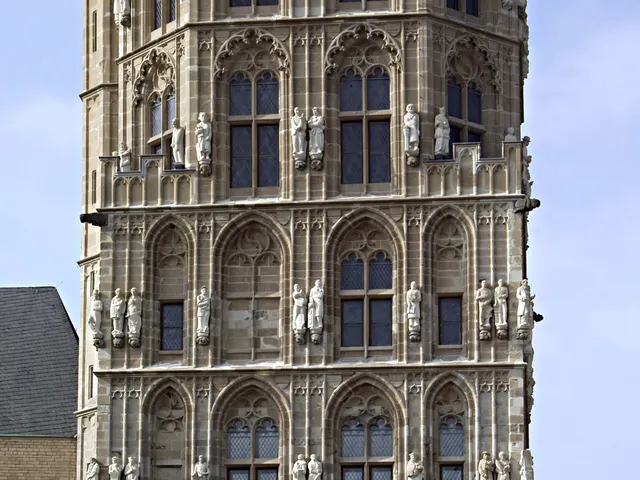
Across several generations, 124 figures on Cologne's town hall tower narrate the city's history – from princes and guilds to the patron saints of the "Cologne Heaven".
Spread across five storeys of the tower of Cologne's town hall are 124 figures, a display that has been renewed and rethought several times over more than a century.
Source: Wikipedia
At a Glance
- Location
- Ratsturm (tower) of Cologne's town hall
- Number
- 124 figures
- Earlier renewal
- new figures commissioned between 1891 and 1901, prompted by archive director Hansen
- Changing materials
- Baumberg sandstone, Heilbronn sandstone, shell limestone, Weibern tuff and finally Savonnières limestone
- Women (post-war programme)
- 18 of the 124 figures depicted
- Cost of post-war programme
- about 2.5 million DM
- Current display
- third generation, complete since November 2008
- Reference
- Kier/Ernsting/Krings (eds.), Köln: Der Ratsturm, J. P. Bachem Verlag, 1996
The Original Figures
The tower's once rich and often praised sculptural decoration had already suffered severe weather damage by the end of the 17th century. Who these early figures represented is not recorded. By the turn of the 19th century only remnants survived: the portal figures, which had been protected with canopy-like coverings in the late 18th century, and a knight figure standing beside them.
The Renewal around 1900
On the proposal of Hansen, director of Cologne's Historical Archive, new figures were commissioned between 1891 and 1901. The city council held a competition in which a figure group had to be designed for each storey following a set arrangement: princes and archbishops on the ground floor, representatives of the patrician families and the guilds on the middle floors, artists and scholars above, and the city's patron saints on the top storey.
The 1893 competition produced the first nine figures, created by Johann Degen, Alexander Iven, Peter Kürten and Heinrich Schmitz in Baumberg sandstone. In 1900 the Cologne Sculptors' Association under Wilhelm Albermann took on the 71 figures of the upper storeys, completed in Heilbronn sandstone by 1902. Including the canopies made by Peter Kribben, the cost came to 72,978 marks. The ground-floor figures were already so damaged by 1925 that they were replaced in shell limestone after a further competition.
Destruction and Redesign after 1945
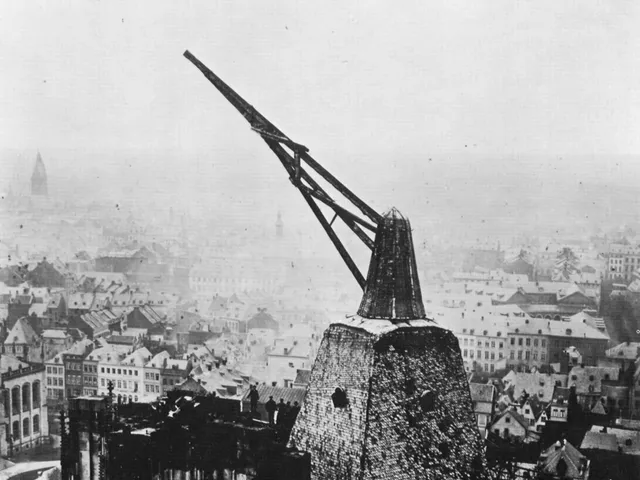
The town hall and its tower were almost entirely destroyed by wartime bombing; only the figures on the south side survived in the rubble. Rebuilding of the complex began in 1959, and by February 1975 the tower had been restored "in its old form" – at first without any figures.
From 1981 a commission of historians spent five years developing a new sculptural programme. It was to portray the city's history up to the present, but to exclude both living people and "negative" figures. The basic concept was adopted in 1986: figures up to the end of the Middle Ages on the ground floor, people important to the city's standing arranged chronologically on the three floors above, and patron saints on the top storey.
Dispute over Women and Realisation
At the decisive council session the Green Party raised substantial objections, chiefly because only five women had been planned for the entire programme. In October 1987 a revised list was presented, now with 18 women among the 124 figures, which the council approved in January 1988. Nine women and 48 men sculptors carved the figures from Weibern tuff, a volcanic stone from the Eifel; five old figures were restored and reused. The work was funded by endowments at a cost of 2.5 million DM, and by 1995 this third generation was fully installed.
The Figures Today
For greater durability the tuff figures had been fully impregnated with acrylic resin using the so-called "Ibach process". This sealing soon caused severe damage, however, and the figures had to be removed. In early 2008 sculptors began producing exact copies in French Savonnières limestone, and since November 2008 all 124 figures once again adorn the Ratsturm.
Gallery
Map
Blue dots: other places nearby — tap to explore.
Address
Rathausplatz
50667 Köln
You might also like — related or nearby
Comments
- Loading comments…
Sources & links
Auto-generated, last verified: 2026-08-22
How this page is made
This page draws on open sources — Wikipedia, Wikidata, official websites and the city’s open data. Every statement is checked against the sources linked here, and pages are refreshed regularly.
Spotted a mistake anyway? Tell us below — we read every submission.