Hof Melaten
Germany's largest medieval leprosarium: at Hof Melaten, west of Cologne, people with leprosy lived behind walls, and the site later became Melaten Cemetery.
The complex lay just beyond the Bischofsweg, the road that separated the city's territory from the archbishop's. As a result, the leprosarium fell under the archbishop's jurisdiction and remained in ecclesiastical hands.
Source: Wikipedia
At a Glance
- Type
- former home for the sick and for people with leprosy (leprosarium)
- Location
- today's Lindenthal district of Cologne, just over a kilometer west of the medieval city
- First documented
- 1243, as "hoff to Malaten"
- Chapel
- St. Mary Magdalene and Lazarus, dating from 1245
- Layout
- fully walled, with seven houses for the sick
- Later use of the site
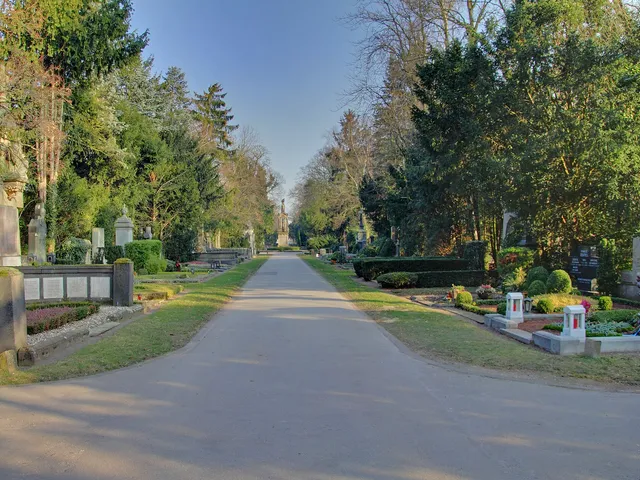
- Melaten Cemetery, opened in 1810
In the Middle Ages, Melaten was the largest leprosarium in Germany: documents from 1247 and 1295 record around 100 residents, including maids, farmhands and bondsmen.
Largest Leprosarium in Medieval Germany
No leprosarium in medieval Germany was larger than Melaten. A document drawn up in 1247 and 1295 lists 100 residents, counting maids, farmhands and serfs. Melaten was one of four Cologne leprosaria ("campus leprosi"), all located outside the city walls because of the risk of contagion. The other three housed the poorer patients, who had little or no property.
Origins and Name
A leprosarium called "Maladen", derived from the French "malade" (sick), is attested as early as 1180 through a donation "in campum leprosi". An entry of 25 April 1243 in the oldest rent book concerns a rebuilding; the earlier buildings were probably destroyed in the war between Count William IV of Jülich and Archbishop Konrad von Hochstaden. Konrad consecrated the chapel on 6 June 1245 and granted an indulgence to all benefactors. In 1247 Pope Innocent IV placed Melaten under his special protection. The name evolved from "vulgariter zuo den malaten" (house of the lepers) in 1342; the form "Malaten" alone first appears in 1364 as "hoysz zu Malayten".
The Grounds and Surroundings
Besides the houses for the sick, there were dwellings for maids and farmhands, a barn, stables, bake, brew and wash houses, a garden and a small cemetery for deceased patients. From the 16th century the Offermannhaus inn was added. Farming was substantial: a flock of 100 sheep is recorded in 1391. To the south, across Aachener Straße (the Via Belgica), lay the Rabenstein execution site. In 1765 a workhouse and house of correction was established at Melaten.
Brotherhood and Provisors
The sick formed the brotherhood Conventus Claustri S. Lazari, which also included the healthy members of the estate. Those who joined swore obedience to the superior, acquired a prebend and worked as far as they were able. From 1227 at the latest, honorary provisors, mostly citizens from patrician families, managed the lands and revenues; the city council could also influence them through this role. There was one provisor in 1385, two in 1392 and three in 1433. They decided on admitting patients, hired staff and kept the leprosarium's seal.
Funding and Leprosy Inspection
The estate was sustained by alms, endowments and bequests, as well as income from properties in and around Cologne, in Düren, Bergheim, Bonn, Blatzheim and Deutz. Wealthy patients paid an entry fee. A fee was also charged for the leprosy inspection (Lepraschau), the examination to determine whether someone was infected. Melaten was additionally supported by a Holy Spirit brotherhood.
Timeline
- 1180Donation 'in campum leprosi' documented (leprosarium 'Maladen')
- 1243First documentary mention of Melaten (25 April), reconstruction
- 1245Chapel of St. Mary Magdalene and Lazarus consecrated by the archbishop
- 1247Pope Innocent IV places Melaten under his special protection
- 1364Name 'hoysz zu Malayten' first recorded
- 1391Flock of 100 sheep documented
- 1765Workhouse and correctional facility established in Melaten
- 1810Melaten Cemetery opened on the site
Map
Blue dots: other places nearby — tap to explore.
You might also like — related or nearby
Comments
- Loading comments…
Sources & links
Auto-generated, last verified: 2026-10-24
How this page is made
This page draws on open sources — Wikipedia, Wikidata, official websites and the city’s open data. Every statement is checked against the sources linked here, and pages are refreshed regularly.
Spotted a mistake anyway? Tell us below — we read every submission.