Gereonsmühle
A surviving stretch of Cologne's medieval city wall with a former defensive tower that was converted into a windmill in the 15th century.
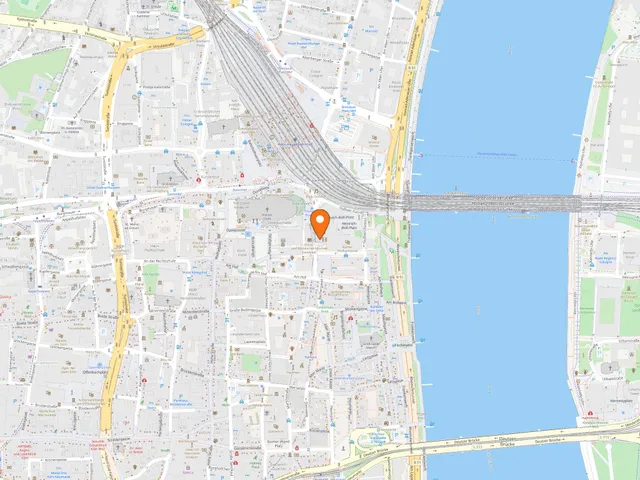
The Gereonsmühle is part of a 113-metre-long surviving section of Cologne's medieval city wall. It lies between Gereonswall and Hansaring, west of the Eigelsteintorburg gate.
At a Glance
- Location
- Between Gereonswall and Hansaring, west of the Eigelsteintorburg
- First mentioned
- Gereonsmühle tower documented since 1446
- Part of
- A 113-metre remnant of the medieval city wall
- Origin
- One of 52 towers of the fortification begun in 1180
- Notable features
- A half-tower turned into a residence and a former windmill
- Present use
- Tower used since the 1950s by the KSJ ("KSJ-Tower")
History
The Gereonsmühle tower has been documented since 1446. It was one of 52 towers that, together with 36 gates and smaller posterns – 12 on the land side, 24 on the Rhine side – enclosed the city from 1180 onwards. The names "Gereons-Mühle" and "Herrenleichnam-Mühle" refer to the neighbouring, no longer preserved Gereonstor gate and to the Herrenleichnam monastery that lay behind it.
In the 15th century the eastern half-tower was converted into a windmill. Besides the Gereonsmühle, two further mill towers were created in the same way: the Kartäusermühle at the Ulrepforte and the Pantaleonsmühle at the Bachtor. In 1558 the tower had to be renovated because it had become dilapidated, and a final repair took place in 1808.
Architecture
Behind the half-tower – built in the same manner as at the Ulrepforte – a mill tower and a mill passage resting on arches were erected. This mill passage is carried by eight cross vaults. The wall contains two half-towers that were open towards the city side; for structural reasons they held bracing or were built out for various purposes. In Prussian times the wall was banked up on the city side and supported against Wallstraße by a retaining wall about 2 to 3 metres high.
Ownership and Museums
Because it passed into private hands in 1838 – Andreas Hochkirchen, originally from Sürth, bought it from the city for 1,460 talers – the Gereonsmühle was spared demolition. In 1908 the city bought the mill back. On a southern reserve plot, the Department of Christian Art of the Schnütgen Collection was built between 1911 and 1913, from which the Museum Schnütgen emerged; the architect Franz Brantzky incorporated the city wall, the wall-walk and the mill tower into the museum building. After the destruction of the Second World War, the museum complex on Hansaring was abandoned. On the eastern narrow side, remnants survived, including a console of the star vault and part of the portal that connected the sculpture hall to the city wall.
Good to Know
In the spring of 1859 a Jupiter altar of coarse-grained sandstone was found nearby. To the south-west of the Gereonsmühle stands another piece of the old city wall, ending at the street Am Kümpchenshof. There, in 1954, the architect Hans Schilling built his home almost entirely into the embankment against the retaining wall; the half-tower forms part of the living space. Behind the wall, on the grounds of the former Klingelpütz prison, lies today's Klingelpützpark.
Gallery
Map
Blue dots: other places nearby — tap to explore.
Address
Gereonswall 108
50670 Köln
You might also like — related or nearby
Comments
- Loading comments…
Sources & links
Auto-generated, last verified: 2026-07-11
How this page is made
This page draws on open sources — Wikipedia, Wikidata, official websites and the city’s open data. Every statement is checked against the sources linked here, and pages are refreshed regularly.
Spotted a mistake anyway? Tell us below — we read every submission.