Filzengrabentor
A gate in Cologne's Rhine wall built around 1200 at the Filzengraben, demolished in 1854 and no longer preserved today.
The Filzengrabentor was one of the gates in Cologne's Rhine-side fortifications. Built around 1200, it shaped the riverbank near St. Maria Lyskirchen for more than six centuries until it was pulled down in 1854.
At a Glance
- Type
- Gate tower in Cologne's Rhine wall
- Location
- on the Filzengraben, near St. Maria Lyskirchen
- Built
- around 1200 (final medieval expansion of the city)
- First recorded
- 1373 as "porta Vilcengraven"
- Function
- city gate, goods handling, later a flour weighing station
- Demolished
- 1854 (medieval structure); nothing survives today
Location and Origin of the Name
The gate stood at the end of the old city moat (civitatis fossa), the "Filzengraben," which served both as a street and as the final course of the Duffesbach stream between Mühlenbach and Holzwerft. Until 1106 this line marked the boundary between the Rhine suburb and the southern suburb of Oversburg. The Cologne historian Adam Wrede traced the street name to the Old Cologne form "Fezejrave" – named after the felt makers who fashioned felt hats and coats, among others for the tower and gate watchmen.
The Rhine Wall and Its Gates
Built in the 13th century, the Rhine wall closed the semicircle of Cologne's ring wall, running between the Bayenturm (erected around 1220) to the south and the Kunibertsturm (around 1223) to the north. Almost every street leading to the wall had a gate or a postern; for the year 1470, 26 such openings are documented. In the southern part of the Oversburg suburb, the Filzengrabentor was one of the larger ones.
Everyday Use
Besides its defensive role, the gate handled goods from the ships and boats that moored here, with the wine and timber trades playing a major part. Records from 1370/80 note restrictions on timber storage near the gate, and in 1555 the foreshore in front of it was widened. Closed after dark, the gate was under the authority of the burgrave, who had it opened at night when needed – for instance for the workers colloquially known as "gold diggers," employed by the executioner to empty latrines. The council had decreed that their loads could pass only through the Neugasse gate and the Filzengrabentor in order to be tipped into the Rhine.
The Structure
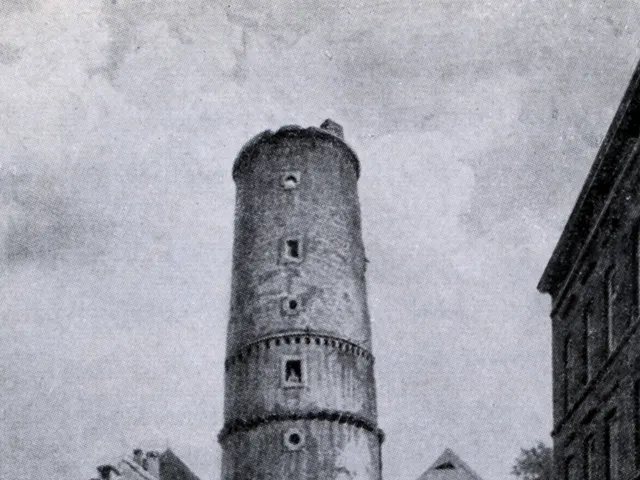
The Filzengrabentor was a square tower with a pointed-arch gateway facing the Rhine, framed by a round-arched blind arch, and a low arched passage on the city side. The upper floor, fitted with cross windows, originally carried a crenellated top and later a plain hipped roof. On the north side stood an added stair tower with an oriel. Shrine records from 1494 describe a dwelling on the upper floor, linked to the city wall by two wall walks.
Reuse and Demolition
In 1744 H. Schölgen had the gate tower enlarged by the master builder Nikolaus Krakamp; until 1834 it served as a flour weighing station – hence the name "Mehlpförtchen" (little flour gate) for a smaller passage nearby. Repeated raising of the ground level around Lyskirchen/Filzengraben had lifted the surface so much that the historiographer Aegidius Gelenius already described the gate as "subterranea" (underground) in the 17th century; by the time of demolition the passage retained a clearance of only three metres. In 1854 the medieval structure was torn down and replaced by a brick gate building. Nothing of the Filzengrabentor survives today.
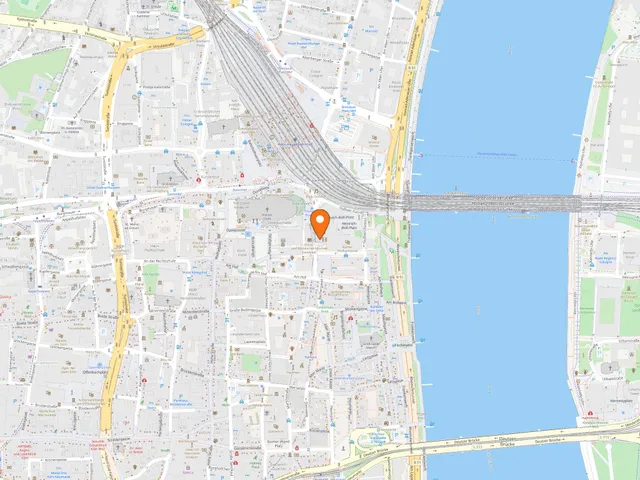
Map
Blue dots: other places nearby — tap to explore.
Address
Auf Rheinberg 2
50676 Köln
You might also like — related or nearby

Comments
- Loading comments…
Sources & links
Auto-generated, last verified: 2026-08-14
How this page is made
This page draws on open sources — Wikipedia, Wikidata, official websites and the city’s open data. Every statement is checked against the sources linked here, and pages are refreshed regularly.
Spotted a mistake anyway? Tell us below — we read every submission.