Domplatte
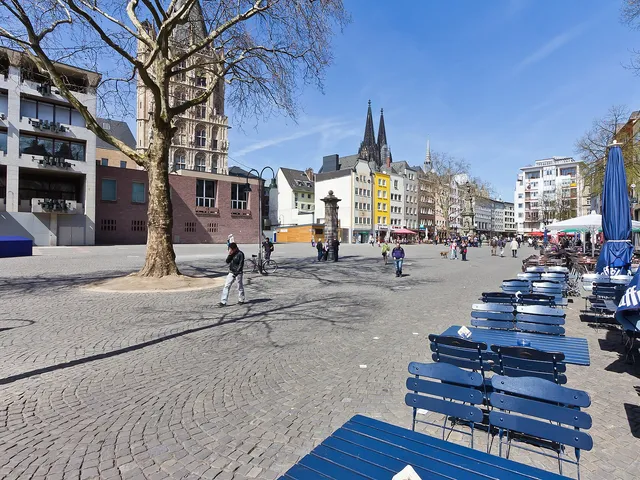
This pedestrian platform lifts the area around Cologne Cathedral to the height of its portals, at the cost of the historic Domhügel hill.
"Domplatte" is not an official name but the colloquial term for the area. Because it raised the city to the cathedral's level, the cathedral's surroundings are considered "completely reinvented".
At a Glance
- Type
- Pedestrian platform around Cologne Cathedral
- Location
- Altstadt-Nord district, Innenstadt borough
- Area
- 7,000 m²
- Built
- 1968–1970
- Getting there
- Dom/Hauptbahnhof underground station on the Stadtbahn Köln
- From the main station
- across the station forecourt, then via the grand staircase or a lift
- Underneath
- two-level car park for 613 vehicles beneath the western and southern Domplatte
- Nearby
- Roman-Germanic Museum, Museum Ludwig, Roncalliplatz
Building the Domplatte meant removing the historic cathedral mound: the ground level around Cologne Cathedral was raised to the height of its portals, which had previously been reachable only by stairs. The 70-metre-wide staircase to the station forecourt, opened in 2005, largely matched a 1964 design by Fritz Schaller that the city had rejected at the time – it was realised by his son Christian.
The City at Cathedral Level
Before the platform was built, the cathedral's portals could only be reached by steps. Architect Fritz Schaller had the ground raised for pedestrians to exactly that level. His aim was to integrate the cathedral into the urban fabric and free it from its spatial isolation. The historic Domhügel had to make way for this. The concrete platform, paved in multicolored granite, surrounds the entire cathedral; since then, the stairs have been located farther from the building, for example to the west towards the tourist office and to the north towards the station forecourt.
How It Came About
An international competition in 1956 was never realized, but it set out the idea of raising the ground. Schaller won the 1964 competition, and work began in 1968. Construction of the underground Stadtbahn made the reorganization easier, as the surface tram was no longer needed. A first section opened to pedestrians in July 1970, and the whole area followed in October 1970. The Roman-Germanic Museum, opened in 1974, filled the last gap in the development, and the formerly landscaped Roncalliplatz shrank as a result. A partial renovation followed in 1988.
Link to the Main Station
Towards the station, the platform spans Trankgasse, an east–west axis for through traffic to the Rhine riverbank. Originally, a sculptural staircase bridged the difference in height. The current grand staircase, 70 meters wide and 5 meters high, was designed by Christian Schaller, son of Fritz Schaller, and handed over in 2005. It largely matched an alternative design by his father from 1964, which the city had rejected at the time. In August 2013, the redesign of the eastern cathedral surroundings between the cathedral, the Roman-Germanic Museum, Museum Ludwig and the main station began. It includes wide walkways, a new lighting concept and the demolition of part of the Trankgasse tunnel.
Life on the Platte
According to a quote cited in the source, there is always something going on on the Domplatte and Roncalliplatz. Skaters, roller skaters, acrobats, street musicians and pavement artists are all mentioned.
Closures During Storms
Wind, moisture and sharp temperature swings make it easier for pieces to come loose from the cathedral facade. Despite frequent inspections using drones and lifting platforms, chunks of stone still fall from time to time. In 2012, fragments of one such chunk injured a man in front of the main portal. The Domplatte is therefore regularly closed ahead of approaching storms.
Timeline
- Februar 1956International competition for redesigning the cathedral surroundings begins
- 1964Domplatte competition held; construction of underground Stadtbahn begins (May)
- 1968Fritz Schaller begins construction work on the Domplatte
- 1970First section opened 7 July, entire Domplatte handed over in October
- 1974Roman-Germanic Museum opened (4 March)
- 1988Competitions lead to a partial renewal of the Domplatte
- 2005Redesigned grand staircase to the station forecourt opened (10 August)
- 2013Redesign of the eastern cathedral surroundings begins (August)
Gallery
Map
Blue dots: other places nearby — tap to explore.
Address
Domplatte
50667 Köln
You might also like — related or nearby
Comments
- Loading comments…
Sources & links
Auto-generated, last verified: 2026-10-21
How this page is made
This page draws on open sources — Wikipedia, Wikidata, official websites and the city’s open data. Every statement is checked against the sources linked here, and pages are refreshed regularly.
Spotted a mistake anyway? Tell us below — we read every submission.