St. Monika (Bilderstöckchen)
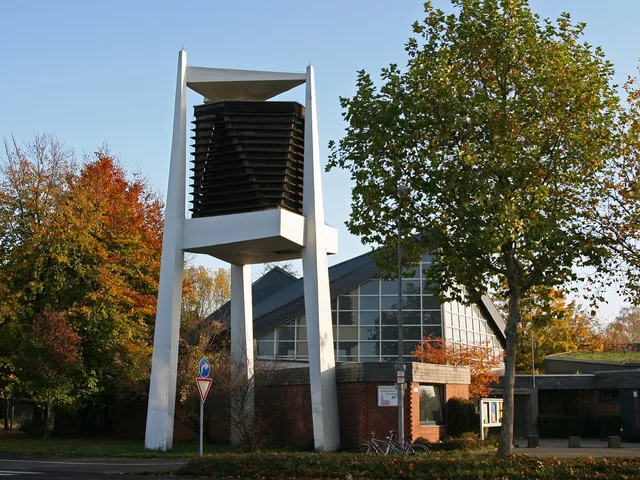
St. Monika was a Catholic branch church in the Cologne district of Bilderstöckchen, built from 1969 to 1970 to designs by Nikolaus Rosiny. It was deconsecrated in 2016 and demolished from autumn 2019 onward – today apartments and a family centre stand on the site.
St. Monika was a Roman Catholic branch church in Cologne's Bilderstöckchen district, erected between 1969 and 1970 to designs by the architect Nikolaus Rosiny. The building no longer exists: after being deconsecrated in 2016, the church was demolished from autumn 2019 onward, and apartments and a family centre were built in its place.
Source: Wikipedia
At a Glance
- District
- Bilderstöckchen
- Architect
- Nikolaus Rosiny
- Construction
- 1969–1970
- Patron saint
- Monica of Tagaste
- Consecration
- 27 August 1972 by Cardinal Joseph Höffner
- Deconsecrated
- 7 June 2016
- Demolition
- from autumn 2019
- Today
- 61 apartments and the St. Monika family centre
Siegfried Haas's altar cross was designed three-dimensionally so that it would be recognisable as a cross from every side of the room – fitting for the church's altar-centred layout.
Things to do here
- See today's St. Monika family centre with kindergarten and senior day-care on the former church site
- Discover the neighbouring Afrikanum, headquarters of the German province of the White Fathers, in the district
History
The St. Monika parish was formed in 1968 by splitting off from the parish area of St. Joseph. Its pastoral care was entrusted to the religious order of the White Fathers, who ran their mission headquarters – the Afrikanum – nearby. This connection also explains the choice of the church's patron saint, who came from North Africa. The foundation stone was laid on 24 August 1969, the first service was celebrated on Christmas Eve 1970, and Cardinal Joseph Höffner consecrated the church on 27 August 1972. Relics of the Ugandan martyr Matthias Murumba Kalemba as well as of Zeno of Verona and his companions were placed in the altar. At the turn of 2007/2008 the parish was dissolved and merged into the new parish of Hl. Franz von Assisi with the parish church of St. Franziskus.
Architecture
The building was a plain cubic flat-roofed structure, raised slightly on a green area amid lower parish buildings and connected in urban terms to the surrounding residential development. The concrete skeleton was infilled with light-coloured stone; a further square block rose centrally on the roof, complemented by a square tower only slightly taller than the rest. Inside, the space was more complex: within an almost square floor plan, four corner pillars supported a skylight with a grid ceiling, defining an inner zone in whose centre the altar stood on a raised platform. The pews faced the altar on three sides, while the fourth side was reserved for the priest's bench.
Furnishings
The central furnishing was the modern altar cross by Siegfried Haas, designed three-dimensionally so that it could be recognised as a cross from every viewpoint in the room. The same artist created the tabernacle, ambo, eternal light, paschal candlestick, Stations of the Cross and a statue of the Madonna between 1975 and 1977. A large wall hanging was knotted by members of the congregation and installed behind the altar in 1981. St. Monika had no bells. A two-manual organ with 17 stops by Hugo Mayer Orgelbau was installed in 1993 following a lengthy donation campaign; after deconsecration it was sold to the St. Jacobus parish in Hilden and set up in the church of St. Konrad there.
Today
As early as around 2008/2009 the parish had identified a growing need for repairs, among other things to the roof and heating. It ultimately decided on demolition and a new building. The site now holds 61 apartments as well as the St. Monika family centre with a kindergarten and a day-care facility for seniors, so that the parish's work remains present at the old location. Services were initially held in the chapel of the neighbouring Afrikanum, the headquarters of the German province of the White Fathers; this location, however, was given up on 1 July 2021.
Gallery
Map
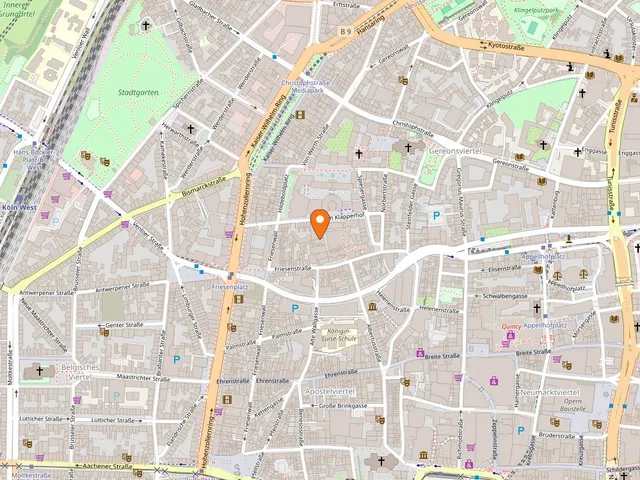
Blue dots: other places nearby — tap to explore.
You might also like — related or nearby
Comments
- Loading comments…
Sources & links
Auto-generated, last verified: 2026-08-29
How this page is made
This page draws on open sources — Wikipedia, Wikidata, official websites and the city’s open data. Every statement is checked against the sources linked here, and pages are refreshed regularly.
Spotted a mistake anyway? Tell us below — we read every submission.