Old Ehrenfeld Cemetery
Listed 1870 cemetery that Ehrenfeld had to build for itself after Cologne refused its citizens burial at Melaten.
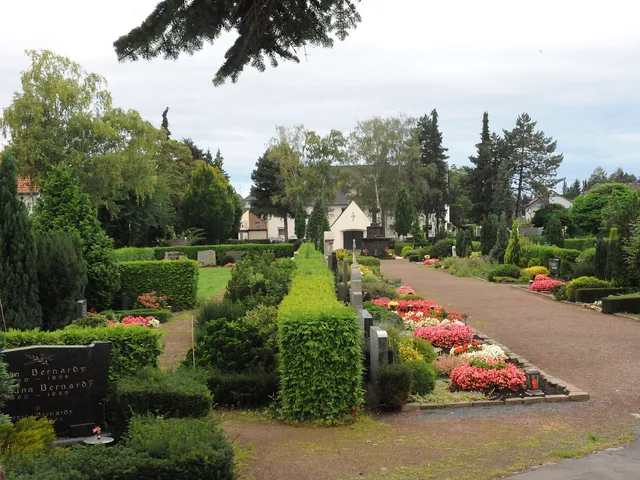
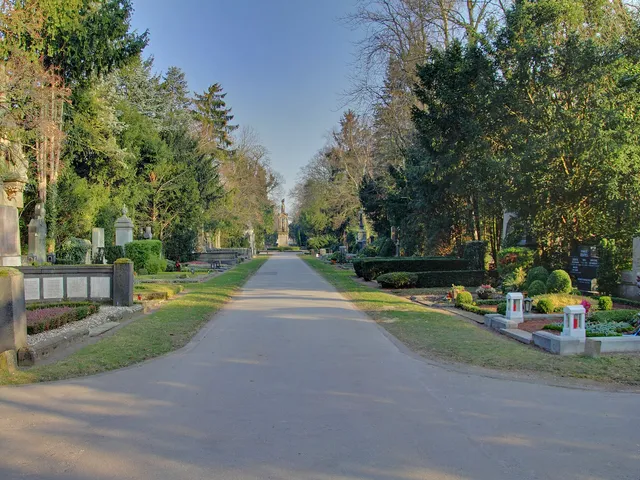
Just north of Melaten, on Weinsbergstraße, lies a cemetery with a story of its own: the then-independent municipality of Ehrenfeld created it in 1870 after Cologne's council had refused its citizens burial at the neighbouring Melaten cemetery. Today the grounds are physically integrated into Melaten, yet remain recognisable as a monument in their own right.
Source: Wikipedia
At a Glance
- Location
- Weinsbergstraße, directly north of Melaten cemetery
- Established
- 1870 as the communal cemetery of the municipality of Ehrenfeld
- Catholic section consecrated
- 31 July 1870
- Extension
- 1885, westward to its present size
- Heritage protection
- since 1 July 1980
- Monument-worthy graves
- 57 (as of 2010), 16 of them from the 19th century
- Notable grave
- cycling world champion Albert Richter
- Today
- managed by and integrated into Melaten cemetery
How the Cemetery Came to Be
Until the mid-19th century, Ehrenfeld's dead were buried at the churchyard of St. Mechtern. Rapid population growth called for new burial grounds: in 1824 a cemetery opened at the corner of Venloer and Alpener Straße (today's Alpenerplatz), and some three decades later burials had to move to Feltenstraße in Bickendorf for lack of space.
In 1867 the municipality of Ehrenfeld asked Cologne's council for permission to bury its dead at Melaten. The city refused, arguing that every municipality had to provide its own burial facilities. So from 1869 Ehrenfeld planned a cemetery of its own, directly north of the Cologne grounds. Its right-angled network of paths was deliberately aligned not with Melaten but with Ehrenfeld's Kirchhofstraße, renamed Weinsbergstraße in 1903.
Two Cemeteries, Visibly Divided
Originally the two grounds were separated by Widdersdorfer Straße; later it was renamed Terrassenweg and ended at Mechternstraße. That two differently conceived cemeteries meet here can still be read today: a wall and a noticeable difference in ground level mark the old boundary. The first Ehrenfeld cemetery stretched from Geisselstraße to Mechternstraße; only ten years after its consecration it had grown too small and was extended westward in 1885. A planned neo-Romanesque mourning hall was never built. In 1895 the Melaten administration took over the care and design of the grounds.
Monuments and Fittings
Several structures and small monuments are protected. The slate-roofed, single-storey gatekeeper's lodge at the main entrance was built in 1914 to plans by Hans Verbeek, beside the wrought-iron gate; the earlier main entrance lay further to the southeast. Among the oldest fittings is the high cross of 1868, designed by Vincenz Statz — a square high stele crowned by a cross and bearing the inscription "Selig die Todten – Die im Herrn sterben" ("Blessed are the dead who die in the Lord"), donated by Jacob Wahlen. During restoration in the 1990s, a medieval armorial grave slab from the early 15th century was found in the foundation, probably from St. Mechtern and reused when the cross was built. The cemetery wall, still partly of original brick, is likewise protected.
Graves and Remembrance
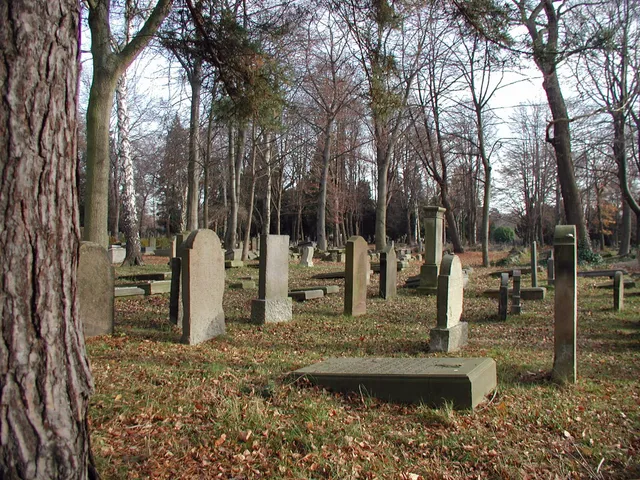
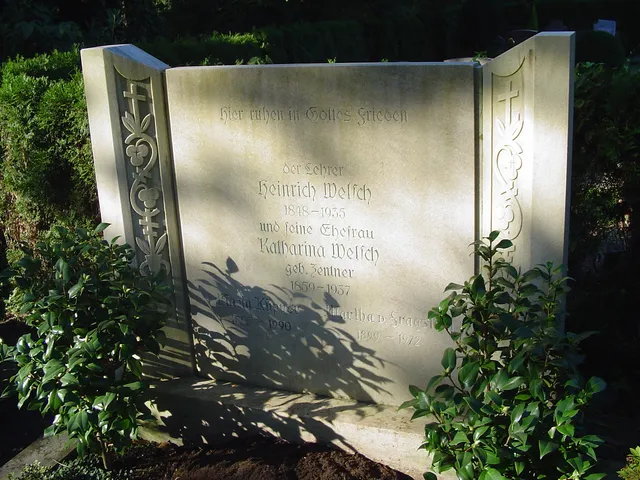
A heritage survey in 2010 identified 57 monument-worthy graves, 16 of them from the 19th century. Steles as well as crosses and cross-steles are characteristic; until the 1920s, serially produced galvanoplastic figures — angels and mourning women — from the art foundry in Geislingen an der Steige were installed. Individual gravestones are the work of noted artists such as Antonio Gobbo, Wilhelm Fassbinder, Emil Rudolf Mewes and Peter Hecker. Buried here, too, is Cologne cycling world champion Albert Richter, whose parental home stood in nearby Sömmeringstraße and who in 1940 presumably fell victim to the Gestapo.
Gallery
Map
Blue dots: other places nearby — tap to explore.
Address
Weinsbergstraße
Köln
You might also like — related or nearby
Comments
- Loading comments…
Sources & links
Auto-generated, last verified: 2026-07-21
How this page is made
This page draws on open sources — Wikipedia, Wikidata, official websites and the city’s open data. Every statement is checked against the sources linked here, and pages are refreshed regularly.
Spotted a mistake anyway? Tell us below — we read every submission.