Friedhof Trenkebergstraße
A small listed cemetery in Cologne-Meschenich with a war memorial and a collection of baroque stone crosses.
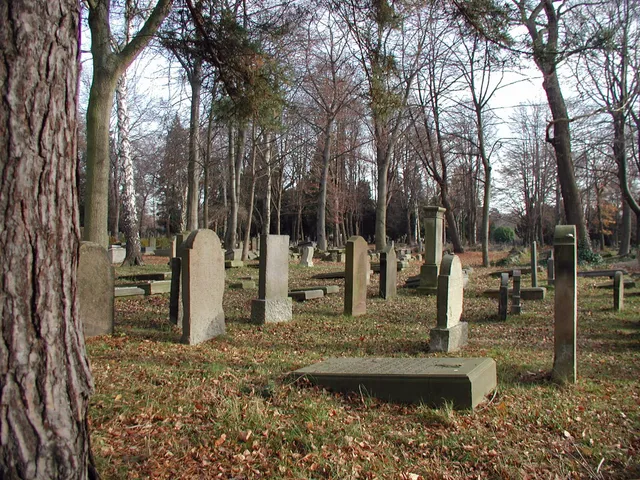
The Friedhof Trenkebergstraße lies in the Cologne district of Meschenich, framed by Trenkebergstraße, Südstraße and Pfarrer-Heinrich-Fuchs-Straße. On a compact site it preserves grave monuments and crosses spanning several centuries and is protected as a historic monument in its entirety.
Source: Wikipedia
At a Glance
- Location
- Cologne-Meschenich, between Trenkebergstraße, Südstraße and Pfarrer-Heinrich-Fuchs-Straße
- Area
- about 4,600 m²
- Capacity
- room for roughly 790 grave sites
- War graves
- 16 graves for German victims of the Second World War
- Mourning hall
- 27 m², space for about 15 people
- Heritage status
- listed as No. 214 in Cologne's register of historic monuments
- Highlight
- twelve trachyte stone crosses from the 16th to 18th centuries, brought from the former St. Blasien cemetery
History
The cemetery was laid out shortly after the First World War. The council of the then municipality of Rondorf bought the plot on what was then Meschenicher Straße – today's Trenkebergstraße – from the widows Rolsdorf and Leikert. The war memorial, set centrally between the entrance and the mourning hall, was erected around 1920, while the mourning hall itself was built in the 1950s.
In the 1960s the grounds were extended to the south. Along the side walls of the mourning hall and the cemetery wall stand twelve trachyte stone crosses that came from the abandoned St. Blasien cemetery and date from the 16th to 18th centuries.
Historic Stone Crosses
Among the oldest pieces from the Rodenkirchen area is a stone cross of about 95 cm from 1540. It bears no name but shows the outline of a coat of arms with a heart-leaf relief. Set into the cemetery wall is the well-preserved cross of the „Endorfer Halffen" Mathias, who died around 1730, marked by a skull above crossed bones. Equally well preserved is the grave cross of Gertrud Bley, who died in 1732 – a variant of the so-called „triple-saddle cross" showing the sorrowful Mother of God.
Memorial and Notable Graves
On the main path rises the memorial to those who fell in the world wars – a tall cross of 1920, its heavy cross carried by two basalt blocks that taper upwards. The same cross also keeps alive the memory of Everhard Stolz (1888–1975), honorary citizen of the municipality of Rodenkirchen. Nearby, on Field 1, lie the grave of Meschenich's parish priest Heinrich Fuchs (1931–1964) and the grave of Karl Kirchmann (died 1943), worked in the pale Belgian granite typical of its time.
Monuments of the 19th and 20th Centuries
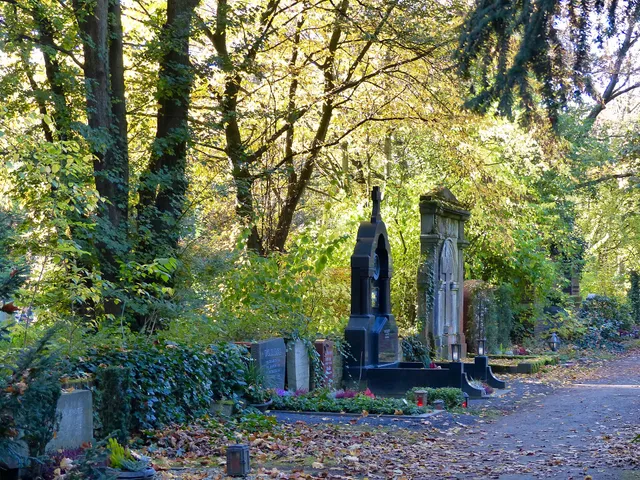
Along the main path stands a series of free-standing cross stelae, popular in the second half of the 19th century, among them the graves of Franz Moos (around 1920) and the Klemmer and Hufschlag families (around 1915). On Field 8, several striking monuments from the first half of the 20th century catch the eye: the Leikert family monument from the Alt-Engeldorfer Hof (first burial 1921), made entirely of shell limestone and signed by J. Bondian of Brühl, is regarded as the only neoclassical example in the Rodenkirchen area, with two fluted columns and Ionic capitals supporting a triangular pediment.
Opposite, the Langel grave (1830–1878) carries a figure of the risen Christ on a black granite base – a bronze cast from 1905 signed L. Piedboeuf. Beside it lies the wall grave of the Assenmacher family, first used in 1926, with a cross of artificial stone framed by wavy stone forms. On the same plot stands the wall grave of the Kelter family (Margarethe Latz, died 1954), with a round-arched top and a bronze relief from around 1920.
Gallery
Map
Blue dots: other places nearby — tap to explore.
You might also like — related or nearby
Comments
- Loading comments…
Sources & links
Auto-generated, last verified: 2026-08-06
How this page is made
This page draws on open sources — Wikipedia, Wikidata, official websites and the city’s open data. Every statement is checked against the sources linked here, and pages are refreshed regularly.
Spotted a mistake anyway? Tell us below — we read every submission.