Nubbel
A life-size straw effigy that serves as the scapegoat of Rhineland carnival, burned in the night before Ash Wednesday.
The figure known as the "Nubbel" takes its name from a Cologne dialect word for "whoever" or "someone" — fitting for its role as an anonymous culprit onto whom all carnival misdeeds are pinned.
Source: Wikipedia
At a Glance
- Type
- Traditional figure of Rhineland carnival
- Form
- Life-size, clothed straw effigy
- Role
- Scapegoat of the carnival season
- Cologne name
- Also called "Zacheies"
- Location
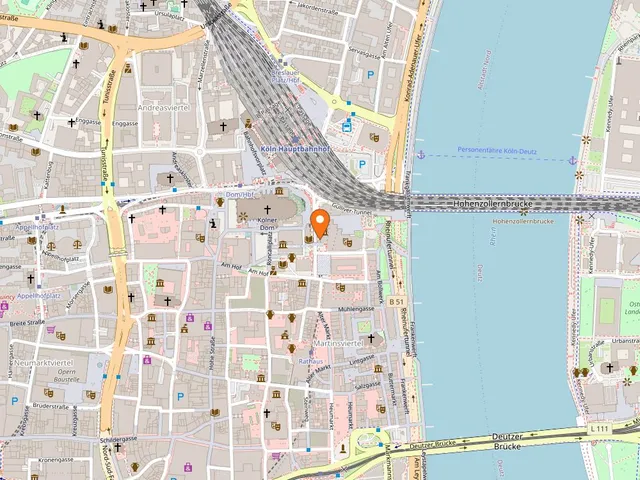
- Cologne city center, Altstadt-Nord district
- Display
- Hung above pubs throughout the carnival season
- Climax
- Burned on the night before Ash Wednesday
- Spread
- Widespread across the Rhineland
In 1913, a Zacheies burning was announced for a fair in Cologne-Buchheim – as a result, the fair was simply banned.
Origin of the Name
"Nubbel" is a Cologne dialect term already in use in the 18th century, employed when no precise details can or should be given — as in "dat wor dä Nubbel" ("that was someone or other"). The word is absent from the 1905 "Dictionary of the Cologne Dialect," though "Zachaies" appears there; later scholars Adam Wrede and Will Hermanns documented and explained the term. In the Cologne area, the name chiefly refers to the "Zacheies," the local form of the biblical name Zacchaeus.
From Fair Custom to Carnival
Originally, the Zacheies was burned to mark the end of a village fair (Kirmes): a straw figure was hung up at the start of the fair to embody the festivities themselves, then burned or buried on the final day — and this figure, too, was called Nubbel. In the Poll district, the Poller Maigeloog still symbolically throws the Zacheies into the Rhine and fishes it out again on the night of May 1st. A planned 1913 burning at the Buchheim fair, one of the oldest fairs on the right bank, led to the fair being banned outright. Only from 1950 did a Zacheies burning resume in Cologne's city center, tied to the St. Severin fair. Burning a figure specifically at carnival is documented in the Rhineland from the early 19th century: Cologne chronicler Ernst Weyden described how, in the 1820s, a puppet was carried through the city in a mock funeral procession on Ash Wednesday and burned in a public square — a custom he claimed to have already witnessed among Napoleonic troops stationed in Cologne in 1812.
How the Ritual Unfolds
The exact ceremony varies from town to town and pub to pub. Typically the Nubbel is fixed to a pub façade on Weiberfastnacht (the Thursday that opens street carnival) and carried to its "grave" at midnight on Shrove Tuesday in a short candlelit procession. A reveler dressed as a clergyman reads out an indictment, often in dialect and rhyme — occasionally a real priest presides instead. The crowd first defends the Nubbel, then ultimately declares it guilty: to questions about squandered money or misbehavior, they answer, "Dat wor der Nubbel!" ("It was the Nubbel!"). The effigy is then set alight.
Good to Know
According to folk belief, the Nubbel's burning absolves revelers of all sins committed during the carnival season. Once the fire dies down, celebrations continue inside the pub until Ash Wednesday morning brings carnival to its close.
Timeline
- 18. JahrhundertTerm "Nubbel" documented in Cologne dialect usage
- 1905"Wörterbuch der kölschen Mundart" omits Nubbel but mentions Zachaies
- 1820er-JahreErnst Weyden describes reorganization of Cologne carnival customs
- 1812Weyden reports carnival play among Napoleonic troops in Cologne
- 1913Burning announced at Buchheimer Kirmes, leading to fair's ban
- um 1950Term "Nubbel" for straw effigy emerges
- ab 1950Zacheies burning at St. Severin fair revived in Cologne city center
Gallery
You might also like — related or nearby

Comments
- Loading comments…
Sources & links
Auto-generated, last verified: 2026-09-23
How this page is made
This page draws on open sources — Wikipedia, Wikidata, official websites and the city’s open data. Every statement is checked against the sources linked here, and pages are refreshed regularly.
Spotted a mistake anyway? Tell us below — we read every submission.