Frankenturm – the vanished defensive and prison tower on the Trankgasse
The Frankenturm was a medieval tower of Cologne's city wall near today's Frankenwerft, demolished in 1856. Only the street name „Am Frankenturm" and three salvaged stone panels in the Cologne City Museum still recall it.
Anyone walking along the Frankenwerft today will look for the Frankenturm in vain: this medieval city-wall tower above the former Rhine quay was pulled down in 1856 and no longer exists.
Source: Wikipedia
At a Glance
- Type
- Medieval defensive and gate tower of Cologne's city wall
- Location
- Northern suburb, at the end of the Trankgasse, above today's Frankenwerft
- Named after
- Probably a burgrave „Franco" from the 12th century
- Later use
- Municipal prison until the 18th century
- Demolition
- 1856
- What survives
- The street name „Am Frankenturm" and three stone panels in the Cologne City Museum
The Defensive Tower at the Franken Gate
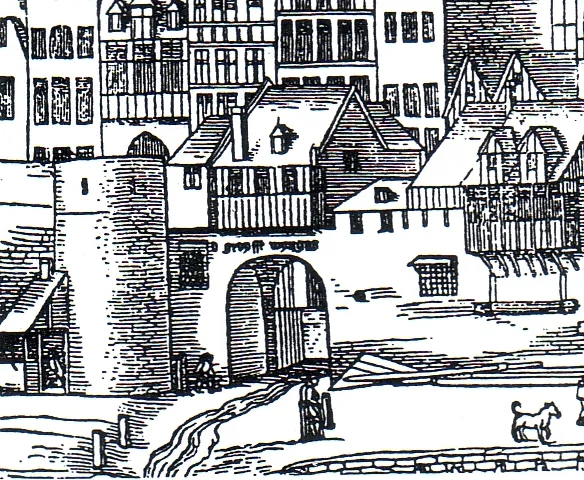
The tower stood at the end of the Trankgasse beside the „Trankgassentor" (Trankgasse Gate) and was known in the Middle Ages as „Franken-thoirn" or „thorn" (as on Mercator's map). Its name probably goes back to a burgrave „Franco" of the 12th century. Around 1370 it was recorded as „porta Franconis"; its gate passage, the Franken Gate, was walled up around 1500.
At this prominent landing place on the Rhine front, three stone panels depicting the Three Kings were mounted above the passage. The connection is no accident: in 1164 the relics of the Three Kings were carried into the city through this gate, which is why the tower was also called „turris trium regium" (Tower of the Three Kings) in 1347.
From Tower to Prison
From the late Middle Ages the Frankenturm served as a municipal prison, much like the nearby Kunibertsturm. Alongside many prisoners whose names are now forgotten, it also held figures of historical note. The reformer Adolf Clarenbach, for instance, was first held in the Frankenturm before being taken for torture – the so-called „peinliche Befragung" (examination under duress) – to the feared Kunibertsturm.
The tower remained in use as a prison until the 18th century. The street running in front of it had been called „Unter Pöster" since medieval times and was given its present name „Am Frankenturm" around 1812, during the French period.
What Remains Today
The Frankenturm itself was demolished in 1856. Unlike the neighbouring Kunibertsturm, which has survived the centuries, it has vanished entirely from the cityscape. Two traces remain: the street name „Am Frankenturm" and the three stone panels of the Three Kings, kept in the Cologne City Museum since the tower's demolition.
Map
Blue dots: other places nearby — tap to explore.
You might also like — related or nearby

Comments
- Loading comments…
Sources & links
Auto-generated, last verified: 2026-08-24
How this page is made
This page draws on open sources — Wikipedia, Wikidata, official websites and the city’s open data. Every statement is checked against the sources linked here, and pages are refreshed regularly.
Spotted a mistake anyway? Tell us below — we read every submission.