Stadttheater in der Glockengasse
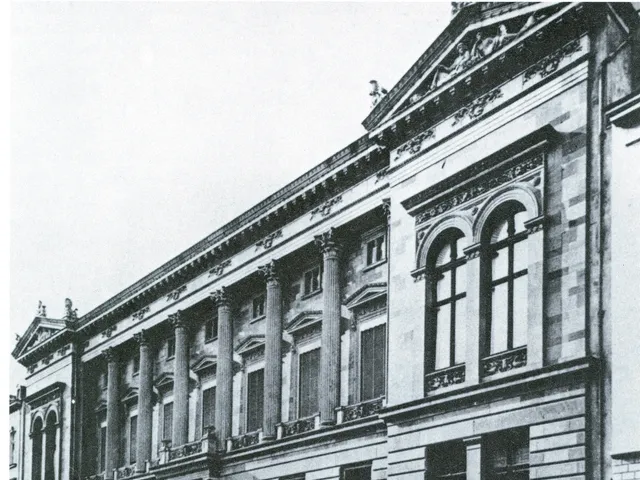
Cologne's grand Neo-Renaissance theatre of 1872 for drama and operetta, lost to bombing in 1943.
The building on Glockengasse continued a long line of Cologne playhouses, several of whose predecessors had been destroyed by fire.
Source: Wikipedia
At a Glance
- Type
- Municipal theatre, later drama theatre
- Location
- Glockengasse, Altstadt-Nord, Innenstadt district
- Opened
- 1 September 1872
- End
- Destroyed on 29 June 1943 during World War II
Before the Stadttheater in der Glockengasse opened in 1872, its predecessor building had burned down twice within just a few decades – in 1869 the entire family of the theater's cashier, who lived on site, even died in the fire.
Earlier History
In 1782, civic captain Franz Kaspar Rhodius commissioned Cologne's first permanent playhouse, built by city architect Dechen on what was then Schmierstraße—today's Komödienstraße. Falling into disrepair, it was demolished in 1828, and a replacement opened the very next year. After that building burned down in 1859, it was rebuilt, only for another fire to destroy it in 1869—a blaze in which the cashier Backhaus and his family, who lived on the premises, lost their lives.
New Building and Architecture
A competition held in 1869, in which Cologne architect Hermann Otto Pflaume also took part, laid the groundwork for the new theatre. From 1870, city architect Julius Carl Raschdorff's designs were realised in Neo-Renaissance style. Sources classify the building as an "educational municipal theatre"—a multipurpose venue for opera, operetta, ballet, and drama.
Two Municipal Stages
In 1898, the city council voted for an additional stage on Habsburgerring, with Berlin architect Carl Moritz winning the corresponding competition. His Neo-Baroque building, complete with restaurant and garden terrace, was completed in 1902. Both venues initially operated jointly as the "Vereinigte Stadttheater" (United Municipal Theatres); from the 1906/07 season they were known separately as the Opera House and the Playhouse, both under the direction of Julius Hofmann (1840–1910). From 1872 to 1906, the Glockengasse building served as the municipal theatre, and thereafter as a playhouse for drama and operetta.
Timeline
- 1782First permanent Cologne playhouse built on Schmierstraße
- 1828Dilapidated building demolished
- 1829First performance in the successor building
- 1859Theatre burns down and is rebuilt
- 1869Theatre destroyed by fire again; competition for new building
- 1872Opening of the Stadttheater in der Glockengasse on 1 September
- 1902New playhouse at Habsburger Ring completed
- 1943Building destroyed on 29 June by bombing
Map
Blue dots: other places nearby — tap to explore.
You might also like — related or nearby
Comments
- Loading comments…
Sources & links
Auto-generated, last verified: 2026-09-10
How this page is made
This page draws on open sources — Wikipedia, Wikidata, official websites and the city’s open data. Every statement is checked against the sources linked here, and pages are refreshed regularly.
Spotted a mistake anyway? Tell us below — we read every submission.