Max-Bruch-Straße 8
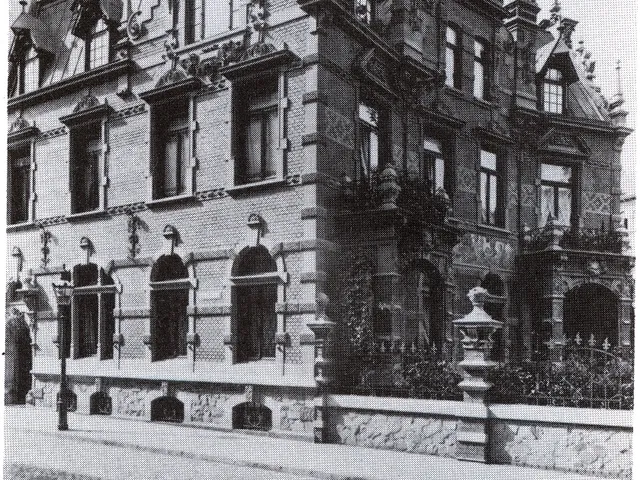
Half of the double villa built around 1910 by Konrad Adenauer and Max Berndorff – later an NSV nurses' home and NRW state service flats.
Together with house no. 6 immediately to the south, the building forms an ensemble. It is one of the few fragments of Lindenthal's villa architecture that survived the heavy wartime destruction.
Source: Wikipedia
At a Glance
- Type
- Semi-detached villa, one half of a double house
- Location
- East side of Max-Bruch-Straße, Cologne-Lindenthal
- Built
- around 1910
- Clients
- Konrad Adenauer and Max Berndorff
- Later use
- NSV nurses' home; after 1945 three state-owned service apartments
- Status
- Listed building
The semi-detached villa was built in 1909/1910 by Konrad Adenauer, then First Deputy Mayor of Cologne, together with Max Berndorff, who succeeded Adenauer in 1912 at just 34 as Cologne's youngest deputy mayor. Later, regional president Franz-Josef Antwerpes lived there from 1980, and his rent sparked a lengthy legal dispute in 1998.
A Neighbourhood by the Stadtwald
The Stadtwald was laid out between 1895 and 1898. In the following years the villa districts around it grew to their greatest extent before the First World War. Max-Bruch-Straße and Brahmsstraße were among the last extensions before the war began. The building land came largely from the former Kitschburg estate and the Hohenlind manor estate, which belonged to the banking family von Stein.
Two Clients from the City Administration
In 1909/1910 Adenauer and Berndorff bought two adjacent plots of about 1,100 m² each and had a double villa built on them. Adenauer could afford this only after his election as First Deputy Mayor (Erster Beigeordneter) on 22 July 1909, when the city council raised his annual salary of 15,000 marks by 3,000 marks. Berndorff, a lawyer born in Cologne in 1878, had worked for the city as a court assessor since 1908. He owned his half, no. 8, for only a few years. On 12 September 1912 he succeeded Adenauer as deputy mayor at 34, the youngest the city had had, and after 1914 he moved to Theresienstraße 16.
The Goldstein Family and the Sale
Before 1918 the Jewish merchant Moritz Goldstein bought the house. After his death in 1934, when the new regime's first restrictions on Jews were already having a lasting effect, his widow Sophie moved in with her son Kurt at Aachener Straße 392/394. The house initially stood empty. The lawyer Moritz Weinberg, administrator of the heirs, may have arranged the contact with the Westdeutsche Bodenkreditanstalt, which probably acquired the house in 1936. The bank rented it to Lieutenant General Fritz Kühne, who had taken command of the 26th Infantry Division on 7 March 1936.
From Nurses' Home to State Property
At the start of the Second World War the house apparently passed into the ownership of the National Socialist People's Welfare organisation (NSV), which set up a nurses' home there. After the NSV was banned by Allied Control Council Law No. 2 of 10 October 1945, its property was confiscated. The State of North Rhine-Westphalia took over as legal successor and owner. It converted the house into three service apartments for senior civil servants from state agencies, including ministries, the university and the Cologne District Government.
Postwar Residents
In the early 1950s the residents included a widow, Felix Schwering, a senior ministry official (Ministerialdirigent), and his wife, as well as Felix Elieser Shinnar, head of the Israel Mission in Cologne. The address books up to 1966, however, list only Maria Schwering and the senior physician Prof. Hans Heinrich Wieck. The neurologist Gert Huffmann followed later, and from 1980 District President (Regierungspräsident) Franz-Josef Antwerpes lived on the ground floor, an apartment of about 170 m² with a 600 m² garden. In 1998 a legal dispute arose over whether his rent was in line with the market, and the state put the property up for sale. Nothing is known about its use after 1998.
Timeline
- 1909/1910Adenauer and Berndorff acquire plots and have a double villa built
- um 1910Construction of the semi-detached villa Max-Bruch-Straße 8
- vor 1918Merchant Moritz Goldstein acquires the house half
- 1934Moritz Goldstein dies; widow moves out, house initially vacant
- 1936Westdeutsche Bodenkreditanstalt presumably buys the house, rents to Fritz Kühne
- 1939House apparently passes to the NSV, used as nurses' home
- 1945NSV banned, property confiscated; State of NRW becomes owner, three official apartments
- 1998Legal dispute over Antwerpes' rent; state offers property for sale
Map
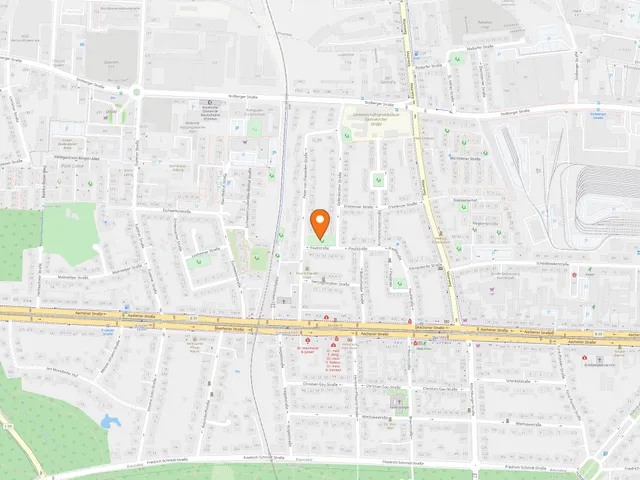
Blue dots: other places nearby — tap to explore.
You might also like — related or nearby
Comments
- Loading comments…
Sources & links
Auto-generated, last verified: 2026-11-08
How this page is made
This page draws on open sources — Wikipedia, Wikidata, official websites and the city’s open data — plus basic place data and photos from Google Maps where a place is listed there. Every statement is checked against the sources linked here, and pages are refreshed regularly.
Spotted a mistake anyway? Tell us below — we read every submission.