Maternushaus
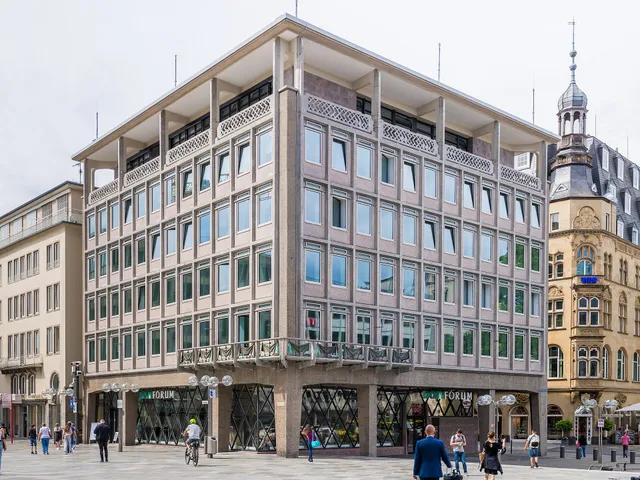
Conference centre of the Archdiocese of Cologne in the old town, built from 1978 to 1983 to a design by Hans Schilling and Peter Kulka.
The Maternushaus is the conference centre of the Archdiocese of Cologne, set in the old town just a few minutes' walk from the cathedral and the main station.
At a Glance
- Location
- Cologne old town, Kardinal-Frings-Straße 1–3 (bounded by Victoriastraße, Auf dem Hunnenrücken and Tunisstraße)
- Built
- 1978 to 1983
- Architects
- Hans Schilling and Peter Kulka
- Operator
- Archdiocese of Cologne
- Capacity
- largest hall (Maternussaal) up to 500 people
- Use
- conference centre with attached hotel
- Award
- Cologne Architecture Prize 1985
- Website
- erzbistum-koeln.de
History
From 1864 to 1978 the St. Vincent Hospital stood on this site. Its seven-storey nurses' residence was preserved and incorporated into the new building as a hotel wing. The house is named after Maternus, who by tradition was the first bishop of Cologne. Opposite, at the corner of Kardinal-Frings-Straße and Gereonstraße, stands the present-day seat of the archbishop.
Architecture
The central location beside the busy north–south trunk road posed a particular challenge: noise-sensitive rooms were placed towards the quieter Kardinal-Frings-Straße, while the functional areas – catering, book stacks and the almost windowless, octagonal Maternussaal – face the Tunisstraße. The building steps back in terraces over three storeys and opens in a semicircle towards the former archiepiscopal park. Classic materials were used: brick for the walls, marble for the floors, timber for the ceilings, and red tile and lead for the roof. The architects deliberately avoided any reference to historical styles.
Chapel and Japanese Garden
Beside the main entrance on the rising forecourt lies the house chapel, framed by a Japanese garden (designed by Jom Suzuki) – a nod to the partner diocese of Tokyo. The altar of the Marian chapel comes from the Herl chapel near Haus Herl in the Buchheim district.
Good to Know
The top of the Maternussaal is crowned by a large sphere bearing a weathervane in the shape of an ox (by artist Paul Nagel). It alludes to Thomas Aquinas, who studied in Cologne and, for his silence paired with the force of his words, earned the nickname "the dumb ox of Aquino". A two-storey public underground car park lies directly beneath the building, entered from the street Auf dem Hunnenrücken.
Use Today
Beyond conferences and its hotel, the building has housed the Archiepiscopal Diocesan and Cathedral Library – one of the largest of its kind – since its completion in 1983, along with the archdiocese's media centre and offices of the archiepiscopal vicariate general.
Gallery
Map
Blue dots: other places nearby — tap to explore.
Address
Kardinal-Frings-Straße 1-3
50668 Köln
You might also like — related or nearby
Comments
- Loading comments…
Sources & links
- Official website
- Wikidata (retrieved 2026-08-11)
- Wikipedia (retrieved 2026-08-11)
Auto-generated, last verified: 2026-08-11
How this page is made
This page draws on open sources — Wikipedia, Wikidata, official websites and the city’s open data. Every statement is checked against the sources linked here, and pages are refreshed regularly.
Spotted a mistake anyway? Tell us below — we read every submission.