Königin Luise School
Cologne's first municipal secondary school for girls, founded in 1871. Today a Gymnasium with a remembrance programme and 34 Stolpersteine at its entrance.
The school has carried its name since 1907, in honour of Queen Louise of Prussia, born Louise of Mecklenburg-Strelitz (1776–1810).
At a Glance
- Type
- Municipal Gymnasium (G9) with open all-day programme, three classes per year group
- Location
- Alte Wallgasse 10, Altstadt-Nord (Innenstadt district), near Ehrenstraße / Friesenplatz
- Main building
- Architect Peter Friedrich Schneider, listed since 1989
- Profile
- Certified "STEM-friendly school" since 2019
- Languages
- English, French, Latin, Spanish from upper school
- Remembrance
- 34 Stolpersteine since 2018
The main building of the Königin-Luise-Schule was built in 1959 on a former Roman burial ground and has been a listed monument since 1989; its staircase was designed by the artist Georg Meistermann.
From Girls' School to Gymnasium
The Höhere Töchterschule was a municipal institution and therefore not tied to any denomination. It originally included a Lyzeum. Over time, further departments were added: a teacher training college, elementary classes, a women's school for training technical teachers, and a kindergarten. After the Prussian reform of girls' education in 1908, an Oberlyzeum followed in 1913, where women could now also take the Abitur. In the 1970s the school became a co-educational Gymnasium.
War and a New Beginning
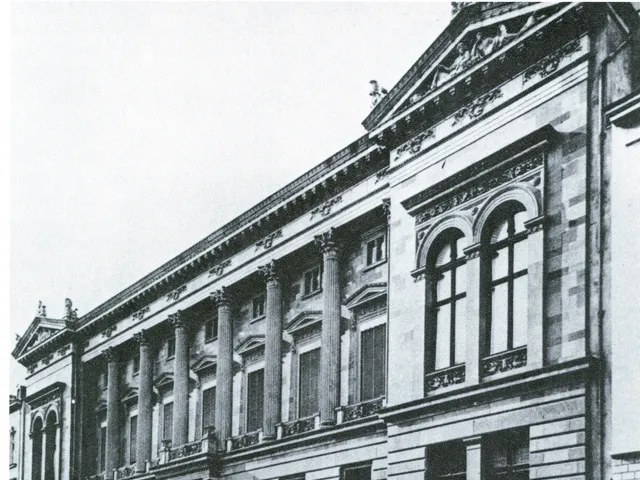
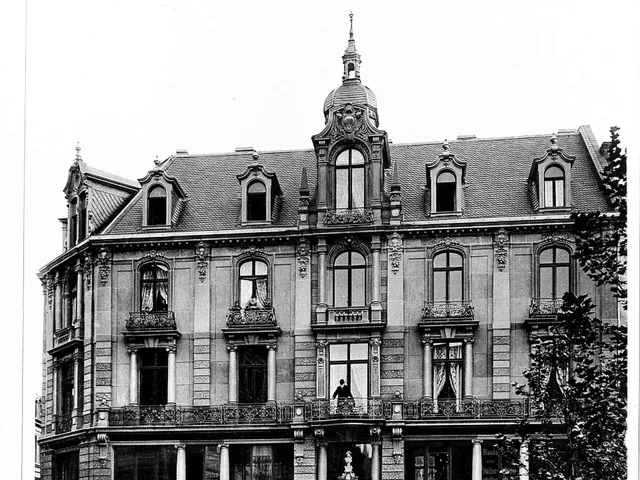
From 1876 until the Second World War, the school was housed on St.-Apern-Straße. It was damaged on 29 June 1943, and lessons were moved to the neighbouring building of the former Jewish reform Realgymnasium Jawne. In July 1944, around 250 pupils were evacuated to the seaside resort of Bansin on Usedom. In the post-war years the school was based on Nußbaumer Straße in Neuehrenfeld. The buildings on St.-Apern-Straße were only partly destroyed and their façades had survived almost intact, yet they were demolished.
The Building on Alte Wallgasse
The current main building opened on 4 September 1959. It lies roughly 300 metres from the old site, between Alte Wallgasse and Albertusstraße, and stands on a former Roman burial ground. A striking feature is the staircase designed by Georg Meistermann. According to the school, the old building has been fully renovated.
Remembering Persecuted Pupils
At least 400 Jewish girls and women attended the school or worked here as teachers since its founding. At Easter 1938, the last 13 Jewish pupils were expelled. As part of a remembrance programme, students research their school's history in courses and projects. Since 2018, a total of 34 Stolpersteine have been laid in front of the school entrance at Palmstraße 1. Of the 34 people commemorated, 13 were murdered in the Holocaust. A memorial book presents their biographies.
The School Today
The school takes part in competitions such as Jugend forscht, the Mathematical Olympiad and a robotics contest. Pupils can earn language certificates such as DELF, CAE and CertiLingua. Exchange programmes exist with the UK, France, the USA and Mexico. The school cooperates with partners including WDR, the DLR, the University of Cologne, the NS-DOK and the Historical Archive of the City of Cologne. It belongs to the "School without Racism – School with Courage" network and regularly takes part in Cologne's Schull- un Veedelszöch carnival processions.
Timeline
- 1871Founded as Cologne's first municipal higher girls' school
- 1874Teacher training institute for women established
- 1876School building on St.-Apern-Straße occupied
- 1907Named after Queen Louise
- 1913Upper lyceum established, enabling women to take the Abitur
- 1943Building damaged on 29 June; classes moved to the Jawne building
- 1959Current school building on Alte Wallgasse opened
- 1970erConverted into a co-educational Gymnasium
Gallery
Map
Blue dots: other places nearby — tap to explore.
You might also like — related or nearby
Comments
- Loading comments…
Sources & links
- Official website (retrieved 2026-11-08)
- Wikidata (retrieved 2026-11-08)
- Wikipedia (retrieved 2026-11-08, rev 264601798)
Auto-generated, last verified: 2026-11-08
How this page is made
This page draws on open sources — Wikipedia, Wikidata, official websites and the city’s open data — plus basic place data and photos from Google Maps where a place is listed there. Every statement is checked against the sources linked here, and pages are refreshed regularly.
Spotted a mistake anyway? Tell us below — we read every submission.