Kaufhaus Isay
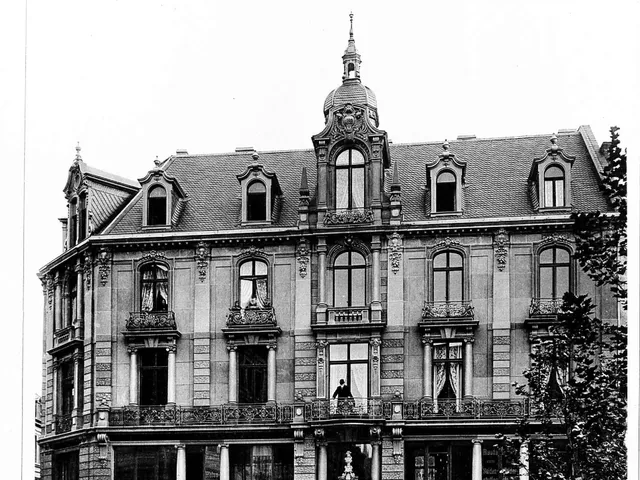
Listed early-20th-century office and commercial building in Cologne, built 1911–1913 by Helbig & Klöckner for textile wholesaler Gebrüder Isay.
The building rose as part of a broader redevelopment of a former military site, where Cologne, under city planning officer Carl Rehorst, laid out the new Zeppelinstraße.
Source: Wikipedia
At a Glance
- Type
- Former office and commercial building, listed monument
- Location
- Zeppelinstraße 4–8, corner of Am Alten Posthof 3, Altstadt-Nord district
- Construction
- 1911 to 1913
- Architects
- Cologne firm Helbig & Klöckner
- Client
- Gebrüder Isay company
- Layout
- Four full storeys, nine bays facing Zeppelinstraße, seven bays along Am Alten Posthof
After the Nazi seizure of power, the Jewish-owned firm Gebrüder Isay was forcibly sold below value in 1933 — to none other than Isay's own former personal secretary, Ludwig Mengel.
The Building
From several preliminary designs, the clients chose a scheme with four full storeys. The hipped roof carries four gables on the longer side and three on the shorter one. The main entrance sits centrally on Zeppelinstraße, with a secondary entrance at the far left on Am Alten Posthof. Architects Rolf Helbig, Albert Klöckner and Oskar Rosendahl worked on the design, and the building was ready for occupancy on 1 April 1913.
The Gebrüder Isay Company
Founded in 1871 as a wholesale business for cloth, wool and knitted goods, Gebrüder Isay acquired the corner plot and had the commercial and office building constructed. Besides the textile wholesaler itself, the building housed other firms and offices, including a bank branch, a corsetry shop and a branch of the Telefunken wireless telegraphy company.
Changing Ownership
In 1933 the Nazis forced the conversion of the general partnership into Wistri Gesellschaft für deutsche Wirk- und Strickwaren GmbH, selling the company below its value. In 1941 ownership of the site and building passed to four new owners. The building suffered comparatively minor damage in the Second World War, and operations resumed once the roof structure had been rebuilt.
Surroundings
Along the newly laid-out Zeppelinstraße, commercial buildings by various architects sprang up on both sides, including the Schwerthof by Jacob Koerfer, the Olivandenhof by Hermann Eberhard Pflaume, and the Haus Reifenberg by Paul Bonatz, the last of which stands directly opposite Kaufhaus Isay.
Timeline
- 1871Founding of the Gebrüder Isay company as a wholesale trader in cloth, wool and knitted goods.
- 1910City of Cologne acquires the site; old buildings demolished under city planner Carl Rehorst.
- 1911Construction of the Kaufhaus Isay begins, designed by Helbig & Klöckner.
- 1913The commercial and office building becomes ready for occupancy on April 1.
- 1930Address book lists Adolph and Alfred Isay as owners.
- 1933Gebrüder Isay converted into Wistri GmbH following the Nazi takeover.
- 1938Renamed WISTRI Mengel, Ritter & Co.; 16 firms based in the building.
- 1941Property ownership transferred to four new owners.
Gallery
Map
Blue dots: other places nearby — tap to explore.
You might also like — related or nearby
Comments
- Loading comments…
Sources & links
Auto-generated, last verified: 2026-09-12
How this page is made
This page draws on open sources — Wikipedia, Wikidata, official websites and the city’s open data. Every statement is checked against the sources linked here, and pages are refreshed regularly.
Spotted a mistake anyway? Tell us below — we read every submission.