Bahnhof Köln Eifeltor
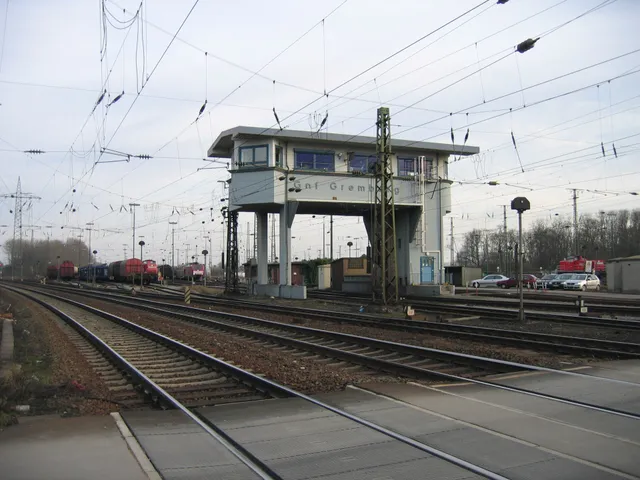
Cologne freight station with the highest transshipment volume in Germany: containers and entire truck trailers switch here between rail and road.
What began in 1968 with a single gantry crane next to an existing freight yard grew over several expansion phases into a terminal handling more than 4,000 trains a year.
Source: Wikipedia
At a Glance
- Type
- Freight station with a transshipment terminal for combined rail–road transport
- Location
- Cologne, Rondorf district (Rodenkirchen borough), on the left-bank Rhine line
- Container terminal opened
- 26 February 1969
- Throughput
- over 300,000 transshipments per year
- Traffic
- more than 26 pairs of trains daily
- Expansion
- officially opened in 2012, an investment of 47 million euros
- Road access
- its own Köln-Eifeltor junction on the A4 motorway
In July 1999, the first container train carrying the German federal government's relocation goods left Köln Eifeltor and arrived in Berlin the next day, so part of the government's move from Bonn rolled out via this station.
A Hub for Containers
Cologne Eifeltor handles more transshipments than any other station in Germany. In 2005, the station was home to the country's largest container terminal for combined transport. Before the 2012 expansion, its 274,000 annual transshipments accounted for 20% of German combined transport, placing the facility third in Europe. About two-thirds of the containers are stored on site before being loaded. The container terminal in the nearby Knapsack Chemical Park serves as a satellite terminal.
Early Days and Growth
At the start, the terminal had a special crane for large containers weighing up to 30 tonnes. Trucks still reached the site by a two-kilometre detour, which also ran through Cologne's Green Belt. Soon, entire trucks were also loaded onto low-loader wagons and carried overnight to a destination station as a "Rolling Highway"; couchette cars travelled along for the drivers. Between 1990 and 1992, the first two crane modules with six crane systems were built. In July 1999, the first container train carrying the federal government's relocation goods left Köln Eifeltor for Berlin.
Expansion from 2011
As the facility reached its limits, it was expanded from mid-2011, largely with funds from the Economic Stimulus Package II. Four additional tracks and two gantry cranes with a 46-metre span raised total capacity to roughly 380,000 loading units. With more than 4,000 trains a year, the terminal is the second largest in the Deutsche Bahn network after Hamburg. A new four-lane road, the B51n, is planned to link directly to the A553 motorway near Brühl; ground was broken on 24 January 2020.
Destinations and Other Uses
Numerous private rail freight companies also use the station, for example on routes to Hamburg, to Kiel with onward travel to Scandinavia, or to the Port of Rotterdam. The longest journeys are made by tank trains heading to the chemical zone at the mouth of the Rhône. SBB Cargo Deutschland and other railway undertakings shunt tank wagons and other freight cars here. SBB Cargo Deutschland and DB Cargo also maintain a locomotive driver base with its own buildings; the station is also used for crew changes and for stabling locomotives.
Timeline
- 1968Construction of the container terminal begins with a gantry crane
- 1969Container Terminal Köln Eifeltor opens on 26 February
- 1990–1992First two crane modules expanded with 6 cranes
- 1999In July, first container train with federal government relocation goods departs for Berlin
- 2011Expansion begins with four additional tracks and two gantry cranes (€47m)
- 2012Expanded facility officially opened on 23 November
- 2020Groundbreaking for the new B51n road on 24 January
Gallery
Map
Blue dots: other places nearby — tap to explore.
You might also like — related or nearby
Comments
- Loading comments…
Sources & links
Auto-generated, last verified: 2026-11-08
How this page is made
This page draws on open sources — Wikipedia, Wikidata, official websites and the city’s open data — plus basic place data and photos from Google Maps where a place is listed there. Every statement is checked against the sources linked here, and pages are refreshed regularly.
Spotted a mistake anyway? Tell us below — we read every submission.