Römerturm
The best-preserved tower of Cologne's Roman city wall, built around 50 AD and decorated on its outer face with an elaborate mosaic of natural stones.
In the heart of Cologne's Altstadt-Nord stands the Römerturm, a Roman watchtower of the ancient city fortification. It is considered the best-preserved part of the once nearly four-kilometre-long Roman city wall.
At a Glance
- Address
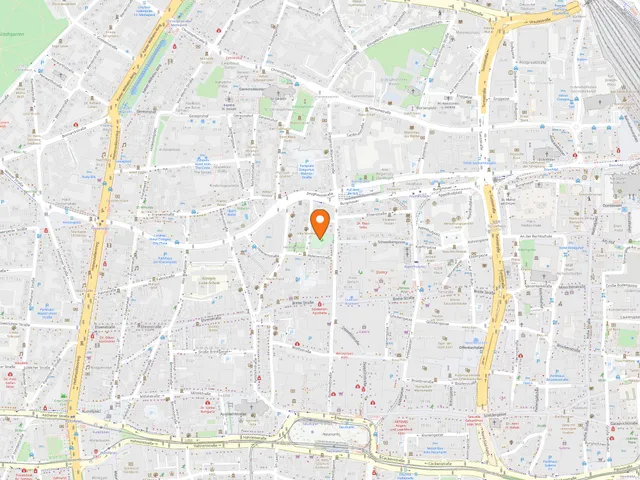
- Zeughausstraße 13, Cologne city centre
- Built
- around 50 AD
- Height
- about 5.50 metres
- Diameter
- roughly 9.20 metres
- Highlight
- ornamental natural-stone mosaic on the field side
- Heritage protection
- since 1980
- Location
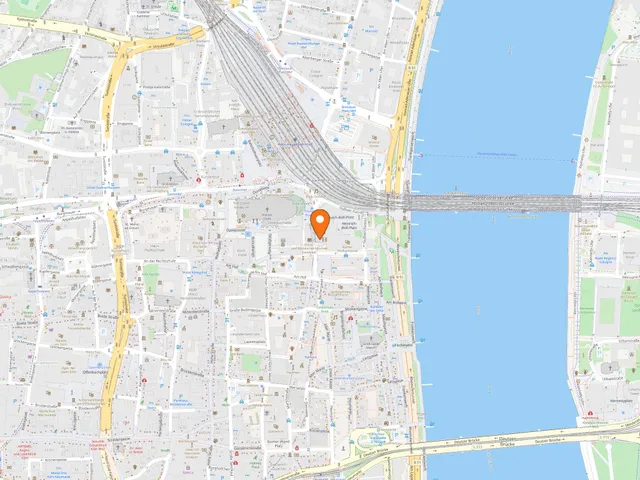
- approx. 200 m from Appellhofplatz underground station, approx. 500 m from the cathedral
History
Shortly after Cologne was elevated to the Roman colony Colonia Claudia Ara Agrippinensium, the Romans began building a new city wall furnished with 19 towers and nine gates. The Römerturm is the north-west tower of this complex and was erected around 50 AD. The decorations in its upper section probably date only from the 3rd century.
From 1304, the Poor Clares' convent of Sankt Clara was built at the height of the tower, founded by Countess Richardis von Jülich. The convent's residents used the tower as a latrine, and it has since been known as the "Clarenturm". Between 1246 and 1805 it belonged to the Cologne cathedral canons; from 1806 it passed into changing private ownership and was again called Römerturm.
Preservation and Alterations
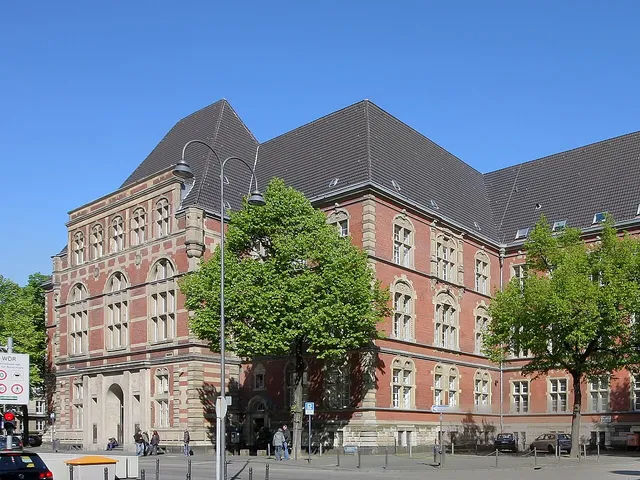
In 1833 the tower was given a superstructure that did not match its historical form, clearly visible in an 1836 watercolour by Georg Osterwald. In 1873 the City of Cologne bought the tower for 19,000 Taler to prevent privatisation and a threatened demolition, and had it restored. When an adjoining neo-Gothic building was erected in 1898/1899 (architect Carl Moritz, seat of the cathedral building administration from 1904 to 1948), the topmost zone with its visible battlements was added. Heritage-listed since 1980, the tower is today once again in private ownership.
Architecture
Striking is the rich ornamental decoration made of various stones: white limestone, red sandstone, grey trachyte and dark greywacke. The mosaic-like facing differs between the lower and upper parts of the tower; the upper zone apparently arose only after a destruction. As a corner tower, its outward-facing wall is markedly thicker at 2.5 metres than the part facing the city at 1.25 metres. The tower is topped by a crown of battlements.
Restoration
In early 2020 a bulge between the wall shell and the core masonry was detected on the north side and initially secured with tension cables, netting and weights. Between August and November 2022 the structurally critical spot was anchored; the cavity was in places up to 16 centimetres wide. A full restoration is planned next.
Good to Know
About 100 metres to the south stands the ruin of the plain Helenenturm, another tower of the Roman fortification. Cologne's surviving Roman towers also include the Lysolphturm near St. Maria ad Ortum and the Ubiermonument, the so-called "harbour tower".
Gallery
Map
Blue dots: other places nearby — tap to explore.
Address
Zeughausstraße 13
Köln
Contact
You might also like — related or nearby
Comments
- Loading comments…
Sources & links
- Official website
- Official website (retrieved 2026-07-09)
- Wikidata (retrieved 2026-07-09)
- Wikipedia (retrieved 2026-07-09, rev 266594263)
Auto-generated, last verified: 2026-07-09
How this page is made
This page draws on open sources — Wikipedia, Wikidata, official websites and the city’s open data. Every statement is checked against the sources linked here, and pages are refreshed regularly.
Spotted a mistake anyway? Tell us below — we read every submission.