Marian Column Cologne
A neo-Gothic Marian monument from 1858 on the Gereonsdriesch in Altstadt-Nord that looks like „a piece of the cathedral“.
since 1858
Tucked away on the Gereonsdriesch, a small green square close to the Romanesque church of St. Gereon, stands Cologne's Marian Column – one of the oldest Marian monuments in the Rhineland. Completed in 1858, the slender neo-Gothic pier carries a blessing figure of Mary at its top and looks almost like a fragment lifted straight from the cathedral.
At a Glance
- Type
- Marian column / monument of Marian devotion
- Style
- Neo-Gothic
- Material
- Udelfangen sandstone
- Height
- 13.50 m (the figure of Mary alone 2.67 m)
- Completed
- May 1858, inaugurated in September 1858
- Architect
- Vincenz Statz
- Location
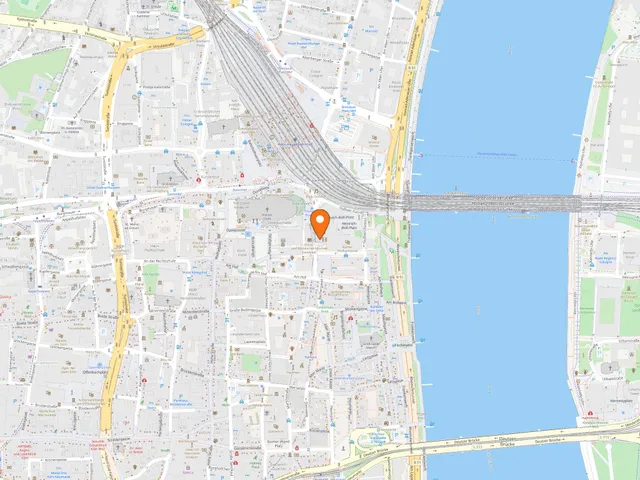
- Gereonsdriesch, Altstadt-Nord, near St. Gereon
- Access
- freely accessible in public space
Age comparison
Age compared with other places in Cologne.
How It Came About
The impulse came from the dogma of the Immaculate Conception, proclaimed by Pope Pius IX in 1854, which sparked a wave of Marian devotion in many places. As early as April 1855, a Cologne association was founded with the aim of erecting a statue of Maria Immaculata.
A Contested Symbol
The plan was far from universally welcomed: newspaper appeals called it „impractical“, and building a hospital was floated as an alternative. At the same time the Prussian city administration was planning an equestrian monument for King Friedrich Wilhelm III – so Cologne found itself with a classicist monument to a ruler on one side and a Gothic Marian column on the other, the secular protector facing the city's religious guardian.
A Column That Moved
The association had hoped to place the column on the Alter Markt opposite the town hall, but the administration refused. Instead it went up on the central strip of Gereonstraße in front of the archbishop's palace. Some 25,000 people attended the laying of the foundation stone on 2 June 1857. When the tram network was expanded in the early 20th century, the column had to make way for the tracks and was relocated in 1901 to its present spot on the Gereonsdriesch – which is why its original east side now faces north.
The Design in Detail
On a polygonal ground plan rise three storeys that merge into one another. The lowest opens into a tabernacle and is flanked by three coats of arms – those of Pope Pius IX, the city of Cologne and Archbishop Johannes von Geissel. Above, four ornate niches hold seated prophets, among them Ezekiel and Jeremiah with scrolls in hand. Over baldachins, pinnacles and a wreath of winged angel heads stands the Immaculata, a serpent and a crescent moon at her feet, hands spread in blessing and her head ringed by a metal halo of stars. A wrought-iron fence, renewed in the 1980s after the old model, surrounds the monument.
Artists and Funding
The overall design is by Vincenz Statz, though individual parts came from other hands: the prophets were carved by cathedral sculptor Peter Fuchs after drawings by Eduard Jakob von Steinle, who also designed the figure of Mary – executed by sculptor Gottfried Renn. Cologne craftsmen paid for the prophets, Marian sodalities for the figure of Mary, and the local locksmiths' guild donated the railing.
Gallery
Map
Blue dots: other places nearby — tap to explore.
Address
Gereonsdriesch
Köln
Hours
So: 00:00–24:00
You might also like — related or nearby
Comments
- Loading comments…
Sources & links
Auto-generated, last verified: 2026-08-16
How this page is made
This page draws on open sources — Wikipedia, Wikidata, official websites and the city’s open data. Every statement is checked against the sources linked here, and pages are refreshed regularly.
Spotted a mistake anyway? Tell us below — we read every submission.