Mülheim am Rhein Synagogue
Two successive Jewish houses of worship on Mülheimer Freiheit; the last was destroyed in 1938, and today only a memorial plaque remains.
The Mülheim am Rhein Synagogue refers to two successive Jewish houses of worship on Mülheimer Freiheit in what is today the Cologne district of Mülheim. The last building was destroyed in 1938; a multi-family house now stands on the site, marked by a memorial plaque.
Source: Wikipedia
At a Glance
- Location
- Mülheimer Freiheit, Cologne-Mülheim
- First synagogue
- house of prayer, before 1770 until 1784
- Second synagogue
- dedicated in 1788 or 1789, designed by master builder Wilhelm Hellwig
- Destroyed
- in the early morning of 10 November 1938 (November pogroms)
- Present state
- ruins removed in 1956, now a multi-family house
- Remembrance
- memorial plaque at Mülheimer Freiheit 78
- Community
- small rural congregation, peak of about 310 members (1929)
The First Synagogue and the Flood of 1784
A small Jewish rural congregation probably formed in Mülheim in the mid-17th century. An early house of prayer stood before 1770 in the house of Simon Cain at what is today Mülheimer Freiheit No. 5 and was known locally as „the synagogue.“ In February 1784 a flood destroyed the building: after a sudden rise in temperature, ice floes piled up on the Rhine and the river reached a record level of 13.55 metres. Twenty-one people in Mülheim drowned and about two-thirds of the houses were destroyed. Ritual objects and furnishings were lost; the Amsterdam congregation sent a new Torah scroll to Mülheim.
The New Building of 1788/89 and the Community
The Mülheim scholar Elieser Cain donated a narrow plot on the Freiheit that was safe from flooding. In 1788 or 1789 a new building designed by Wilhelm Hellwig was dedicated there. Only a rear-courtyard synagogue was permitted, so a residential and community house was placed in front of it. The synagogue had a men's section with 17 benches and a women's section with four wall benches; an inventory from 1851 lists seven Torah scrolls. The very small congregation never had its own rabbi; religious duties were carried out by teachers and cantors. The independent Mülheim synagogue congregation was founded in 1865, and by 1929 it numbered around 310 members. After Mülheim was incorporated into Cologne in 1914 it continued for a time, but joined the Cologne community amid the growing antisemitism of the 1920s. The community house also held the Jewish school and a residence.
Destruction in 1938
During the November pogroms the synagogue was set on fire in the early morning hours of 10 November 1938 and largely destroyed. The congregation's archive has been considered lost ever since. In the course of the „Aryanization“ of Jewish property, the plot with the ruin was sold on 7 August 1942; the residential house built there was destroyed by bombing in 1944. The teachers Leopold Vogel and Israel Janowski, who taught in Mülheim into the 1930s, perished with their families in Majdanek and Theresienstadt.
Remembrance Today
After the Nazi era, the re-established Cologne synagogue community applied in 1948 for restitution of the plot, which was granted by court order in 1954. The remaining ruins were removed in the summer of 1956, and a multi-family house was built on the site of the former community house. A memorial plaque at Mülheimer Freiheit 78 marks the location, bearing the inscription: „Im Hause Mülheimer Freiheit 78 befand sich bis 1938 die Mülheimer Synagoge. Sie wurde ebenso wie die kleine Religionsschule für jüdische Mülheimer Kinder am 9.11.1938 zerstört.“ (In the house at Mülheimer Freiheit 78 stood the Mülheim synagogue until 1938. Like the small religious school for Jewish children of Mülheim, it was destroyed on 9 November 1938.) The community's deceased members were buried at the Jewish Cemetery Cologne-Mülheim.
Map
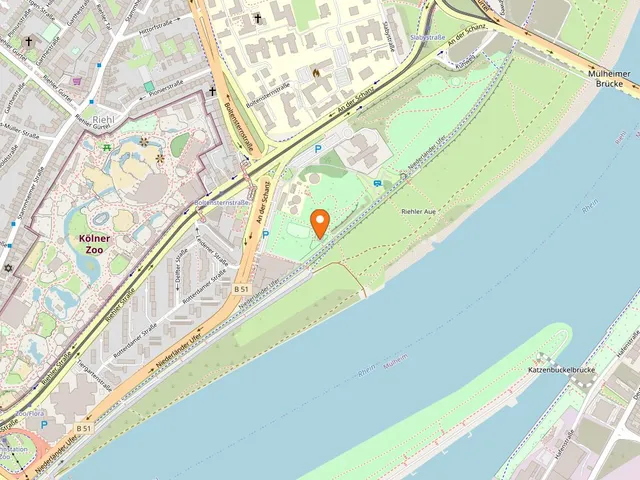
Blue dots: other places nearby — tap to explore.
Address
Mülheimer Freiheit 78
51063 Köln
You might also like — related or nearby
Comments
- Loading comments…
Sources & links
Auto-generated, last verified: 2026-08-13
How this page is made
This page draws on open sources — Wikipedia, Wikidata, official websites and the city’s open data. Every statement is checked against the sources linked here, and pages are refreshed regularly.
Spotted a mistake anyway? Tell us below — we read every submission.