Kulturbunker Köln-Mülheim (Cultural Bunker)
A WWII air-raid bunker on Berliner Straße that today serves as a listed cultural centre in Cologne-Mülheim.
On Berliner Straße in Cologne-Mülheim, on the right bank of the Rhine, stands a massive concrete block with an unusual past: the Kulturbunker is a former air-raid shelter that today is home to the neighbourhood's art and culture.
At a Glance
- Type
- Former WWII high-rise bunker, now a cultural centre
- Location
- Berliner Straße, Cologne-Mülheim (right bank of the Rhine)
- Architect
- Hans Schumacher (a Cologne architect)
- Built
- 1942/43, or 1944 according to other sources
- Heritage listing
- Protected since 1 July 1980 (monument no. 635)
- Usable area
- around 1,710 m² across five floors
- Operator
- Kulturbunker Köln-Mülheim e.V. (non-profit association)
- Cultural use
- since 1991
Built During the Second World War
The bunker was designed by Cologne architect Hans Schumacher – deliberately in the shape of a church, which is why such structures are also called "church bunkers". It was built in the early 1940s under inhumane conditions: forced labourers, prisoners of war and concentration-camp inmates were used for its construction. With a total usable area of around 1,710 m², it was meant to offer short-term shelter to as many as 2,845 people – just 0.6 m² per person. During an alarm, all five floors were fully occupied. Two of the levels held around 80 cells fitted with bunk beds; these were assigned by fixed reservation, so those seeking shelter effectively "rented" a spot.
From Dance Hall to Vacancy
After the war, the bunker took on a second, almost cheerful life: for about ten years it operated as a guesthouse, "Hotel Zapp", complete with a dance hall. Since many of Mülheim's meeting places had been destroyed in air raids, the building became one of the few spots where public and cultural life could take root again – from carnival and marksmen's festivals to theatre and dancing. In the 1960s it served as a storeroom, after which it stood largely empty for more than two decades. It remained the property of the Federal Republic of Germany and was still dedicated to civil defence.
Saved by the "Mülheimer Frechheit"
When the Stern cinema on Clevischer Ring closed in 1985, the cultural initiative "Mülheimer Frechheit" came together. Many refused to watch one of the district's last cultural venues disappear – especially since right-bank Mülheim then had almost no cultural spaces or offerings. The association "Zentrum für Arbeit und Kultur e.V." eventually proposed the bunker at the Berliner Straße marketplace. In 1987 the district council instructed the city to negotiate a usage agreement with the association. With the founding of the operating association "Kulturbunker Mülheim e.V." (today "Kulturbunker Köln-Mülheim e.V."), the concrete structure was extensively renovated. In 1990 the building was formally released from civil-defence duty.
Today: A Cultural Centre for the Neighbourhood
Since 1991 the non-profit association has run the Kulturbunker. Its aim is to promote Mülheim's art and culture and to bring together people of different social backgrounds, nationalities and ages. The programme includes exhibitions, theatre performances, readings and seminars. The building also provides studio, music-rehearsal and seminar rooms, which are rented out to artists and musicians. The work is supported by the City of Cologne's cultural office (Kulturamt).
Map
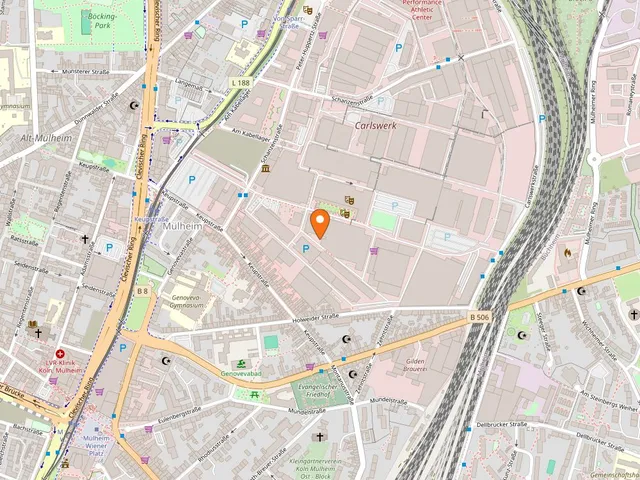
Blue dots: other places nearby — tap to explore.
Address
Berliner Straße
Köln
You might also like — related or nearby
Comments
- Loading comments…
Sources & links
- Official website
- Wikidata (retrieved 2026-07-21)
- Wikipedia (retrieved 2026-07-21)
Auto-generated, last verified: 2026-07-21
How this page is made
This page draws on open sources — Wikipedia, Wikidata, official websites and the city’s open data. Every statement is checked against the sources linked here, and pages are refreshed regularly.
Spotted a mistake anyway? Tell us below — we read every submission.