Katholischer Friedhof Köln-Mülheim
One of the oldest surviving cemeteries in Cologne, with a 13th-century chapel and still in use for burials today.
The Old Catholic Cemetery on Sonderburger Straße in the right-bank district of Mülheim is among the oldest cemeteries preserved as such within the Cologne city area. It is still managed by the Catholic parish of St. Clemens und Mauritius and remains in use for burials.
At a Glance
- Location
- Sonderburger Straße, Mülheim district (right bank of the Rhine)
- Operator
- Catholic parish of St. Clemens und Mauritius
- Origin
- probably 13th century or earlier
- Oldest grave
- dated 1841 (Keup family)
- Chapel
- Alt St. Mauritius, built in the 13th century
- Heritage status
- cemetery and chapel listed since 1989
- Use
- still active for burials today
History
The exact year the cemetery was founded is not documented. But because the surviving cemetery chapel of Alt St. Mauritius was built in the 13th century, and church and churchyard usually formed a single unit in the Middle Ages, it is assumed that burials took place here as early as the 13th century or before. Those laid to rest were members of the St. Mauritius parish living in Mülheim and neighbouring Buchheim, today likewise part of Cologne. No details survive from the period up to the 18th century, and none of the very earliest graves remain – the oldest verifiable one dates from 1841.
When the Duchy of Berg, which included Mülheim, was occupied by French revolutionary troops in the late 18th century, the Napoleonic burial laws came into force in 1804. These banned burials inside towns and required existing inner-town burial grounds to be relocated – the same reason that led to the founding of Cologne's Melaten Cemetery at the time. The St. Mauritius parish resisted the demanded relocation, arguing that neither the funds nor suitable land were available. Since the Berg administration did not press its demand forcefully, the parish avoided the obligation for decades. The matter was finally settled in 1865, when a Prussian decree confirmed churchyards as parish property wherever ownership had been long and undisputed.
Temporary Closure
In the 20th century operations were briefly suspended: in 1904 the city of Cologne laid out the municipal Mülheimer Friedhof nearby and soon afterwards allowed only burials in existing family graves at the St. Mauritius cemetery. Much of the churchyard fell into neglect over the following decades. In the 1930s the city and parish negotiated over a partial sale and the conversion of the land into a green space; the talks dragged on until the city abandoned its plans after the war began. Only in 1955 did the parish part with a no-longer-needed section, selling it to a Redemptorist community seeking land for a monastery. A new burial ordinance in the 1970s secured its continued existence as a Catholic parish cemetery, and unrestricted burials have taken place there ever since. The cemetery was enlarged several times (1844, 1870 and 1970); in 1982 and 1992 the parish bought back portions of the previously sold land.
Notable Graves
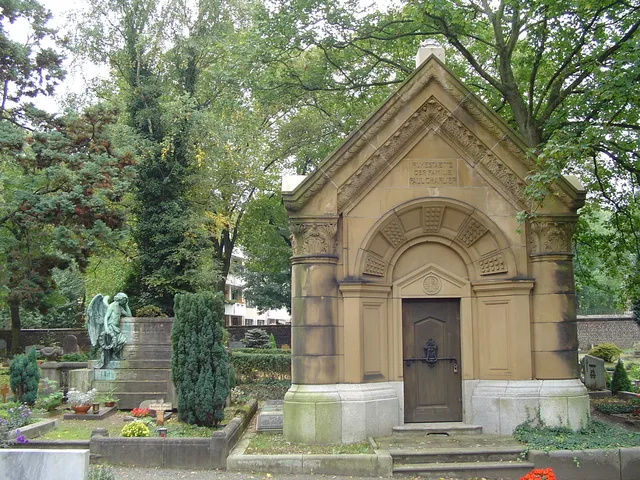
The oldest datable headstone, from 1841, belongs to the grave of the Keup family, who once donated a hospital to the parish and after whom Mülheim's Keupstraße is named. Also striking is the 1868 monument of landowner Ludwig Köhler – a stele with an angel figure and reliefs, at the same time the tallest grave marker in the churchyard. The oldest section, with numerous and sometimes elaborate 19th-century headstones, lies on a rise around the chapel and near the entrance gate on Sonderburger Straße.
Map
Blue dots: other places nearby — tap to explore.
Address
Sonderburger Str. 1 A
51065 Köln
Hours
Mo: 08:00–19:00
Di: 08:00–19:00
Mi: 08:00–19:00
Do: 08:00–19:00
Fr: 08:00–19:00
Sa: 08:00–19:00
So: 08:00–19:00
Contact
You might also like — related or nearby
Comments
- Loading comments…
Sources & links
- Official website
- Official website (retrieved 2026-08-07)
- Wikidata (retrieved 2026-08-06)
- Wikipedia (retrieved 2026-08-06, rev 212501204)
Auto-generated, last verified: 2026-08-06
How this page is made
This page draws on open sources — Wikipedia, Wikidata, official websites and the city’s open data. Every statement is checked against the sources linked here, and pages are refreshed regularly.
Spotted a mistake anyway? Tell us below — we read every submission.