Jeremiahaus
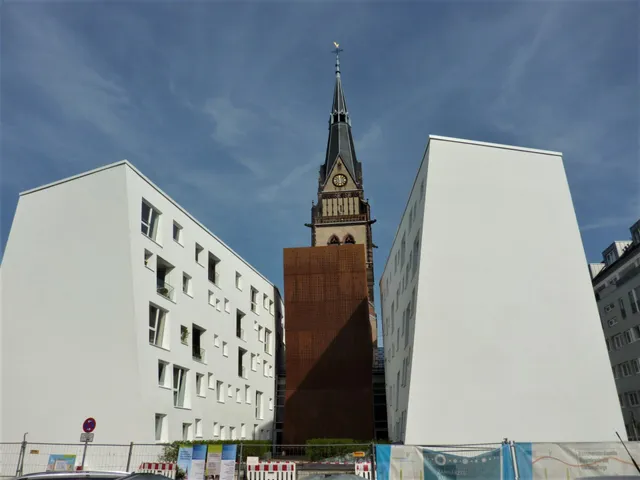
Protestant church center whose street-facing façade looked just like an ordinary 1960s brick apartment building, hiding a sanctuary behind.
Its unassuming appearance made the Jeremiahaus a quiet fixture of the Composers' Quarter for over four decades. When it was deconsecrated in 2006, it marked the first church closure in the history of its parish.
Source: Wikipedia
At a Glance
- Type
- Community center with integrated sanctuary
- Operator
- Evangelical Congregation of Cologne
- Location
- Mozartstraße 15, Composers' Quarter, western edge of the city center
- Foundation laid
- 22 December 1963
- Dedicated
- 6 December 1964 (Second Sunday of Advent)
- Namesake
- the prophet Jeremiah
- Deconsecrated
- Sunday of the Dead (Totensonntag), 2006
- Notable feature
- bilingual services held by the Finnish congregation
Architecture
From the street, the building looked like an ordinary 1960s brick apartment block. Only a small bell tower, a display case, and a cross hinted at its religious purpose. The sanctuary itself faced the garden at the rear, hidden from passersby. After the Thomaskirche (1968), the Jeremiahaus was the second-youngest place of worship in the Cologne-Innenstadt district, which once counted seven Protestant churches.
From Old House to New Building
Since the 1930s, the congregation had owned a rental building at Mozartstraße 15 that served as a pastor's residence; it was badly damaged in the war and lost its upper floor. Afterward it housed the bombed-out Friedrich-Wilhelm-Gymnasium as emergency shelter until 1956, and later held community rooms and staff apartments. When renovation plans proved unworkable, the presbytery decided in January 1962 to demolish the "Old House" and rebuild. Construction began in November 1962, with pastor Wolfram Buisman—known for his long-running book "Du und die Religion"—among the planners.
Community Life
The center saw lively activity across all age groups, with youth work so vibrant it occasionally drew neighbors' noise complaints. Martin Kahle served as choir director and organist from 1974 to 1981, and a 1991 playgroup for toddlers grew into the still-active initiative "Die Mozartkugeln e. V." Since the Finnish Evangelical Lutheran Congregation of Cologne—once the second-largest of its kind in Germany—had no church of its own, it held its services here.
Closure
Friedrich Karl Weber served as pastor from the 1980s until the congregation dissolved in 2006. Facing financial pressure, the presbytery voted in 2005 to close both the Jeremiahaus and the nearby Kreuzkirche, reasoning that parting with a building not immediately recognizable as a church would be easier. The deconsecration service took place in late November 2006, when city superintendent Rolf Domning extinguished the candles for the last time.
Gallery
Map
Blue dots: other places nearby — tap to explore.
You might also like — related or nearby
Comments
- Loading comments…
Sources & links
Auto-generated, last verified: 2026-08-30
How this page is made
This page draws on open sources — Wikipedia, Wikidata, official websites and the city’s open data. Every statement is checked against the sources linked here, and pages are refreshed regularly.
Spotted a mistake anyway? Tell us below — we read every submission.