Lindenallee 51
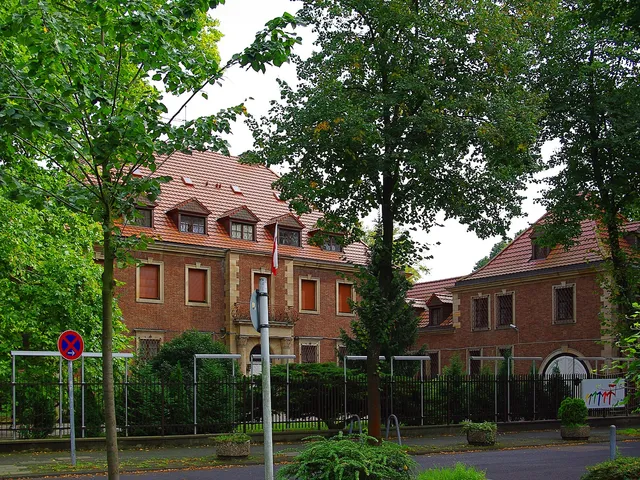
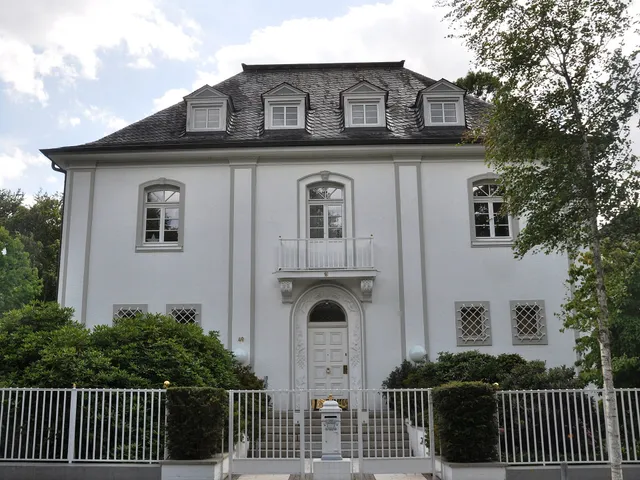
Late Baroque-style "palace" from 1927/28, probably the last Historicist building in Cologne, later home to the Japanese ambassador.
The design of this villa was inspired by numerous art treasures that the tobacco manufacturer Hermann Neuerburg had acquired as salvaged architectural fragments. The house is part of the Köln-Marienburg villa colony.
Source: Wikipedia
At a Glance
- Type
- Villa, listed building
- Location
- Marienburg district, Rodenkirchen borough
- Built
- 1927/28
- Client
- Hermann Neuerburg (1890–1937), tobacco manufacturer
- Architect
- Emil Felix
- Style
- Historicism, designed as a "palace" in the Late Baroque style
- Heritage register
- listed on 13 August 1991
The villa, built in 1927/28, is considered probably the last Historicist building in Cologne and was designed around numerous art treasures acquired as spolia; its east façade even bears an epitaph from 1569.
A Late Work of Historicism
Emil Felix had already completed several building projects for the Neuerburg family before this design. The villa, conceived as a Late Baroque-style "palace," was probably the last Historicist building in Cologne. Wolfgang Wallner carried out the sculptural work and Carl Wyland the wrought ironwork. At the same time, a matching chauffeur's and garage building (Lindenallee 80) was built on the opposite side of the street to plans by Felix. A garden house was added in 1931.
Architecture and Interior
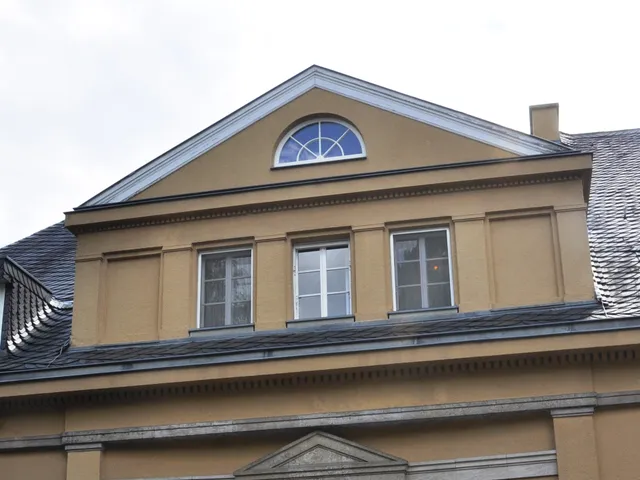
The plastered main building has two storeys, three including the mansard level. A single-storey service wing, which originally housed the kitchen and staff rooms, adjoins it. Reddish sandstone and white wooden window frames define the exterior. Two wrought-iron gates separate the property from the street, while to the south it sits within an extensive park. Inside, a large, wood-paneled promenade hall with a Renaissance-style stucco ceiling forms the centerpiece. The former study on the street side is designed in Gothic forms with tracery. An original Rococo stair balustrade, reworked by Carl Wyland, is part of the original furnishings. An epitaph dating from 1569 is set into the east façade.
War and Restoration
During the Second World War, the villa served as a branch site of the Cologne University of Music. War damage hit the roof severely and the main staircase partially. From 1946, the house was refurbished for the university, and it was finally restored in 1950/51 for the British occupying forces. The hipped roof dates from that time. The colonnade that had connected the fountain courtyard, a "Tuscan Renaissance arcaded courtyard," with the garden pavilion was removed then.
Changing Occupants
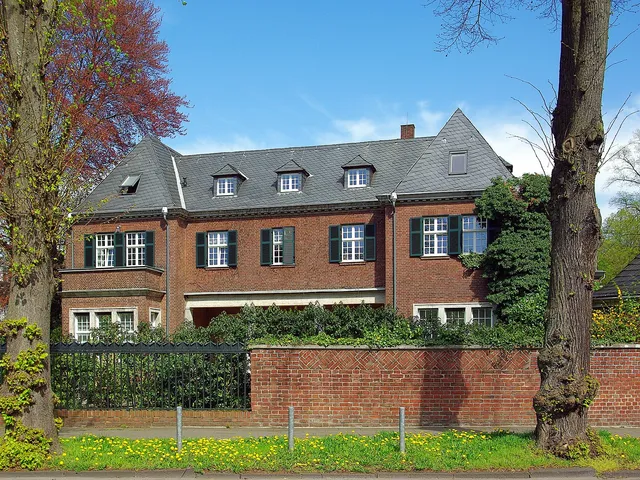
From 1962 to 1973, the villa was the residence of the Japanese ambassador to the Federal Republic of Germany, whose government seat was in Bonn. The detached house at Lindenallee 49 in the garden area belonged to it as well. Afterwards, the Wema Institute for Empirical Social Research, Informatics and Applied Cybernetics was based here. Following its insolvency in the late 1970s, the furniture of the villa, which then had 25 rooms, was seized.
Timeline
- 1927/28Villa built for Hermann Neuerburg to a design by Emil Felix
- 1931Garden house added by Emil Felix; plot No. 49 split off
- 1946War-damaged villa restored for the Cologne University of Music
- 1949Villa at Lindenallee 49 replaced by a single-family house
- 1950/51Final restoration for the British occupation forces
- 1962–1973Residence of the Japanese ambassador to West Germany
- Ende der 1970erWema Institute insolvency; furnishings seized
- 1991Listed in the Cologne heritage register (13 August)
Map
Blue dots: other places nearby — tap to explore.
You might also like — related or nearby
Comments
- Loading comments…
Sources & links
Auto-generated, last verified: 2026-11-11
How this page is made
This page draws on open sources — Wikipedia, Wikidata, official websites and the city’s open data — plus basic place data and photos from Google Maps where a place is listed there. Every statement is checked against the sources linked here, and pages are refreshed regularly.
Spotted a mistake anyway? Tell us below — we read every submission.