Mülheimer Schiffbrücke
Floating timber bridge on some 40 anchored pontoons (1888–1927), with an opening section for river traffic, that replaced the Rhine ferry crossing at Mülheim.
From 1888 to 1927, the Mülheimer Schiffbrücke spanned the Rhine at Mülheim, replacing a long-standing ferry crossing between Mülheim and the Mülheimer Häuschen hamlet of Longerich. It lay roughly 200 metres south of today's Mülheimer Brücke.
Source: Wikipedia
At a Glance
- Type
- Floating wooden bridge on around 40 pontoons anchored in the Rhine
- Location
- Mülheim, approx. 200 m south of today's Mülheimer Brücke
- Width
- 12 metres
- In operation
- 29 May 1888 – 20 June 1927
- Origin
- Purchased second-hand from Mainz in 1885
- Total investment
- 185,000 Marks (~€1.7 million today)
- Distinctive feature
- One bridge section swung open on a schedule to allow ship traffic through
The used pontoon bridge was purchased from Mainz in 1885 for 45,000 marks – but the transport costs alone amounted to 120,000 marks, nearly three times the purchase price. On its very first day of operation, it was severely damaged by a passing ship.
Ferry Crossings Before the Bridge
This slightly elevated, flood-protected bank north of the Strunde estuary had long been a convergence point for regional roads. In 1265, Count Adolf built a fortification here; in 1268, the Cistercian monks of Altenberg Abbey acquired the right to operate a ferry to the Electorate of Cologne's bank. Around 1700 the right passed to the House of Berg, which ran a current-driven reaction ferry (Gierponte). That service ended in 1844 and was replaced by rowboats until 1872, then by a wire-rope ferry until 1887 — whose vessels are said to be the origin of the nickname "Mülheimer Böötche."
Purchase and Operation
On 7 May 1885, the city of Mülheim bought the second-hand pontoon bridge from Mainz for 45,000 Marks. Transporting it to its new site cost a further 120,000 Marks; electrical connections, anchoring the sections, and dredging a navigation channel added another 85,000 Marks, bringing the total to 185,000 Marks — roughly €1.7 million in today's money. The bridge was positioned at Buchheimer Straße, leading to Wiener Platz. Smoking was banned on the twelve-metre-wide crossing due to fire risk, and a toll of four Pfennig was charged per crossing. On its very first day, a passing ship caused serious damage to the structure. The city ran the bridge itself until 1912, when operator Richard Majewski took over the lease.
End of the Pontoon Bridge
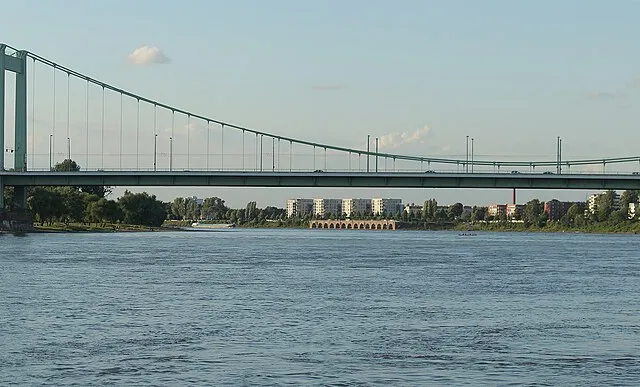
The ageing bridge could no longer keep pace with early-twentieth-century traffic and was repeatedly closed by ice drift or flooding. As early as 1913, Cologne had pledged to build a permanent bridge as part of the annexation negotiations. After closure and dismantling, the Mülheimer Hängebrücke followed in October 1929 — at its opening, it was considered the largest suspension bridge in the world.
Timeline
- 1268Cistercian monks receive right to operate first Rhine ferry at Mülheim
- um 1700House of Berg leases a flying-bridge (Gierponte) operation for 400 Reichsthaler/year
- 1844End of the Gierponte; ferryboats take over until 1872
- 1872Mülheim introduces cable ferry (operated until 1887)
- 7. Mai 1885City of Mülheim purchases a used pontoon bridge from Mainz for 45,000 Mark
- 29. Mai 1888Pontoon bridge opens to traffic
- 1912Lessee Richard Majewski takes over operation of the pontoon bridge
- 20. Juni 1927Old pontoon bridge is closed and dismantled
Map
Blue dots: other places nearby — tap to explore.
You might also like




Comments
- Loading comments…
Sources & links
Auto-generated, last verified: 2026-06-26