Takuplatz
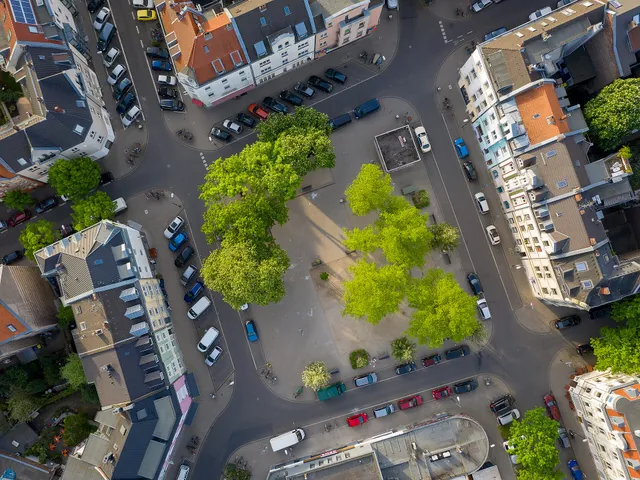
Triangular square in Neuehrenfeld's "Chinese Quarter" — the centre serves as a pétanque court on a former tram turning loop.
Takuplatz in Cologne's Neuehrenfeld neighbourhood forms the heart of a residential area known colloquially as the "Chinese-Veedel" (Chinese Quarter). The centre of the square today serves as a playing area for pétanque.
At a Glance
- Type
- City square with pétanque court
- Location
- Neuehrenfeld district, Ehrenfeld borough
- Shape
- roughly triangular, bounded by Iltisstraße, Takustraße and Takuplatz
- Buildings
- four-storey residential buildings of a housing cooperative, built in the early 20th century
- Named after
- the Chinese Taku Forts
- Highlight
- Station 23 of the Ehrenfeld History Trail ("Ehrenfelder Geschichtspfad")
Beneath Takuplatz a World War II civilian air-raid bunker remains in place to this day, because demolishing the massive concrete structures was deemed too costly — even though the surrounding houses survived the war without destruction. The whole neighbourhood is nicknamed "Chinese-Veedel" (Chinatown) because the square and its streets were named in 1913 after the German assault on China's Taku Forts during the Boxer Rebellion.
Name and the "Chinese Quarter"
The names of Takuplatz and Takustraße — like the nearby Iltisstraße and Lansstraße — refer to the Boxer Rebellion in China in 1900. The gunboat Iltis under Captain Lans took part in the German Navy's assault on the Chinese Taku Forts, giving the area its lasting nickname. The streets were named in 1913, when the Ehrenfeld workers' housing cooperative built the surrounding residential blocks; these now belong to the non-profit Wohnungsgenossenschaft Ehrenfeld e.G. In 1971, local residents founded the carnival club "Ihrefelder Chinese".
Layout and Surroundings
The square's distinctive semicircular form traces back to a disused tram turning loop, still flanked by two rows of old black locust trees; the track itself was removed in February 2008. A windowless utility substation belonging to RheinEnergie and a small kiosk (Büdchen) occupy the square. Since the late 1990s the centre has been laid out for pétanque and is used by the Ehrenfelder Boule Club and the Boulogne Boyz. The first three houses on Takustraße stand out for their elaborate, multicoloured brick facades.
Colonial Legacy Debate
Since late 2009, the street names in the "Chinese Quarter" and other Neuehrenfeld streets linked to German colonial history have been the subject of ongoing debate. On a Green Party initiative, both explanatory plaques and renamings were discussed. In August 2011, a sign was unveiled at Takuplatz explaining the name's history and Germany's colonial policies; the debate resurfaced again in 2020.
The Second World War
During the Second World War, a civilian deep bunker was constructed beneath the centre of the square to protect residents from air raids. Large parts of this concrete structure remain underground today, as demolition proved too costly. Despite heavy bombing of Cologne, the buildings around Takuplatz were damaged but not destroyed. Records from 1942 document that a banned youth group — the Neuehrenfeld Group — met secretly at Takuplatz; clashes with Nazis and arrests by the Gestapo are known to have followed.
Timeline
- 1900Boxer Rebellion in China; German gunboat Iltis attacks the Taku Forts
- 1913Residential buildings around Takuplatz built; square and streets named
- 1942Bündische youth group meets at Takuplatz (banned by National Socialists)
- Ende der 1990erCentre of square laid out as a pétanque/boules area
- 1971Carnival club 'Ihrefelder Chinese' (Ehrenfeld Chinese) founded
- 2008Tram loop track removed (February)
- 2009Debate about colonial street names in Ehrenfeld district council
- 2011New explanatory sign on the history of the name erected at Takuplatz (August)
Map
Blue dots: other places nearby — tap to explore.
Address
Takuplatz
50825 Köln
You might also like — related or nearby
Comments
- Loading comments…
Sources & links
Auto-generated, last verified: 2026-06-27
How this page is made
This page draws on open sources — Wikipedia, Wikidata, official websites and the city’s open data. Every statement is checked against the sources linked here, and pages are refreshed regularly.
Spotted a mistake anyway? Tell us below — we read every submission.