Ehrenfeld Synagogue
A synagogue in Cologne-Ehrenfeld, consecrated in 1927 and destroyed during the 1938 pogrom – a mural and floor markers keep its memory alive.
The Ehrenfeld Synagogue was a Jewish house of worship at Körnerstraße 93 in Cologne's Ehrenfeld district. It stood for just eleven years before being destroyed during the November pogroms of 1938.
Source: Wikipedia
At a Glance
- Location
- Körnerstraße 93, Cologne-Ehrenfeld
- Built
- 1926/27 to designs by architect Robert Stern
- Consecrated
- 18 September 1927
- Construction cost
- around 110,000 Reichsmark
- Capacity
- 250 on the men's ground floor, 150 in the women's gallery
- Destroyed
- 9 November 1938 (November pogroms)
- Today
- no longer standing – memorial traces at the present-day building
History
As industrialisation drove rapid growth in Ehrenfeld during the second half of the 19th century, the district founded its own synagogue congregation in 1899. Made up mostly of workers and clerks, the community could not sustain itself financially and was reincorporated into Cologne's main synagogue congregation in 1914. By the mid-1920s the district's Jewish population had grown to around 1,100 people, prompting plans for a synagogue of its own.
The building site was part of the former Koenemann gold-moulding factory, acquired by the Cologne synagogue congregation in 1926. The foundation stone was laid on 18 October 1926, the dome was raised the following winter, and the synagogue was ceremonially consecrated on 18 September 1927.
Architecture
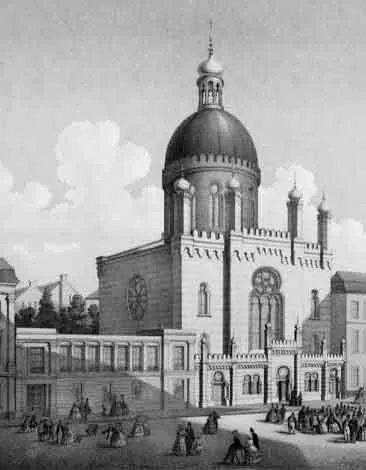
The street-facing front house was preserved and fitted out as the cantor's residence, with the synagogue itself set behind it and reached across a forecourt through a columned portico. The prayer hall had an octagonal plan, seating 250 men on the ground floor and 150 women in the gallery. A tent-shaped dome rose above the octagon, regarded as one of the most remarkable feats of engineering of its time in Cologne. Inside, a symbolic decorative scheme dominated: shades of red that grew lighter towards the apex of the dome, culminating in an eight-pointed red star.
Destruction
As early as the summer of 1938, faced with members leaving and falling into poverty, the congregation tried in vain to sell the buildings to the Catholic Church. On the morning of 9 November 1938 the deliberate destruction began: men first smashed the interior with axes, then set the furnishings in the adjacent house ablaze, and finally the buildings were burned down to their outer walls. The last rabbi, Dr Isidor Caro, died in the Theresienstadt ghetto in 1943.
Remembrance Today
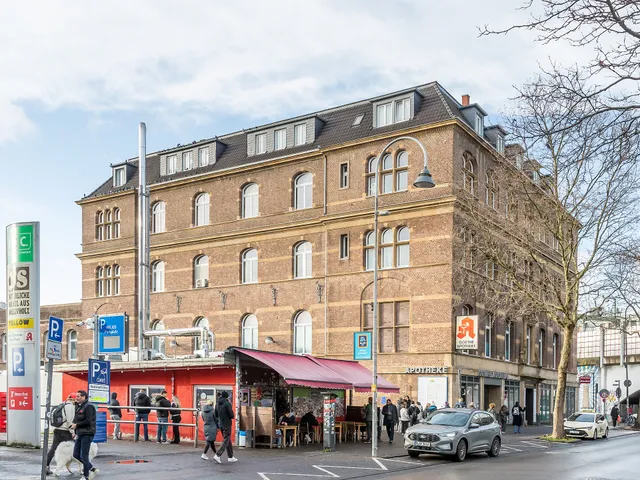
In 1988, 50 years after the destruction, a mural designed by graphic artist Brigitte Schulten was installed on the surviving neighbouring house. When an apartment building with a day-care centre was erected on the site in 1998/99, excavation work uncovered the foundations of both the synagogue and the mikveh. The new building incorporated memorial features, including stones set into the ground that trace the synagogue's floor plan. A local support association also preserves a wooden model of the former synagogue in the nearby Körnerstraße high-rise bunker.
Gallery
Map
Blue dots: other places nearby — tap to explore.
Address
Körnerstraße 93
50823 Köln
You might also like — related or nearby
Comments
- Loading comments…
Sources & links
Auto-generated, last verified: 2026-07-19
How this page is made
This page draws on open sources — Wikipedia, Wikidata, official websites and the city’s open data. Every statement is checked against the sources linked here, and pages are refreshed regularly.
Spotted a mistake anyway? Tell us below — we read every submission.