Kaiser-Wilhelm-Ring 34
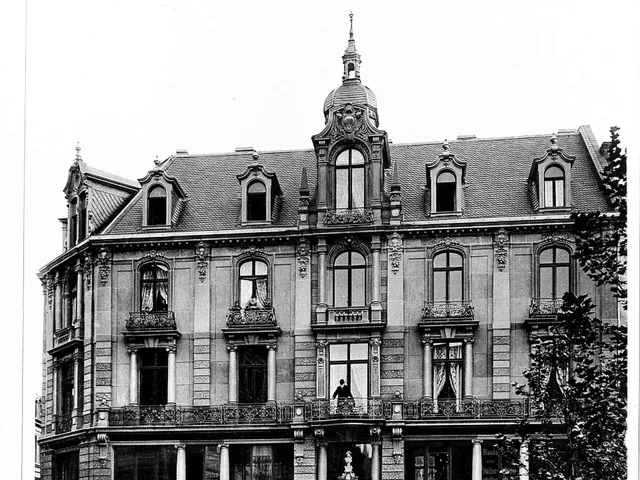
A lost Cologne house from the 1880s, a typical example of how palace-façade motifs were adopted for residential buildings, with a striking centrepiece and figural ornament.
The industrialist Wilhelm Leyendecker commissioned the building. Its façade combined a rusticated base with a striking central section adorned with figural decoration.
Source: Wikipedia
At a Glance
- Type
- former house, no longer standing
- Location
- Kaiser-Wilhelm-Ring 34, Neustadt/Nord, Innenstadt district, Cologne
- Built
- 1883 to 1886
- Design
- architects De Voss & Müller; according to Wikidata, Alfred Müller-Grah
- Façade ornament
- stele-shaped caryatids
The house at Kaiser-Wilhelm-Ring 34 was described as a "characteristic example" of how façade motifs from Cologne's grand buildings like Palais Oppenheim and Palais Mevissen were adopted for residential buildings of all social classes; in the triumphal arch of its central projection, stele-shaped caryatids stood above a pedimented triple window.
Models from Cologne's Palace Architecture
A few of Cologne's grand buildings, including the Palais E. v. Oppenheim and the Palais Mevissen, had façades in the style of the Italian and French Renaissance. In the 1880s, their design motifs were "eagerly adopted". They were transferred to residential buildings across all social classes. The house at Kaiser-Wilhelm-Ring 34 was a characteristic example of this development.
The Façade
The ground floor was rusticated, with windows ending in round arches. On the upper floors, a broad central projection (Mittelrisalit) structured the central axis. A large triumphal arch was set into this projecting bay. At the top, a powerful cornice and a steep, domed hip roof capped the projection. Within the triumphal arch were stele-shaped caryatids, beneath which sat a triple window with a pediment.
Timeline
- 1883–1886House built for Wilhelm Leyendecker, designed by De Voss & Müller
Map
Blue dots: other places nearby — tap to explore.
You might also like — related or nearby
Comments
- Loading comments…
Sources & links
Auto-generated, last verified: 2026-11-05
How this page is made
This page draws on open sources — Wikipedia, Wikidata, official websites and the city’s open data. Every statement is checked against the sources linked here, and pages are refreshed regularly.
Spotted a mistake anyway? Tell us below — we read every submission.