Lindenthaler Kanal
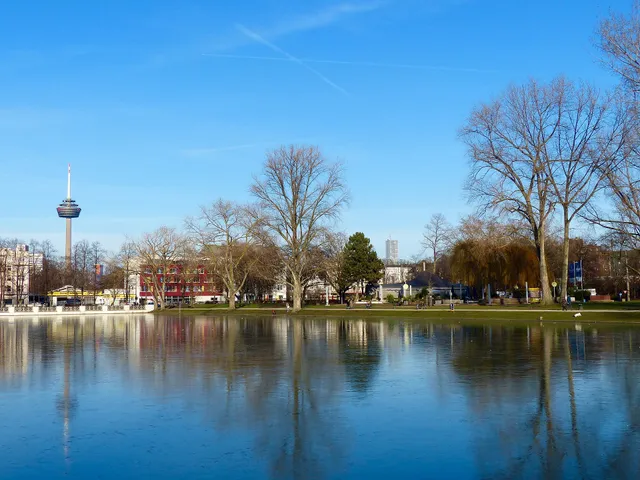
Radial water and green corridor in Lindenthal's green belt, best known for its chestnut avenue, maple-lined canal, and the shell limestone sculptures Centaur and Naiad.
In the Cologne district of Lindenthal, the Lindenthaler Kanal connects the inner and outer green belt as a radial water and green corridor. Two offset sections define the complex: the Clarenbachkanal and the Rautenstrauchkanal.
At a Glance
- Type
- Canal complex with green borders on both sides
- Location
- Lindenthal district, Cologne
- Length
- nearly 600 m
- Design
- 1925 by parks director Fritz Encke
- Sections
- Clarenbachkanal and Rautenstrauchkanal
- Wildlife
- fish, Canada geese, coots, mallards
- For families
- rose garden and sandpit at Karl-Schwering-Platz
According to city planner Fritz Schumacher's own planning notes, the nearly 600-metre-long canal shares almost exactly the same width of around 100 metres as Düsseldorf's famous Königsallee.
Idea and Planning
The complex grew from a desire to draw an attractive green boulevard outward from the densely built-up city. It was based on Fritz Schumacher's master development plan of 1920–1923, who compared the full width of around 100 metres to Düsseldorf's Königsallee. At the far end, where the church stands, the green strip opens out in a cruciform shape.
Clarenbachkanal
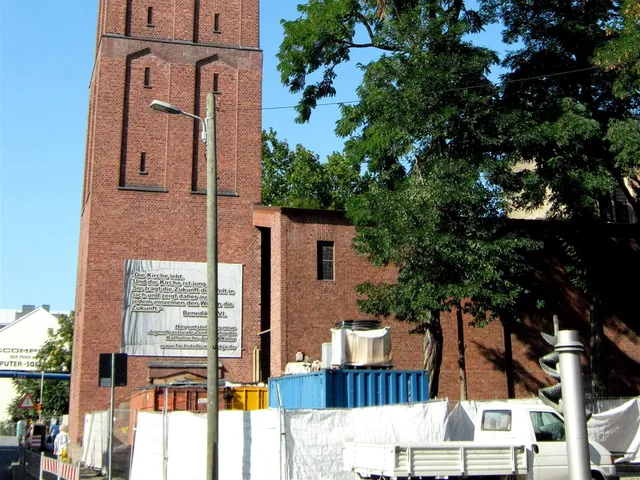
This section continues the east-west axis of the Aachener Weiher and ends at the Church of Christ's Resurrection, designed by Gottfried Böhm. Horse chestnuts planted here from the very beginning have grown into a sweeping, canopied avenue.
Rautenstrauchkanal
A circular water basin flanked by the sculptures Centaur and Naiad marks the entrance at Rautenstrauchstraße. Eduard Schmitz carved the two shell limestone figures in 1930 to designs by Georg Grasegger, each showing a naiad seated on a centaur's back — both figures rooted in Greek Archaic water mythology. The canal, divided into three maple-lined segments, extends to the Stadtwaldgürtel, the gateway to Cologne's city forest.
Renovation
A restoration lasting about a year began in winter 2010, relocating fish and removing several hundred tonnes of silt. The Kölner Grün Stiftung led the project, with the state of North Rhine-Westphalia contributing most of the funding. A fountain added at the Stadtwaldgürtel in 2016 feeds groundwater along the full length of the Clarenbachkanal; the swans that had lived there were moved to Decksteiner Weiher in 2018.
Timeline
- 1920–1923General development plan by Fritz Schumacher as basis for the canal
- 1925Canal design implemented by garden director Fritz Encke
- 1930Sculptures Centaur and Naiad created by Eduard Schmitz after designs by Georg Grasegger
- 2007Rautenstrauch canal section given new path surfaces
- 2010Revitalisation begins: fish removed, ~600 t of silt transported away
- 2016Fountain erected at Stadtwaldgürtel to feed groundwater into the Clarenbach canal
- 2018Swans relocated to Decksteiner Weiher
Map
Blue dots: other places nearby — tap to explore.
Address
Lindenthaler Kanal
50931 Köln
You might also like
Comments
- Loading comments…
Sources & links
Auto-generated, last verified: 2026-06-26