St. Remigius
Neoclassical former parish church in Sürth (1825–1830) blending ancient and medieval forms, preserving baroque furnishings rescued from a demolished Cologne church.
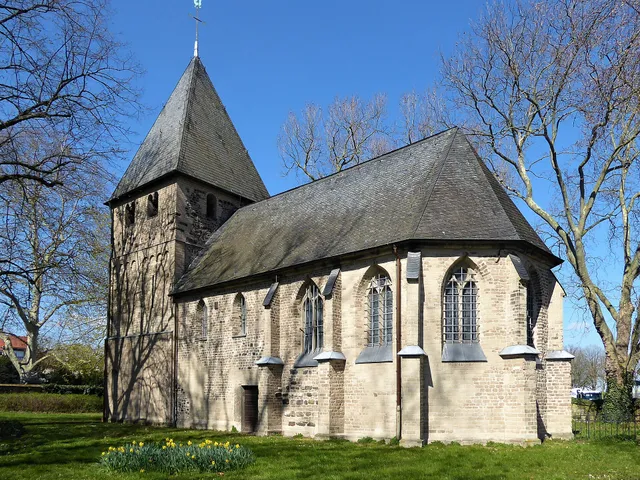
St. Remigius is a former Roman Catholic parish church in the Cologne district of Sürth. The neoclassical building combines ancient and medieval architectural forms and preserves furnishings salvaged from a demolished Cologne baroque church.
Source: Wikipedia
At a Glance
- Type
- former Roman Catholic parish church
- Location
- Sürther Hauptstraße, district of Sürth (borough of Rodenkirchen)
- Architectural style
- Neoclassicism with Gothic and Baroque elements
- Built
- 1825–1830, consecrated 25 July 1830
- Architect
- Johann Josef Baudewin
- Tower
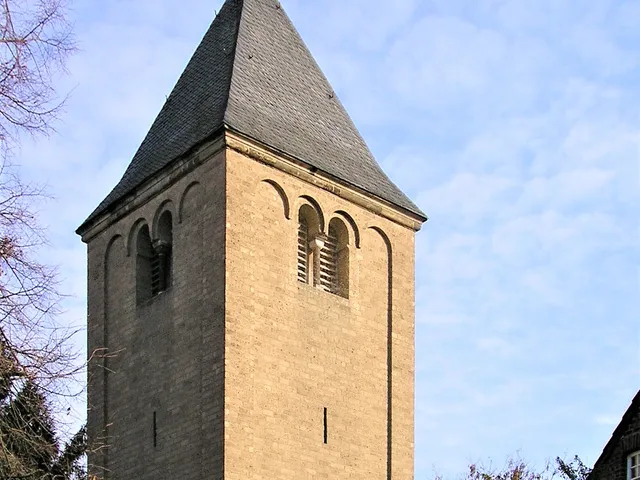
- 31-metre choir tower
- Surroundings
- private park (former churchyard)
- Patronage
- Saint Remigius since 1904
Most of the baroque interior of St. Remigius originally came from another Cologne church: St. Johann Evangelist was demolished in 1829 to expose the cathedral choir, and its pulpit, confessionals, and sculptures were relocated to Sürth.
History
Before the new building, a three-bay Romanesque chapel stood in the Alte Kirchgasse. As the local population grew, Cologne law professor Peter Andreas Breuer and his wife funded a new parish church; the founding couple are commemorated by a cast-iron inscription tablet above the main portal and a memorial sheet in the entrance hall. At the 1830 consecration the church was dedicated to Saints Peter and Andrew, Breuer's name patrons. Following a refurbishment and the addition of the sacristy, a rededication took place in 1904, at which point the church adopted the patronage of Saint Remigius.
Architecture
The façade takes its cue from early Christian basilicas in Italy, contrasting brickwork with white window mullions, blind arcades, and cornices. The building is notable for its stylistic blending: Gothic elements appear in the clerestory windows and bell tower, while the portal features an aedicule and segmental pediment in the Baroque tradition. Flanking the central window, niches hold statues of Saints Peter and Andrew carved by Cologne sculptor Matthias Heiermann between 1999 and 2000.
Interior
Seven sturdy Tuscan columns divide the nave from the aisles and draw the eye towards the altar. Rather than a flat ceiling, segmental-arch ribbed vaults span the central nave, while a seven-pointed star vault singles out the chancel. Light enters through Gothicising clerestory windows and the round windows of the aisles, weaving antique and medieval forms into a coherent whole.
Furnishings
A significant portion of the baroque fittings came from the Cologne church of St. Johann Evangelist, demolished in 1829 to expose the cathedral choir. These include the pulpit, the draught lobby, the confessionals, and sculptures of the Madonna on the crescent moon and of Saint Remigius. The Crucifixion group on the north wall beneath the gallery once served as the high altar in the original church.
Timeline
- 1825–1830New church built by Johann Josef Baudewin
- 25. Juli 1830Consecration, dedicated to Saints Peter and Andrew
- 1829Demolition of St. Johann Evangelist; furnishings transferred to Sürth
- 1901Major renovation, new furnishings, and sacristy extension
- 5. Juli 1904Reconsecration; church receives patronage of Saint Remigius
- 1971Renovation and redesign by architect Hannsjosef Schäfer
- 1998Further renovation with new colour scheme and rearrangement of furnishings
- 1. Januar 2007Parish merged into the Catholic community St. Joseph and Remigius
Gallery
Map
Blue dots: other places nearby — tap to explore.
You might also like
Comments
- Loading comments…
Sources & links
Auto-generated, last verified: 2026-06-27