Nikolaus-Kapelle
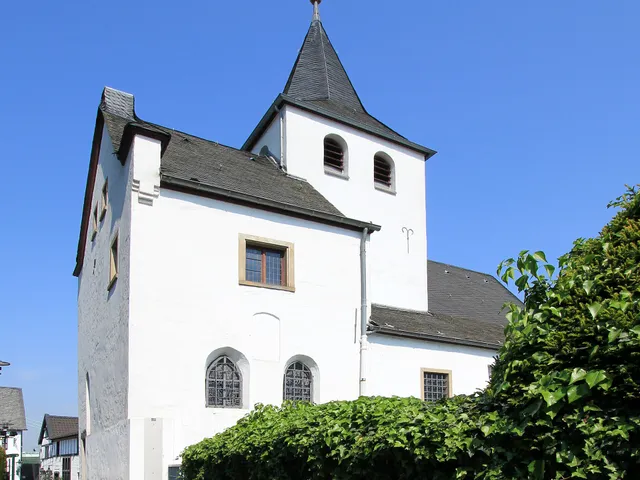
Built around 1100 near the Rhine in Westhoven — Cologne's smallest surviving Romanesque village chapel, enclosed by an ancient churchyard.
In Westhoven, a district not far from the Rhine, stands the Roman Catholic Nikolaus-Kapelle, whose construction dates back to around 1100. Its patron is Nicholas of Myra, protector of sailors and seafarers.
Source: Wikipedia
At a Glance
- Type
- Romanesque hall church, Roman Catholic
- Location
- Westhoven, Porz district
- Footprint
- 8 × 13 m
- Building material
- Tuff, greywacke and Rhine pebbles
- Status
- Listed monument in North Rhine-Westphalia
- Maintained by
- Förderverein Romanische Kirchen Köln
When Cologne's 1259 staple right forced merchants to unload their goods in the city, many simply bypassed it by unloading across the Rhine in Zündorf and carting their wares overland – stopping along the way to have them blessed at the Nikolaus Chapel.
History
Originally the chapel belonged to St. Heribert's Abbey in Deutz, sparing the people of Westhoven the long journey there for services. Burial rights were granted in 1128. When Cologne's monasteries were dissolved during the secularisation of 1802, the tie to Deutz Abbey was severed. Between 1794 and 1814, French occupation forces razed the entire village of Westhoven — but spared the chapel alone to keep the view to the Rhine open.
Bargemen and the Staple Right
Alongside locals, travelling merchants and Rhine bargemen also came to worship here. Their numbers grew after traders found a way around Cologne's staple right, in force since 1259: they unloaded cargo at Zündorf on the right bank, transported it overland to Mülheim, and had their goods blessed at the Nikolaus-Kapelle along the way.
Architecture
The hall church closes to the east with a recessed square chancel. Renovations in the 1960s and 1990s gave the plain, compact masonry — with its few round-arched windows — a coat of white render. A slate saddle roof is crowned by a ridge turret with a pointed cap. Inside, a round arch resting on two impost stones opens into the sanctuary, flanked by Baroque figures of the Virgin Mary and St. Nicholas. The altar table in the chancel is adorned with a carved vine tendril.
Churchyard and Upkeep
The chapel is enclosed by an ancient churchyard, last used for burials in 1929 and restored in 1987. The chapel itself underwent restoration between 1959 and 1964, and again in the 1990s.
Timeline
- um 1100Chapel built, belonged to the Abbey of St. Heribert in Deutz
- 1128Chapel granted burial rights
- 1259Cologne staple right introduced; merchants have goods blessed at the chapel
- 1794–1814French occupying forces demolish Westhoven except for the chapel
- 1802Secularisation: ties to Deutz Abbey dissolved
- 1929Cemetery surrounding the chapel used for the last time
- 1959–1964First comprehensive restoration of the chapel
- 1987Cemetery restored; further chapel restoration in the 1990s
Map
Blue dots: other places nearby — tap to explore.
You might also like
Comments
- Loading comments…
Sources & links
Auto-generated, last verified: 2026-06-26