Cologne-Merkenich Combined Heat and Power Plant
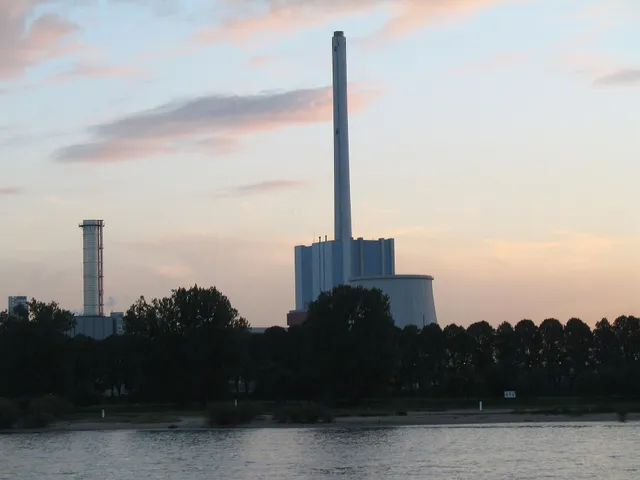
At 250 metres, this power plant's chimney is Cologne's second-tallest structure after the Colonius tower — and the city's primary source of district heating for its northern districts.
The Cologne-Merkenich Combined Heat and Power Plant is a RheinEnergie facility in the Merkenich district and the central producer of district heating for northern Cologne.
Source: Wikipedia
At a Glance
- Type
- Combined heat and power plant operated by RheinEnergie
- Location
- Merkenich district, Chorweiler borough
- Function
- Central district heating supply for northern Cologne
- Electricity
- Grid feed-in via combined heat and power generation
- Staff
- Around 75 employees (as of 2005)
- Access
- Open for guided tours
The 250-metre chimney of the Merkenich power plant – long out of service – is the second-tallest structure in Cologne after the Colonius TV tower, dwarfing even Cologne Cathedral, and ranks among the 100 tallest structures in all of Germany.
The 250-Metre Chimney
The site has three chimneys, the tallest of which stands 250 metres and is now out of service. This makes it Cologne's second-tallest structure after the Colonius TV tower — considerably taller than Cologne Cathedral — and one of the 100 tallest structures in Germany. It was taken out of service in 2004 when Boiler 5 of the original plant was decommissioned.
Heating Northern Cologne
The 75-kilometre "North Network" supplies the districts of Bocklemünd, Chorweiler, and Merkenich with heat. Alongside private households, industrial and commercial customers receive heat, process steam, and deionised water — including the Ford, Deutsche Infineum, and Vinnolit plants in Cologne-Niehl. The electricity generated through combined heat and power is fed into the grid.
History
Construction began in 1956, and the plant came online in 1958 with two boilers, initially supplying neighbouring industry with steam. In 1961, Cologne City Council resolved to provide district heating to the city's north from Merkenich, and the first households received heat from 1962.
Transition Away from Lignite
Boiler 6, commissioned in 1990, burned Rhenish lignite in a circulating fluidised bed combustion system. Lignite firing was discontinued in 2025; heat and power supply will in future be handled by the existing combined-cycle gas turbine plant. A sewage sludge incineration facility is planned for the site by 2029, and the potential addition of a large-scale heat pump is under review. The plant operates almost exclusively in combined heat and power mode, achieving fuel utilisation rates of up to 80 percent.
Criticism
The civic initiative "Tschö RheinEnergie" has criticised the burning of lignite for producing significantly higher emissions of pollutants and CO₂ than natural gas would.
Timeline
- 1956–1958Construction and commissioning with two boilers; steam supply to Esso AG
- 1961–1962City council resolution on district heating for Cologne North; first households supplied
- bis 1969Expansion by three boilers; extension of the Neustadt district heating network
- 1985–1989Major modernisation: blocks 4+5 converted to natural gas/light oil with low-NOx burners
- 1990Blocks 1–3 decommissioned; new brown-coal circulating fluidised-bed boiler 6 commissioned
- 1998–2000Construction and commissioning of the combined-cycle (CCGT) plant replacing boiler 5
- 2010Separation of common-bus plant; blocks 4 and 6 restructured; turbine 3 decommissioned
- 2025Brown-coal firing ceased; CCGT plant takes over heat and electricity supply
Map
Blue dots: other places nearby — tap to explore.
You might also like
Comments
- Loading comments…
Sources & links
Auto-generated, last verified: 2026-06-26