Weiberfastnacht
On the Thursday before Ash Wednesday, women seize power for a day — the Rhineland's exuberant unofficial kickoff to street carnival season.
Weiberfastnacht falls on the Thursday before Ash Wednesday, marking the transition in the Rhineland from the seated carnival season to full street carnival. In Cologne, where the day is called Wieverfastelovend, it signals the official start of the street festivities.
Source: Wikipedia
At a Glance
- Type
- Carnival custom and unofficial public holiday
- Date
- Thursday before Ash Wednesday
- Cologne venue
- Alter Markt, Altstadt-Nord (city centre)
- Start of celebrations
- usually 11:11 a.m.
- Regional names
- Wieverfastelovend (Cologne), Altweiber (Lower Rhine), Fettdonnerstag (Aachen), Schwerdonnerstag (Koblenz)
- Region
- Rhineland, Eifel and Hunsrück
- Core idea
- Women hold power for one day
A German court ruled that cutting off a man's tie at Weiberfastnacht can constitute property damage — unless the wearer was actively participating in the carnival and therefore should have known about this widespread custom.
Idea and History
The tradition of granting women temporary authority dates back to the Middle Ages, when it was seen as a "world turned upside down." In some places the custom grew out of women's guilds (Weiberzechen), where the ruling class entertained women with wine. Evidence suggests that women's carnival originally fell on what is now Ash Wednesday; as carnival shifted, Thursday became the established day in the Rhineland.
Cologne and the Alter Markt
Cologne's Wieverfastelovend evolved in the 18th century from the Mötzenbestot — the boisterous goings-on of market women at the Alter Markt. At the stroke of noon, women would snatch off their bonnets (Mötz) and fling them into the air, often along with cabbages. No longer "under the bonnet," they allowed themselves considerable freedoms. Cologne is widely regarded as the heartland of this tradition.
Customs
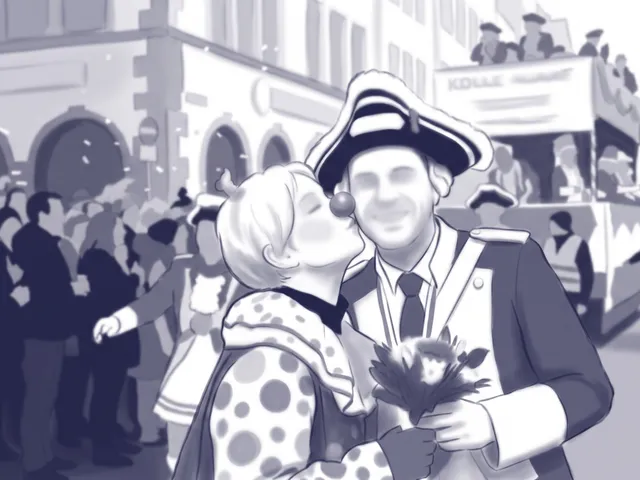
In earlier times women would dress as old women, hand the household over to the men, and celebrate among themselves; from this emerged the Möhnenvereine (women's carnival clubs), whose members later dressed more like 19th-century townswomen. Since the mid-20th century, women have been snipping off men's ties as a symbol of male authority; a Bützchen — a peck on the cheek — follows as compensation. The Essen District Court ruled that cutting a tie without consent constitutes a property offence, though it noted that consent may be presumed when the wearer is visibly taking part in the carnival.
Town Hall Storming and Public Holiday
As early as 1824, washerwomen in the Bonn district of Beuel banded together; to this day, the Beueler Wäscherprinzessin and her committee storm the town hall and symbolically seize power — broadcast live by WDR television. Storming the town hall has since become a firm tradition across many parts of the Rhineland. Throughout the region the day is treated as an unofficial public holiday: work often stops at midday, celebrations in costume spill into pubs and streets, and while full processions are held in only a few places, the festive atmosphere is unmistakable everywhere.
Timeline
- MittelalterTradition of women taking charge for one day documented since the Middle Ages
- 18. JahrhundertMarket women's 'Mötzenbestot' on Alter Markt in Cologne as precursor
- 19. JahrhundertFoundation of 'Möhnenvereine'; women dress as bourgeois citizens of the 19th century
- 1824Beuel laundresses found the 'Altes Damenkomitee von 1824 e.V.'
- Mitte 20. JahrhundertCustom of cutting men's ties as symbol of male power becomes established
You might also like — related or nearby



Comments
- Loading comments…
Sources & links
Auto-generated, last verified: 2026-06-27
How this page is made
This page draws on open sources — Wikipedia, Wikidata, official websites and the city’s open data. Every statement is checked against the sources linked here, and pages are refreshed regularly.
Spotted a mistake anyway? Tell us below — we read every submission.