Kölsch
A pale, filtered, top-fermented beer that may only be brewed in Cologne and its immediate surroundings — governed by the Kölsch Convention.
Kölsch is a pale, top-fermented full beer closely tied to Cologne, where it is brewed and enjoyed above all else.
Source: Wikipedia
At a Glance
- Type
- pale, clear (filtered), top-fermented full beer
- Original gravity
- 11.3 °P on average
- Alcohol content
- 4.8% on average
- Fermentation temperature
- 15 to 20 °C
- Production area
- Cologne and its surroundings
- Regulation
- Kölsch Convention of March 1986 (16 articles)
After World War II, only two breweries remained in all of Cologne by 1946, and the first pure top-fermenting yeast had to be secretly sourced from Copenhagen through personal connections to the Carlsberg brewery.
Things to do here
- Try a freshly tapped Kölsch from a slim Cologne brewhouse glass
- Watch the "Köbes" waiter top up your glass and tally on the beer mat
- Compare and taste different Kölsch brands in a traditional brewhouse
- Learn about the Kölsch Convention and the city's brewing history
- Enjoy the pale top-fermented beer with classic Cologne cuisine
From Gruit Beer to Hopped Beer
Cologne's brewers' guild has represented the city's brewers since 1250; in 1396 they formed a cooperative and signed the Verbundbrief charter. Beer of that era was flavoured with gruit rather than hops and fermented spontaneously. As the Archbishop of Cologne held a monopoly on gruit, he banned the production or import of hopped beer in 1381. By the early 15th century, hops had nonetheless prevailed in Cologne's brewing trade.
A Tightly Guarded Guild
To prevent an influx of too many brewers, the guild kept their numbers closely in check — a tally that remained virtually unchanged for nearly three centuries; records from 1500 count 80 brewers. Those who brewed without permission — known as Heckenzäpper — could only sell their beer outside the city gates or on floating taverns. From 1698, the guild required every new master to swear not to brew Dollbier — a bottom-fermented beer spiked with henbane and other intoxicating herbs. When French Revolutionary troops marched in in 1794, they brought freedom of trade with them, ending the guild system entirely.
Industrialisation and Wieß
Well into the 19th century, Cologne had around 100 home breweries producing mainly top-fermented styles. The steam engine and the first mechanical refrigerator, invented in 1873, transformed brewing methods, and growing industrialisation caused the old home breweries to decline. What was brewed there at the time was the cloudy, unfiltered Wieß — the precursor from which modern Kölsch evolved.
The Name Kölsch Takes Hold
The Sünner brewery has been producing Kölsch in the modern sense since 1906 and used the term "Kölsch" in advertising for the first time in 1918. After the Second World War, only two breweries remained by 1946 — Dom and Sünner; the first pure top-fermenting yeast had to be sourced through Hans Sion's connections at the Carlsberg brewery in Copenhagen. The number of Kölsch breweries later rose again to 24, and by 1960 around 500,000 hectolitres were being brewed in Cologne annually. In 1963 the Cologne Regional Court ruled that Kölsch was not merely a beer style but also a designation of origin; confirmed by the Cologne Court of Appeal in July 1977, Kölsch may no longer be produced outside the region.
Timeline
- 1396Cologne brewers' cooperative founded, signs the Verbundbrief
- 1906Sünner brewery brews the first Kölsch in the modern sense
- 1918Sünner first uses the term 'Kölsch' for pale top-fermented beer
- 1946After World War II only two breweries remain: Dom and Sünner
- 1960Around 500,000 hectolitres of Kölsch brewed in Cologne
- 1963Cologne regional court rules Kölsch denotes a geographic origin
- 1977Cologne court of appeal confirms Kölsch may not be brewed outside the region
- 1986Kölsch Convention (16 articles) signed on 6 March
Cologne's breweries
One of the city's best-selling Kölsch brands.
Wikipedia ↗Brews Gaffel Kölsch as well as the Garde and Richmodis brands.
Wikipedia ↗Known for the large Früh am Dom brewhouse.
Wikipedia ↗Cologne's oldest still-operating brewery; the first modern Kölsch was created here in 1906.
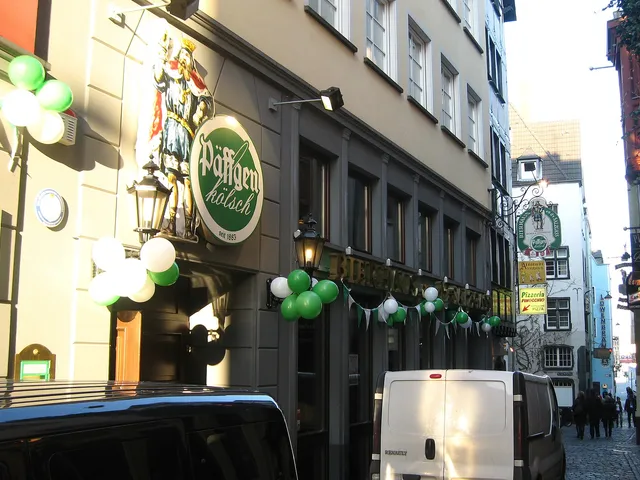
Wikipedia ↗A traditional house brewery serving its Kölsch fresh from the cask.
Wikipedia ↗A house brewery on Heumarkt producing Mühlen Kölsch.
Wikipedia ↗A long-established Kölsch brand with its own brewhouse in the old town.
Wikipedia ↗Known for the Peters Brauhaus in the old town.
Wikipedia ↗A traditional brand served among others at the Gilden im Zims brewhouse.
Wikipedia ↗A house-brewery Kölsch served in its own distinctive glass.
Wikipedia ↗A well-known Cologne Kölsch brand.
Wikipedia ↗One of the best-known Kölsch brands.
Wikipedia ↗A long-standing Kölsch brand.
A smaller Cologne private brewery.
Gallery
You might also like — related or nearby
Comments
- Loading comments…
Sources & links
Auto-generated, last verified: 2026-06-26
How this page is made
This page draws on open sources — Wikipedia, Wikidata, official websites and the city’s open data. Every statement is checked against the sources linked here, and pages are refreshed regularly.
Spotted a mistake anyway? Tell us below — we read every submission.