Kölner Dreigestirn
Trio of Prince, Peasant, and Virgin that leads Cologne Carnival — appointed fresh each year by the Festival Committee.
The Kölner Dreigestirn (Cologne Carnival Trio) serves as the official ruling body of Cologne's carnival season, leading the city's festive folk and representing Cologne to the outside world. It consists of the Prince, the Peasant, and the Virgin — and is therefore also known as the Trifolium ("three-leaf clover").
At a Glance
- Type
- Representative group of Cologne Carnival
- Composition
- Appointed annually by the Festkomitee Kölner Karneval
- As a trio since
- 1870
- Name "Dreigestirn" since
- 1938
- Street carnival opening
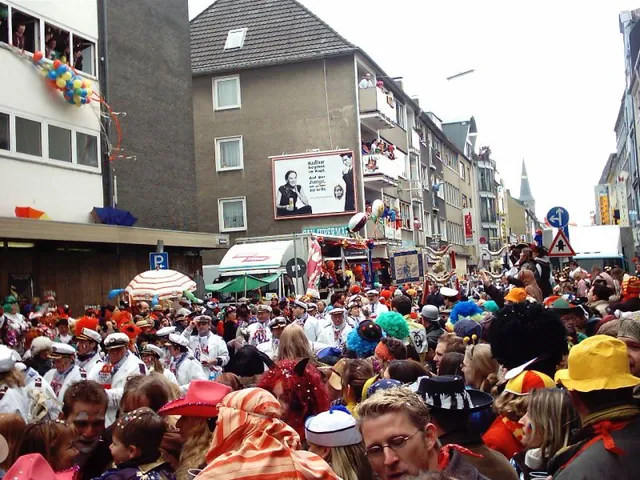
- Weiberfastnacht (Women's Carnival Thursday), 11:11 a.m., today at the Heumarkt
The Kölner Jungfrau is traditionally always played by a man – only in 1938 and 1939 was the role required by the NSDAP to be performed by a woman.
Things to do here
- Cheer on the Dreigestirn at a carnival parade
- Experience the start of street carnival on Weiberfastnacht
- Admire Prince, Farmer and Maiden in their magnificent costumes
- Watch for the final and largest float in the Rose Monday parade
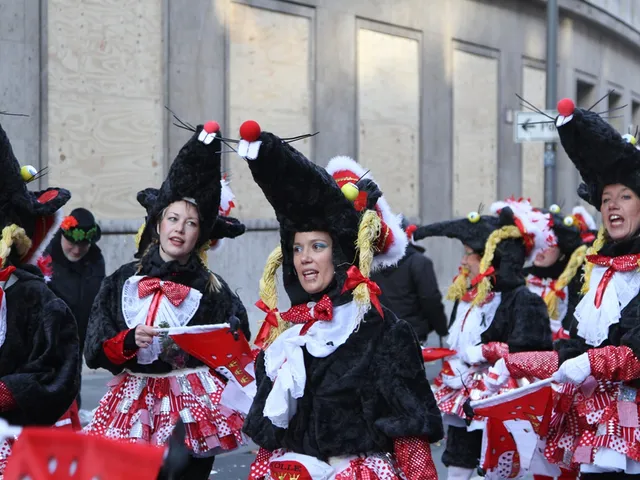
- Catch sweets and sing along to Cologne carnival songs
- Take photos of the festively decorated appearances
Origins and History
After the carnival reform of 1823, the hero Carneval stood at the head of the festivities. With the founding of the German Empire in 1871, this figure became Prince Carnival, occasionally joined by the rarely seen Princess Venetia, who soon disappeared again. The Peasant and Virgin appeared in the Rose Monday Parade only when the year's theme allowed it, before firmly establishing themselves as permanent figures in the 1870s.
The Three Figures
"His Foolishness," Prince Carnival, is the supreme representative of Cologne Carnival; at the proclamation he receives the jester's slapstick (Pritsche) from the Lord Mayor and closes the Rose Monday Parade on the final and grandest float. The Peasant, "His Earthiness," symbolizes the martial spirit of the old imperial city, recalling Cologne's liberation from archiepiscopal rule at the Battle of Worringen and the city's status as a free imperial city. He wears the city keys at his belt, carries a flail in his left hand, and wears 125 peacock feathers on his hat — said to represent Cologne's immortality. The Virgin, "Her Loveliness," embodies the protective mother figure Colonia and is always played by a man — only in 1938 and 1939, on orders from the NSDAP, was a woman required to take the role. Her crenellated crown alludes to the impregnability of Cologne behind its former city walls; her Roman attire references Agrippina the Younger, regarded as the city's founder according to Tacitus's Annals.
Escorts and Processions
In the parades and the Rose Monday Parade, the Prinzen-Garde Köln 1906 e. V. escorts the Prince, while the EhrenGarde der Stadt Köln 1902 e. V. accompanies the Peasant and the Virgin. On Rose Monday, the Peasant and Virgin share a single float.
Did You Know?
Since 1993, the Virgin has received a silver mirror at the proclamation — an idea by Lord Mayor Norbert Burger, so she would not go empty-handed while the Prince received the slapstick and the Peasant the city keys. Since 1965 there has also been a Cologne Children's Carnival Trio (Kinderdreigestirn), an initiative tracing back to Hans Wallpott, then president of the Bürgergarde "blau-gold" of 1904, escorted throughout by young guards and pages in blue-and-gold uniforms.
Timeline
- 1823Reform of Cologne Carnival; the character Held Carneval placed at the top
- 1870The Dreigestirn exists as a unit for the first time
- 1871Founding of the German Empire: the hero becomes Prinz Karneval
- 1872The Kölner Bauer is permanently added alongside the Prince and the Virgin
- 1938Officially named 'Dreigestirn'; NSDAP orders the Virgin role to be played by a woman
- 1939Last year the NSDAP ordered a woman to portray the Virgin
- 1965Cologne Children's Dreigestirn founded (idea by Hans Wallpott)
- 1993Silver mirror introduced as official symbol of the Virgin at the proclamation
Gallery
You might also like — related or nearby



Comments
- Loading comments…
Sources & links
- Official website
- Official Instagram (@altstaedter)
- Official website (retrieved 2026-06-25)
- Wikidata (retrieved 2026-06-25)
- Wikipedia (retrieved 2026-06-25, rev 268199733)
Auto-generated, last verified: 2026-06-26
How this page is made
This page draws on open sources — Wikipedia, Wikidata, official websites and the city’s open data. Every statement is checked against the sources linked here, and pages are refreshed regularly.
Spotted a mistake anyway? Tell us below — we read every submission.