Tünnes and Schäl
Two puppet characters from Cologne's Hänneschen Theatre – the good-natured Tünnes and the crafty Schäl. Since 1803, they have shaped Cologne's folk culture to this day.
Tünnes and Schäl are two fictional characters from the Hänneschen Puppet Theatre of Cologne, who have long since grown far beyond the stage to become enduring fixtures of the city's folk culture.
At a Glance
- Type
- Characters of the Cologne Hänneschen Puppet Theatre
- Tünnes introduced
- 1803, by theatre founder Johann Christoph Winters
- Schäl introduced
- 1850s, in response to a rival puppeteer
- Tünnes's appearance
- Bulbous nose, rustic manner, easy-going temperament
- Schäl's appearance
- Slender figure, always in a tailcoat, cross-eyed
- Notable fact
- The Cologne public transport authority (KVB) still uses "Tünnes" as a call sign in radio communications
Source: Wikipedia · retrieved 2026-06-25
Origins of the Names and Characters
The name Tünnes derives from the Rhineland form of the given name Anton. His character blends a peaceable nature with peasant cunning. The name Schäl is deliberately ambiguous: it alludes to the character's squint and simultaneously means "bad" or "wrong" in Kölsch dialect. Schäl is considered sly and devious. Folklore scholars trace the character's introduction to Winters's irritation with Franz Andreas Millowitsch – an ancestor of the popular actor Willy Millowitsch – who ran a rival puppet theatre on the opposite bank of the Rhine, in the area known as the Schäl Sick.
Tünnes and Schäl in Carnival and the Arts
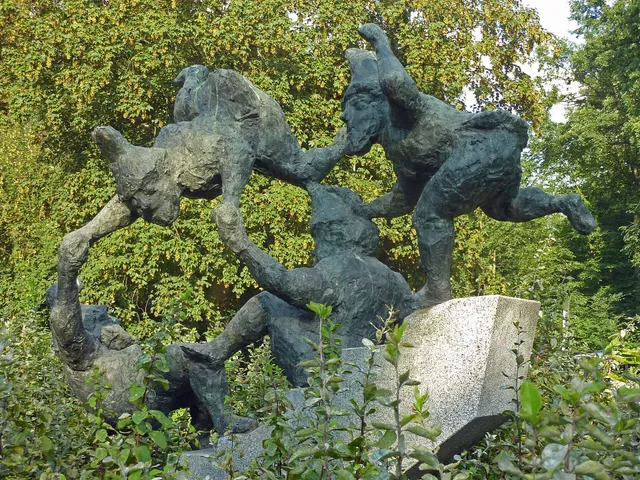
Comedy duos performing as Tünnes un Schäl had already appeared on Cologne carnival stages before the First World War. In the 1920s, performers such as Gerhard Ebeler and Karl Simons took on the roles. The brothers Gerd and Karl Jansen went on to embody the duo at Cologne's carnival for over 40 years. The graphic artist Otto Schindler, who designed the Cologne Rose Monday parade and its themed imagery until the mid-1980s, repeatedly drew on both figures. In 1950, Austrian sculptor Wolfgang Wallner created a four-metre-tall sculptural group of the pair, first displayed to mark the reconstruction of the Gürzenich hall, where it still stands today. Tünnes and Schäl also appear in the right pointed arch of the side portal of Cologne Cathedral facing the main railway station.
Legal History
In 1993, Cologne's satirical carnival show Stunksitzung displayed a crucifix bearing the inscription "Tünnes" in place of "INRI." The sign was seized by police following a criminal complaint for the defamation of religious organisations. However, the director's appeal against the resulting penalty order of 6,000 DM was upheld on the grounds that artistic freedom takes precedence.
Gallery
You might also like
Comments
- Loading comments…
Sources & links
- 🌐 Official website
- Official website (retrieved 2026-06-25)
- Wikidata (retrieved 2026-06-25)
- Wikipedia (retrieved 2026-06-25, rev 268211581)
Auto-generated, last verified: 2026-06-25