Richmodis-Haus
Cologne landmark with two stone horse heads in its octagonal tower — rooted in the haunting legend of Richmodis von Aducht from the Black Death era.
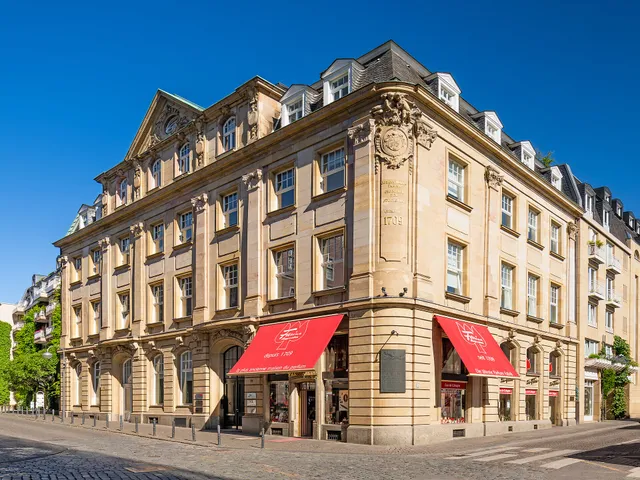
The Richmodis-Haus on Cologne's Neumarkt square is above all associated with the Richmodis legend from the plague years, which explains why two carved horse heads peer from its tower windows.
At a Glance
- Type
- Commercial building with dressed-stone façade
- Location
- Cologne Altstadt-Nord, Neumarkt / corner of Richmodstraße
- Built
- 1928/29 based on historical models
- Tower
- Octagonal staircase tower, renewed in 1928
- Distinctive feature
- Two horse heads in the tower windows, known in Kölsch dialect as "Päädsköpp"
- Status
- Listed monument in North Rhine-Westphalia
When Richmodis von Aducht returned home alive after being buried during the plague and her husband refused to believe her, he declared that his two white horses would sooner climb up into the tower than she could have returned – whereupon the horses actually neighed from the tower windows. Rather than being slaughtered for Rhineland-style Sauerbraten, which is traditionally made from horse meat, the animals were safely lowered from the tower using a pulley.
The Legend of Richmodis von Aducht
The story is set during the 14th-century plague. Richmodis von Aducht, a Cologne patrician from the Lyskirchen family, was believed dead during a wave of pestilence and taken to the Apostles' Church. When two grave robbers tried to steal her jewels at night, she sat up and made her way home. Her husband Mengis refused to believe his supposedly dead wife stood at the door — unless, he scoffed, his two white horses were to climb the tower stairs and look out from the windows. Which is precisely what happened. The horse heads have commemorated the moment ever since; the earliest documented reference to them dates to 1687.
How It Ends
According to the legend, the horses were not turned into Sauerbraten — the Rhineland dish traditionally made with horse meat — but were carefully lowered back down from the tower by pulley, safe and sound.
A Kernel of Truth
The legend has genuine historical roots. During the 14th century, roughly half of Cologne's population — around 20,000 people — died of the plague. In the chaos of mass death, post-mortem examinations were far from rigorous, and it was not unheard of for the living to be buried prematurely.
The Legend in City Culture
The Richmodis story remains alive in Cologne today. It inspired Richmodis Kölsch, a beer brand revived by REWE in 2012 whose logo features the two white horses and the building. In 2004, BAP frontman Wolfgang Niedecken set the tale to music in the song "Zwei Päädsköpp ahm Nümaat" (Two Horse Heads on the Neumarkt).
Earlier Buildings on the Site
The site's history stretches back to the Middle Ages. In the early 16th century, Emperor Maximilian I commissioned a grand residence here — complete with tower, oriel windows, grand halls and a private chapel — that served as an imperial lodging under names such as "Hackeney'scher Hof" and "Palatium." Its three-winged palace featured a 28-metre-high octagonal spiral staircase tower, the first of its kind in Cologne. Emperor Charles V stayed here on several occasions; his brother Ferdinand I also lodged here from 5 January 1531, when he came to Cologne following his election as King of the Romans. The house chapel held an altarpiece painted in 1515 by Joos van Cleve, now in the Wallraf-Richartz-Museum. Over the centuries the buildings and tower were torn down and rebuilt multiple times; the current structure dates from 1928/29.
Timeline
- 1409Johann van dem Buchel acquires the estate "zume Heydenriche" at Neumarkt
- 1507–1508Nicasius Hackeney unites both plots and commissions an imperial palace
- 1515Joos van Cleve paints altarpiece for the chapel (now Wallraf-Richartz-Museum)
- 1518Nicasius Hackeney dies; inauguration of the estate presumed early 1520
- 1520Emperor Charles V. stays at the palace for the first time (29 October)
- 1531Archduke Ferdinand I. stays ahead of his election as King (5 January)
- frühestens 1687Horse heads in the tower first documented
- 1928/29Current Richmodis-Haus built with renewed octagonal tower based on historic models
Map
Blue dots: other places nearby — tap to explore.
Address
Richmodstraße 6
50667 Köln
Hours
So: 00:00–24:00
You might also like
Comments
- Loading comments…
Sources & links
- Official website
- Official website (retrieved 2026-06-25)
- Wikidata (retrieved 2026-06-24)
- Wikipedia (retrieved 2026-06-24, rev 265065471)
Auto-generated, last verified: 2026-06-27